
🏆 Key Takeaway
At the heart of photoperiodism is a sophisticated system of photoreceptors called phytochromes. These are pigments in the plant’s leaves that are sensitive to specific wavelengths of light, particularly red and far-red light. The phytochrome system exists in two interconvertible forms:
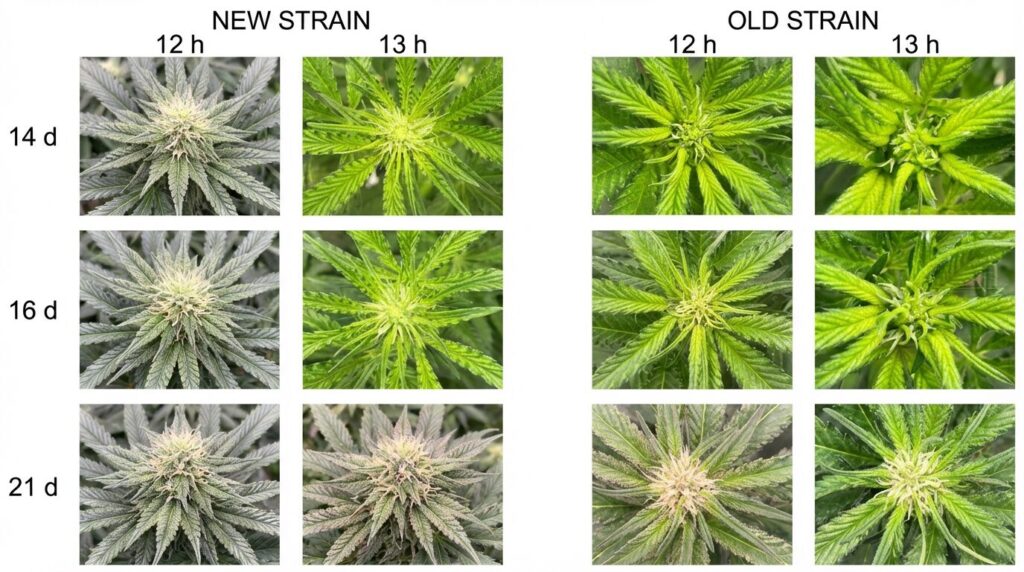
Table of Contents
🔍 1. Introduction: The Master Switch of Cannabis Growth
Light is the lifeblood of the cannabis plant. It is the primary source of energy that fuels its growth, development, and the production of the cannabinoids and terpenes that make it so valuable. However, the role of light extends far beyond simple energy provision. For most cannabis varieties, the duration of light and darkness—the photoperiod—acts as a master switch, a biological clock that dictates the plant’s transition from vegetative growth to flowering. Understanding and mastering the art of light cycle management is arguably the most crucial skill for any indoor cannabis cultivator.
This guide is designed to be your definitive resource on the intricate relationship between cannabis and light. We will demystify the science of photoperiodism, providing a clear explanation of how cannabis plants perceive light and why the length of the night is so critical. We will then provide a detailed, stage-by-stage breakdown of the optimal light cycles for vegetative growth and flowering, exploring both the industry standards and the latest scientific research that challenges them.
Whether you are a beginner setting up your first grow tent or an experienced cultivator looking to optimize your yields, this guide will equip you with the knowledge to make informed decisions about your lighting strategy. We will compare the needs of traditional photoperiod strains with their autoflowering counterparts, delve into advanced techniques like light spectrum manipulation and extended flowering photoperiods, and provide a comprehensive troubleshooting guide for common light-related problems. By the end of this guide, you will not just be following a set of rules; you will understand the fundamental principles that govern your plants’ behavior, empowering you to tailor your light cycles for maximum potency, yield, and quality. This knowledge is the difference between being a passive observer and an active participant in your plant’s life cycle, allowing you to steer its development with precision and confidence. We will transform the abstract concepts of photobiology into practical, actionable strategies that you can implement in your grow room today.
🏆 2. The Science of Photoperiodism: How Cannabis Tells Time
To truly master light cycles, you must first understand the biological mechanism that allows cannabis to “tell time.” This process is called photoperiodism, and it is a plant’s physiological reaction to the length of day or night. Cannabis, in its most common form, is classified as a short-day plant. This is a slightly misleading term, as it is not the length of the day that matters, but rather the length of the uninterrupted dark period. The discovery of this phenomenon dates back to the early 20th century with experiments on tobacco and soybeans, which laid the foundation for our understanding of how plants measure time. This ability is crucial for their survival, allowing them to synchronize their life cycles with the changing seasons to ensure they reproduce at the most opportune moment. For an annual plant like cannabis, timing is everything. Flowering too early in the season might mean the plant is not large enough to produce a significant number of seeds, while flowering too late might mean the seeds do not have time to mature before the first frost. Photoperiodism is the plant’s elegant solution to this timing problem, using the most reliable environmental cue—the length of the day—to perfectly time its reproductive cycle.
The Phytochrome System: The Plant’s Light-Sensing Switch
At the heart of photoperiodism is a sophisticated system of photoreceptors called phytochromes. These are pigments in the plant’s leaves that are sensitive to specific wavelengths of light, particularly red and far-red light. The phytochrome system exists in two interconvertible forms:
- Pr (Phytochrome red): This is the inactive form of the phytochrome. It is sensitive to red light (around 660 nm), which is abundant in sunlight and from most grow lights.
- Pfr (Phytochrome far-red): This is the active form of the phytochrome. It is sensitive to far-red light (around 730 nm) and is the form that regulates most developmental processes, including flowering.
Here is how the system works as a biological clock:
- During the day (light period): When the plant is exposed to light, the abundant red light converts the inactive Pr into the active Pfr form. The plant accumulates a high concentration of Pfr.
- During the night (dark period): In the absence of light, the active Pfr form slowly and naturally reverts back to the inactive Pr form.
The Critical Night Length
The key to triggering the flowering response in cannabis is the length of time the plant spends in darkness. As the Pfr form slowly converts back to Pr during the night, its concentration in the plant gradually drops. When the dark period is long enough for the Pfr concentration to fall below a certain critical threshold, it triggers a cascade of hormonal signals that initiate the flowering process. This signaling cascade is incredibly complex, but at its core is a mobile flowering signal known as florigen. Florigen is a protein (specifically, the Flowering Locus T protein) that is produced in the leaves in response to the correct photoperiod. It then travels through the plant’s vascular system (the phloem) to the apical meristems—the growing tips of the stems and branches. Once it reaches the meristems, it acts as a master signal, reprogramming them to stop producing vegetative growth (leaves and stems) and start producing floral structures (bracts, pistils, and eventually, buds). For most cannabis cultivars, this critical night length is around 12 hours of uninterrupted darkness 1.
This is why the term “short-day plant” is a misnomer. A short-day plant is, in fact, a long-night plant. It is not the 12 hours of light that induces flowering, but the 12 hours of continuous, uninterrupted darkness that allows the Pfr level to drop and stay below the critical threshold.
The Importance of Uninterrupted Darkness
Understanding the phytochrome system highlights the absolute necessity of a completely dark, uninterrupted night period for photoperiod cannabis. Even a brief exposure to light during the dark cycle can have a dramatic effect. A flash of light, even for just a minute, will be rich in red wavelengths, causing a rapid conversion of Pr back to Pfr. This “resets the clock,” pushing the Pfr concentration back above the critical threshold and preventing the flowering signal from being sent. This is why light leaks in a grow room are one of the most common reasons for a failed or delayed flowering stage. Even a small amount of light from an indicator LED on a piece of equipment can be enough to disrupt the process.
🌱 3. The Vegetative Stage: Building a Strong Foundation
The vegetative stage is the period of active growth where the cannabis plant focuses on developing a strong root system, a sturdy stalk, and an abundance of leaves and branches. The goal of the vegetative stage is to build a large, healthy plant structure that can support a heavy yield of dense, resinous flowers. The light cycle you choose during this phase is the primary tool you have to control the duration and vigor of this growth.
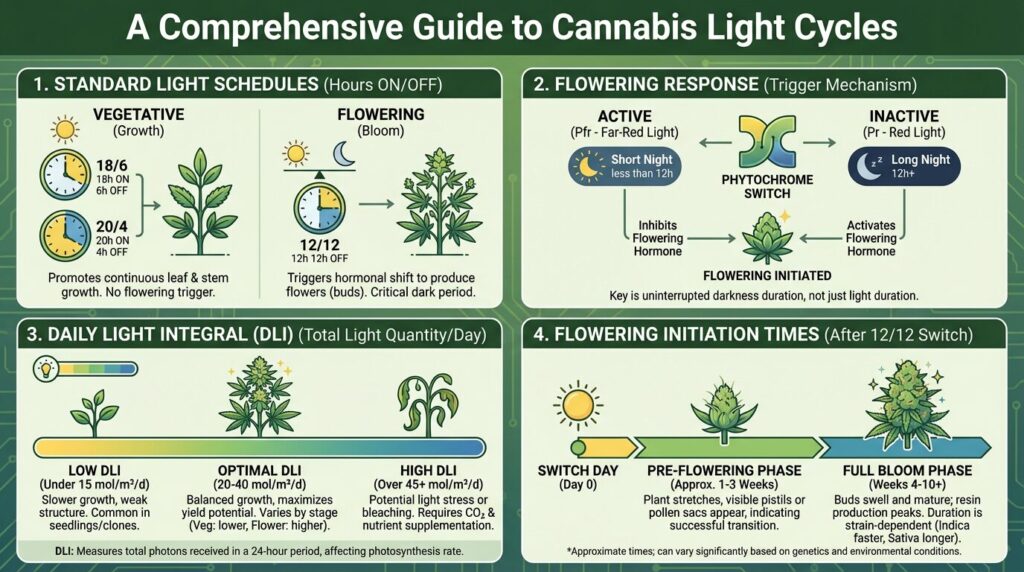
A comprehensive guide to cannabis light cycles, comparing standard schedules, flowering response, Daily Light Integral (DLI), and flowering initiation times.
The Principle of Vegetative Light Cycles
To keep a photoperiod cannabis plant in the vegetative stage, you must ensure that the dark period is shorter than the critical night length. By providing a long day and a short night, you keep the concentration of the active Pfr phytochrome consistently high, which inhibits the flowering signal and promotes continued vegetative growth. This gives you, the grower, complete control over how long your plant stays in this stage. You can keep a plant in a vegetative state for weeks, months, or even years, a technique used to maintain “mother plants” for cloning.
Common Vegetative Light Schedules
While any light cycle with a dark period shorter than 10-12 hours will maintain vegetative growth, a few standard schedules have become popular for their balance of growth, energy efficiency, and plant health.
| Light Schedule | Total Light Hours | Pros | Cons |
| 18/6 | 18 | The industry standard; excellent growth | – |
| 20/4 | 20 | Faster growth than 18/6 | Higher energy cost; less rest for the plant |
| 24/0 | 24 | Fastest possible growth | Highest energy cost; some strains may show stress |
| 16/8 | 16 | More energy efficient | Slower growth than 18/6 |
- The 18/6 Light Cycle (18 hours light, 6 hours dark): This is the most widely used and recommended light cycle for the vegetative stage. It provides the plant with ample light to fuel rapid growth while also giving it a 6-hour rest period. Many growers believe this dark period is beneficial for the plant’s respiration and overall health, allowing it to process the energy it has stored during the day. It offers a perfect balance between vigorous growth and energy consumption.
- The 20/4 Light Cycle (20 hours light, 4 hours dark): For growers looking to accelerate vegetative growth, the 20/4 cycle is a popular option. The two extra hours of light per day can lead to noticeably faster development and a shorter overall vegetative period. This can be particularly useful for commercial growers who want to reduce their time to harvest. The trade-off is a higher electricity bill and a shorter rest period for the plants.
- The 24/0 Light Cycle (24 hours of continuous light): This schedule provides the maximum possible amount of light to the plant, resulting in the fastest possible vegetative growth. However, it is a topic of some debate among growers. While some swear by it for its speed, others argue that a continuous light period can stress the plant and that the dark period is essential for certain biological processes. It also carries the highest energy cost. This schedule is often used for autoflowering varieties but can be used for photoperiods as well.
- The 16/8 Light Cycle (16 hours light, 8 hours dark): This is a more energy-conscious option. While the growth will be slightly slower than with an 18/6 cycle, it can still produce healthy, robust plants. This is a good choice for growers on a tight budget or for those who are not in a hurry to get to the flowering stage.
How Long to Keep Plants in the Vegetative Stage
The duration of the vegetative stage is entirely up to you and depends on your goals and your growing space. A longer vegetative period will result in a larger plant, which generally leads to a larger yield. A common rule of thumb is to switch to the flowering cycle when the plant has reached about half of the desired final height. This is because most cannabis plants will undergo a significant growth spurt (the “flowering stretch”) in the first 2-3 weeks of the flowering stage, often doubling in size. This rapid elongation is driven by a hormonal shift, as the plant reallocates its energy from producing broad leaves to elongating its stems and branches to create more space for future bud sites. This is an evolutionary strategy to lift the flowers up high, away from ground-level pests and into the path of the wind for pollination. The primary hormone responsible for this stretch is gibberellin. The change in photoperiod triggers a surge in gibberellin production, which promotes cell elongation in the stems. This is why the stretch can be so dramatic, and why it is so important to account for it in your planning. A typical vegetative period for an indoor grow is between 4 and 8 weeks. During this time, it is not just about the light cycle, but also about providing the right environment. This includes maintaining optimal temperature (70-85°F or 21-29°C), humidity (40-60%), and providing a nutrient solution rich in Nitrogen, which is essential for leafy growth. Pruning and training techniques like topping, LST (Low-Stress Training), and ScroG (Screen of Green) are also employed during the vegetative stage to shape the plant and create a flat, even canopy. This ensures that when the plant does enter the flowering stage, all of its bud sites will receive an equal and optimal amount of light, leading to a much higher and more uniform yield. The vegetative stage is your opportunity to build the ‘factory’ that will produce your final product. A larger, healthier, and better-structured factory will inevitably lead to a better and more abundant output. Think of it as the architectural phase of your grow; the decisions you make here about plant structure will directly impact the final harvest quality and quantity. A well-trained plant with a flat canopy is far more efficient at converting light into biomass than an untrained, ‘Christmas tree’ shaped plant where lower branches are starved of light.
🌱 4. The Flowering Stage: Triggering the Bloom
The transition from the vegetative to the flowering stage is the most exciting and critical moment in the life of a cannabis plant. This is when the plant shifts its focus from growing leaves and branches to producing the resinous flowers, or buds, that are the primary goal of cultivation. This transition is initiated by a simple but profound change in the light cycle.
The 12/12 Light Cycle: The Universal Flowering Trigger
To induce flowering in a photoperiod cannabis plant, you must switch the light cycle to provide a long, uninterrupted period of darkness. The universally accepted standard for this is the 12/12 light cycle, consisting of 12 hours of light followed by 12 hours of complete darkness. This long night ensures that the concentration of the active Pfr phytochrome drops below the critical threshold, sending a clear and unambiguous signal to the plant to begin flowering.
This switch is not gradual; it is an abrupt change. One day the plant is on an 18/6 cycle, and the next, you switch your timer to 12/12. This sudden shift mimics the natural change of seasons from summer to autumn, which is the plant’s natural cue to reproduce before the winter comes.
The Flowering Stretch
Once you switch to a 12/12 light cycle, the plant does not immediately start producing buds. Instead, it enters a phase of rapid, often explosive, vertical growth known as the “flowering stretch.” This typically lasts for the first 2-3 weeks of the flowering stage. During this time, the plant can easily double in height. This is a crucial factor to consider when planning your grow. If you have limited vertical space, you must initiate the flowering stage when the plant is still relatively small to avoid it outgrowing your tent or room.
Is 12/12 Always Optimal? The Science of Longer Flowering Photoperiods
For decades, the 12/12 light cycle has been the unquestioned dogma of cannabis cultivation. However, recent scientific research has begun to challenge this one-size-fits-all approach. A groundbreaking study by Ahrens et al. (2023) investigated the flowering response of ten different cannabis cultivars to photoperiods longer than 12 hours 2. Their findings revealed a more complex picture:
- Cultivar-Specific Responses: The study found that the optimal photoperiod for flowering is highly dependent on the specific genetics of the cultivar.
- Quadratic Responses: Some cultivars, such as ‘Blue Dream’ and ‘Purple Dream’, showed a quadratic response, with their ideal photoperiod for maximum floral biomass being between 12.5 and 13 hours of light.
- Potential for Increased Yield: By providing a longer light period, you increase the Daily Light Integral (DLI), which is the total amount of light energy the plant receives in a 24-hour period. A higher DLI can lead to more photosynthesis and, consequently, a larger yield. The study suggests that for some cultivars, a 13/11 light cycle could potentially increase yield without significantly delaying the flowering time.
Practical Implications:
While the 12/12 light cycle remains the safest and most reliable method to induce flowering in any photoperiod strain, experienced growers with a known cultivar may want to experiment with slightly longer photoperiods (e.g., 12.5/11.5 or 13/11) to see if they can achieve a higher yield. However, it is crucial to monitor the plants closely for any signs of delayed or abnormal flowering. For beginners, or when growing a new, untested strain, sticking to the proven 12/12 method is the most prudent course of action. The risk of experimenting with longer photoperiods is that you may inadvertently delay or even prevent flowering if the cultivar is particularly sensitive. This could lead to a crop of stretched, underdeveloped plants. Always err on the side of caution until you have a deep understanding of your specific genetics. A good approach for experimentation is to use a separate, smaller grow space to test a few clones of a given cultivar on a different light cycle before committing your entire crop to a non-standard schedule. This allows you to gather data and observe the plant’s response without risking your main harvest.
🌱 5. Autoflowering Cannabis: The Exception to the Rule
While the vast majority of cannabis cultivation revolves around the careful manipulation of photoperiods, there is a unique and increasingly popular category of cannabis that plays by a different set of rules: autoflowering cannabis.
The Ruderalis Heritage
Autoflowering strains get their unique characteristic from a third, less-known subspecies of cannabis called Cannabis ruderalis. Native to the harsh climates of Central Asia and Siberia, C. ruderalis evolved to survive in regions with very short summers. In these environments, waiting for a change in the light cycle to trigger flowering would be a fatal evolutionary strategy. Instead, C. ruderalis evolved to flower automatically based on its age, typically beginning to flower just 2-4 weeks after germination, regardless of the photoperiod.
Modern autoflowering strains are hybrids created by crossing these hardy C. ruderalis genetics with traditional indica and sativa strains. The result is a plant that retains the desirable cannabinoid profiles and flavors of its photoperiod parent, but with the age-dependent flowering trait of its ruderalis ancestor.
Light Cycles for Autoflowers: More is More
Since autoflowers do not rely on a specific dark period to initiate flowering, the lighting strategy for them is fundamentally different. You do not need to switch to a 12/12 cycle. In fact, doing so would be counterproductive, as it would unnecessarily limit the amount of light the plant receives during its flowering phase, thereby reducing its potential yield.
The goal with autoflowers is to provide them with as much light as they can handle throughout their entire, relatively short, life cycle. The most common light schedules for autoflowers are:
- 18/6 (18 hours light, 6 hours dark): This is the most popular and widely recommended schedule. It provides a high Daily Light Integral (DLI) for vigorous growth and bud production, while still giving the plant a short rest period.
- 20/4 (20 hours light, 4 hours dark): This schedule pushes the DLI even higher, which can lead to slightly faster growth and larger yields in some strains. It is a great option for growers who want to maximize their harvest in the shortest possible time.
- 24/0 (24 hours of continuous light): While possible, this schedule is less common. It provides the absolute maximum DLI but can be stressful for some plants and is the least energy-efficient option.
The key takeaway is that you can use the same light cycle from seed to harvest when growing autoflowers. This simplicity is one of their main attractions for beginner growers. It removes the single biggest point of failure for new indoor cultivators: managing the light cycle and preventing light leaks. For someone just starting, the guarantee of a harvest, even if it is a smaller one, is often more valuable than the higher potential yield (and higher risk) of a photoperiod strain. This makes autoflowers an excellent entry point into the world of cannabis cultivation, allowing beginners to learn the fundamentals of watering, feeding, and environmental control without the added complexity of photoperiod management. The first autoflowering strain, known as the ‘Lowryder’, was developed in the early 2000s and, while it was revolutionary, it was also small and low in potency. Since then, decades of intensive breeding have led to modern ‘super autos’ that can compete with photoperiod strains in terms of both potency and flavor, while still retaining their characteristic speed and simplicity.
Pros and Cons of Autoflowering Strains
Pros:
- Speed: Autoflowers have a very short life cycle, often going from seed to harvest in just 10-12 weeks.
- Simplicity: There is no need to worry about changing light cycles or light leaks, making them very beginner-friendly.
- Compact Size: They tend to be smaller and more discreet than photoperiod plants, making them ideal for small tents or stealth grows.
Cons:
- Lower Yield: Due to their smaller size and shorter vegetative period, the yield per plant is generally lower than that of a well-grown photoperiod strain.
- Less Control: You have no control over when the plant starts to flower. If the plant experiences stress or stunted growth in its first few weeks, you cannot extend the vegetative period to allow it to recover.
- No Cloning: Because they flower based on age, you cannot keep an autoflower in a vegetative state to serve as a mother plant for clones.
🔧 6. Advanced Light Cycle Techniques and Theories
Once you have mastered the fundamental principles of vegetative and flowering light cycles, you can begin to explore more advanced techniques that can further optimize your grow. These methods are generally recommended for experienced cultivators who are familiar with their specific strains and growing environment.
Gas Lantern Routine (GLR)
The Gas Lantern Routine is an energy-saving vegetative light cycle that is based on the principle of interrupting the dark period to prevent flowering. The most common GLR schedule is 12 hours on, 5.5 hours off, 1 hour on, 5.5 hours off (12/5.5/1/5.5).
- How it works: The 1-hour light period in the middle of the 11-hour dark cycle is enough to break the plant’s perception of a long night, preventing the Pfr phytochrome from dropping below the critical threshold. This keeps the plant in a vegetative state.
- Benefits: The primary benefit is energy savings. Compared to a standard 18/6 cycle, GLR uses 5 fewer hours of light per day, which can significantly reduce electricity costs over the course of a grow. Some proponents also claim it leads to more compact, bushy growth and faster flowering transition.
- Drawbacks: The growth rate will be slower than with an 18/6 cycle. It also requires a more complex timer setup.
Light Spectrum Manipulation
Beyond just the duration of light, the color spectrum of the light you provide can also influence your plant’s growth and development. Different wavelengths of light are used more efficiently by the plant for different processes.
- Blue Light (400-500 nm): Blue light is crucial for vegetative growth. It promotes the development of short, stocky plants with large, healthy leaves. Using a light source rich in blue light (such as a metal halide lamp or a full-spectrum LED with a “veg” setting) during the vegetative stage can help you build a strong, compact plant structure.
- Red Light (600-700 nm): Red light is the primary driver of photosynthesis and is essential for the flowering stage. It encourages stretching and bud production. Switching to a light source rich in red light (such as a high-pressure sodium lamp or an LED with a “flower” setting) can help maximize your yield during the bloom phase.
- Far-Red Light (700-800 nm): Far-red light plays a key role in the phytochrome system. Some advanced growers use a brief period of far-red light at the very end of the light cycle to accelerate the conversion of Pfr back to Pr, theoretically telling the plant that the night has started more quickly. This is a highly advanced technique that is still the subject of ongoing research. The idea is to mimic the natural sunset, which has a higher ratio of far-red light. This can theoretically shorten the time it takes for the plant to recognize the start of the dark period, potentially leading to a more robust flowering response and even a slightly shorter flowering time. However, this requires specialized LED fixtures with controllable far-red diodes and is not a technique for beginners. Some studies have shown that a 10-15 minute blast of far-red light at the end of the main light cycle can reduce the total flowering time by several days, which can be a significant advantage for commercial cultivators. It is a fascinating area of research that highlights how precisely we can communicate with the plant through light.
Daily Light Integral (DLI)
Daily Light Integral is a measure of the total amount of photosynthetically active radiation (PAR) that a plant receives over a 24-hour period. It is a more accurate way to think about lighting than just the intensity (PPFD) of your lamp. DLI is measured in moles of light per square meter per day (mol/m²/day).
Why it matters: Cannabis plants have an optimal DLI range for each stage of growth. Providing a DLI that is too low will result in slow growth and low yields. Providing a DLI that is too high can cause light stress and is a waste of energy.
Optimal DLI Ranges:
- •Seedlings/Clones: 10-15 DLI
- •Vegetative Stage: 20-40 DLI
- •Flowering Stage: 30-50 DLI (can be pushed higher with CO2 supplementation)
By understanding DLI, you can make more informed decisions about your light cycle and intensity. For example, if your light is not very powerful, you may need to run a longer light cycle (e.g., 20/4 instead of 18/6) to achieve the target DLI for your vegetative plants. Conversely, if you have a very powerful light, you may be able to use a shorter light cycle (e.g., 16/8) and still hit your target DLI, saving energy in the process. You can measure the PPFD of your light at the canopy level using a quantum sensor or a smartphone app (though apps are less accurate) and then use an online DLI calculator to determine your daily light integral. This data-driven approach to lighting is a hallmark of advanced cultivation. It allows you to move beyond simple rules of thumb and truly optimize your environment for your specific equipment and goals. It can also help you diagnose problems; if your plants are not growing well, checking your DLI is a good first step to ensure they are receiving the fundamental energy they need.
📂 7. Common Mistakes and Troubleshooting
Even with a solid understanding of photoperiodism, mistakes can happen. Identifying and correcting these issues quickly is key to a successful harvest. Here are some of the most common light-cycle-related problems and how to solve them.
Problem 1: Plants Won’t Start Flowering
This is the most frequent issue faced by new growers. You have switched your timer to 12/12, but weeks have passed, and your plants are still just stretching and not producing any pistils or buds.
Cause: The most likely culprit is a light leak. Your dark period is not completely, uninterruptedly dark. Even a tiny pinhole of light from outside the tent, an indicator light on a power strip, or a faulty zipper can be enough to disrupt the flowering process.
Solution: Get inside your grow tent or room during the dark cycle, close it up, and wait for your eyes to adjust (at least 5-10 minutes). Look for any sources of light, no matter how small. Cover them with black electrical tape or another opaque material. Ensure all vents have light-proof baffling.
Other Causes:
- •Incorrect Timer Setting: Double-check that your timer is set correctly for 12 hours on and 12 hours off. Mechanical timers can sometimes fail or get stuck.
- •Strain Genetics: Some sativa-dominant strains, particularly those from equatorial regions, can be notoriously slow to flower and may require a longer dark period (e.g., 11/13 or 10/14) to initiate flowering.
Problem 2: Plants Start to Flower, Then Revert to Vegetative Growth (“Re-vegging”)
Your plants were flowering nicely, but now you are seeing strange, new growth. Instead of forming dense buds, the plant is producing single, smooth-edged leaves and new, leafy shoots are emerging from the flowers.
- Cause: This is almost always caused by an interruption of the dark cycle after flowering has already begun. The plant has been tricked into thinking that the “long nights” are over and it is time to go back to vegetative growth.
- Solution: Immediately identify and eliminate the source of the light leak. Correct your timer if it is faulty. The plant will eventually resume flowering, but the re-vegging process will have stressed the plant, delayed your harvest, and likely reduced your final yield. The strange, re-vegged growth can be trimmed off.
Problem 3: Hermaphroditism
The plant starts producing both male pollen sacs and female pistils. This is a survival mechanism triggered by stress.
- Cause: An inconsistent or interrupted light cycle is a major environmental stressor that can cause a female plant to become a hermaphrodite. If the plant senses that its environment is unstable, it may try to pollinate itself to ensure the survival of its genetic line.
- Solution: Maintain a strict, consistent, and uninterrupted dark period. If you catch it early, you can carefully remove the male pollen sacs with tweezers (be careful not to rupture them). However, if the problem is widespread, the best course of action is often to remove the plant from the grow room to prevent it from pollinating your other female plants, which would result in a crop full of seeds. A seeded crop is a major disappointment for most growers, as the plant diverts its energy from producing cannabinoids and terpenes to producing seeds, resulting in a less potent and less flavorful final product. This is because the production of seeds is a resource-intensive process that competes directly with the production of the secondary metabolites that are the primary goal of most cannabis cultivation. A single hermaphrodite can ruin an entire crop, making light cycle stability a critical component of risk management in any grow operation.
Problem 4: Stretching and Leggy Growth
Your plants are growing very tall and thin, with long distances between the nodes (the points where branches grow from the stalk).
- Cause: This is usually a sign that the light source is too weak or too far away from the plants. The plants are “stretching” to get closer to the light. This is an evolutionary response to seek more light when the plant perceives it is being shaded by competitors. This is known as shade avoidance syndrome. While not a direct photoperiod issue, it is a common lighting problem that can lead to weak, spindly plants that cannot support the weight of heavy buds. It is particularly common in the seedling and early vegetative stages. The plant is essentially gambling that by growing taller, it can out-compete its neighbors for access to the sun. In an indoor environment, this is a wasted effort that leads to a suboptimal plant structure.
- Solution: Lower your light source to the manufacturer’s recommended distance from the plant canopy. If your light is already as low as it can safely go, you may need to invest in a more powerful light to provide the necessary intensity (PPFD) for your grow space. You can also increase airflow in the grow room to help strengthen the stems and slow down vertical growth. A gentle breeze from an oscillating fan will cause the stems to sway, which encourages them to grow thicker and stronger in response. This phenomenon is known as thigmomorphogenesis, and it is another way the plant responds to its physical environment to become more resilient.
✅ 8. Conclusion: Mastering the Light
Understanding and controlling the light cycle is the cornerstone of successful indoor cannabis cultivation. It is the language you use to communicate with your plants, telling them when to grow and when to bloom. While the principles of photoperiodism are rooted in complex biology, their practical application is straightforward: long days for growth, long nights for flowers. This simple dichotomy is the engine that drives the entire indoor cultivation process. By mastering this one variable, you gain an incredible amount of control over your plants’ destiny. You become the sun, the seasons, and the clock, all in one. This is the power and the beauty of indoor cultivation, and the key to, indoor cultivation. The 18/6 and 12/12 cycles are the time-tested standards that will serve any grower well. However, as science continues to illuminate the nuances of the cannabis plant, we are learning that there is room for optimization and experimentation. By understanding the roles of DLI, light spectrum, and cultivar-specific responses, experienced growers can push their plants to new heights of productivity and quality. Whether you stick to the basics or explore the cutting edge, remember that consistency and a truly dark night are your most powerful tools in the quest for a bountiful harvest.
For more expert cannabis guides, strain insights, and collectible seeds, visit Weed.de, PreRollJoints.com, bluedream.com, sourdiesel.com and OfficialCannabisSeeds.com.
❓ 9. Frequently Asked Questions (FAQs)
❓ Can I use a 24-hour light cycle for the entire grow?
For autoflowering strains, yes, you can technically use a 24/0 light cycle from seed to harvest, although 18/6 or 20/4 is more common and may be less stressful for the plant. For photoperiod strains, you absolutely cannot. They require a 12-hour (or longer) dark period to trigger and maintain the flowering stage. A 24-hour light cycle will keep a photoperiod plant in a perpetual state of vegetative growth.
❓ What happens if I have a power outage during the dark cycle?
If the power outage is brief (less than an hour or two), it is unlikely to have a significant impact. The plant’s internal clock is not that sensitive. However, if the power outage is prolonged and significantly disrupts the 12/12 cycle, it could potentially stress the plant or delay flowering. The best course of action is to simply get back to the correct schedule as soon as possible. Consistency is key, but a single, isolated incident is usually not catastrophic.
❓ Can I switch back to a vegetative light cycle after flowering has started?
Yes, this is a process known as “re-vegging.” If you switch a flowering plant from a 12/12 cycle back to an 18/6 cycle, it will stop producing buds and revert to vegetative growth. This is sometimes done intentionally by growers who want to take clones from a plant after they have seen its flowering characteristics, or to harvest a plant and then grow it out again for a second harvest (a technique called “monstercropping”). However, it is a stressful process for the plant and the new growth is often strange and mutated at first.
❓ How do I know when to switch from vegetative to flowering?
A good rule of thumb is to switch to the 12/12 light cycle when the plant has reached approximately half of the final height you want it to be. This accounts for the flowering stretch, where the plant can double in size. For example, if your grow tent is 6 feet tall and you need to leave a foot of space for the light and a foot of space between the light and the plant, your maximum plant height is 4 feet. In this case, you should flip to flowering when your plant is about 2 feet tall.
❓ Does the color of the light matter for the photoperiod response?
The phytochrome system is most sensitive to red and far-red light. Therefore, any light source that contains these wavelengths can potentially interrupt the dark period. This includes white light from a flashlight, a phone screen, or an indicator LED. While green light is often touted as being “safe” for use during the dark period because plants reflect green light, this is not entirely true. A bright green light can still trigger the phytochrome system and disrupt flowering. It is always best to aim for complete and total darkness.