
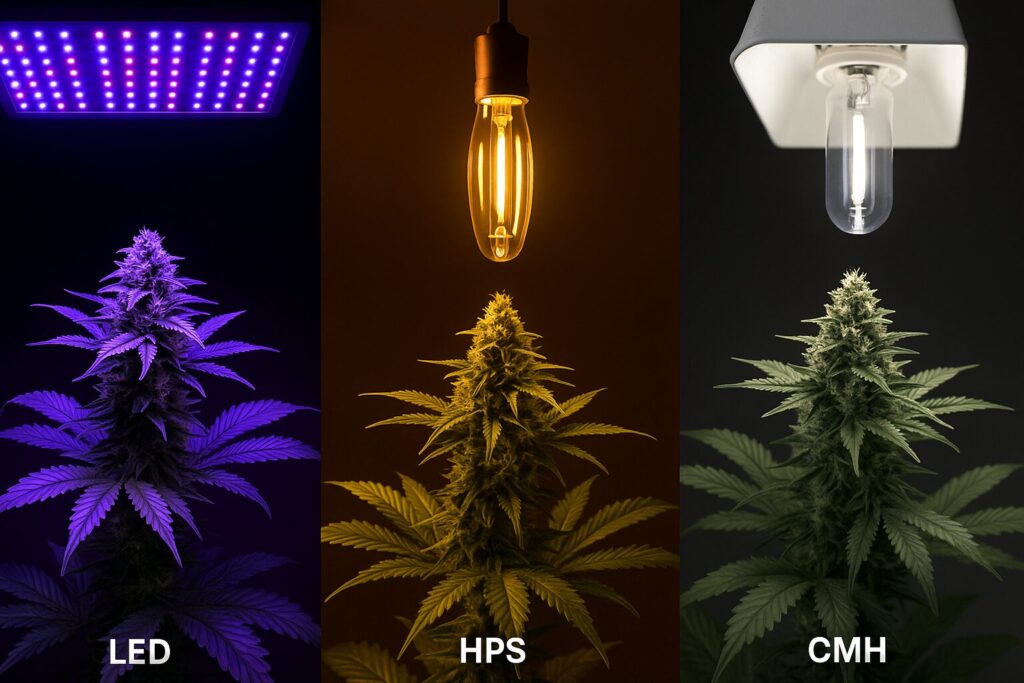
Three-way comparison: CMH vs HPS vs LED grow lights for cannabis cultivation
Table of Contents
Key Takeaways
LED Lights Offer Maximum Efficiency: Modern LED grow lights convert electricity to usable light more efficiently than any other technology, reducing energy costs by thirty to fifty percent compared to HPS while producing significantly less heat. This efficiency makes LED ideal for small spaces, hot climates, and growers prioritizing low operating costs. However, quality LED fixtures require substantial upfront investment, with premium units costing three to five times more than equivalent HPS systems.
HPS Lights Deliver Proven Performance: High Pressure Sodium lights have dominated cannabis cultivation for decades, producing consistently high yields with reliable, affordable technology. HPS excels during flowering with its red-heavy spectrum, and replacement bulbs cost just twenty to sixty dollars. The technology’s main drawbacks are high heat output requiring robust ventilation and lower energy efficiency that increases electricity costs by thirty to fifty percent compared to LED.
CMH Lights Balance Quality and Efficiency: Ceramic Metal Halide lights bridge the gap between HPS and LED, offering superior light spectrum and better efficiency than HPS at lower cost than premium LED. CMH produces the most natural, sun-like spectrum of any grow light technology, potentially enhancing terpene production and overall plant quality. However, CMH fixtures are less common than LED or HPS, limiting selection and sometimes requiring special ballasts.
Spectrum Quality Affects More Than Yield: While all three technologies can produce excellent yields, spectrum quality influences secondary metabolites including cannabinoids and terpenes. CMH’s full-spectrum white light most closely mimics natural sunlight and may enhance terpene complexity. Modern full-spectrum LED can match CMH quality, while HPS’s red-heavy spectrum maximizes flower production but may produce slightly less complex terpene profiles.
Heat Management Drives System Design: Heat output fundamentally shapes grow room design. LED’s minimal heat allows closer canopy placement and reduces cooling requirements, potentially eliminating air conditioning in moderate climates. HPS’s substantial heat demands powerful ventilation and often air conditioning, adding to operating costs. CMH produces moderate heat between LED and HPS, requiring good ventilation but less cooling than HPS.
Your Choice Depends on Scale and Budget: Small-scale growers in warm climates benefit most from LED’s efficiency and low heat. Large commercial operations often choose HPS for its proven performance and low initial cost, accepting higher energy bills. CMH suits growers seeking quality and efficiency without LED’s high upfront cost. Many experienced growers use CMH for vegetative growth and HPS for flowering, combining the strengths of both technologies.
Introduction: Understanding Cannabis Grow Lights
Light is the fundamental energy source driving cannabis growth, photosynthesis, and cannabinoid production. Indoor cultivation requires artificial lighting that replicates the sun’s intensity and spectrum, delivering the photons plants need to convert carbon dioxide and water into sugars, starches, and the complex molecules that make cannabis valuable. The choice of grow light technology represents one of the most significant decisions in indoor cultivation, influencing everything from initial investment and operating costs to yields, quality, and environmental control.
Three lighting technologies dominate modern cannabis cultivation: Light Emitting Diodes (LED), High Pressure Sodium (HPS), and Ceramic Metal Halide (CMH, also called Light Emitting Ceramic or LEC). Each technology produces light through different physical processes, resulting in distinct characteristics regarding efficiency, spectrum, heat output, cost, and performance.
LED technology uses semiconductor diodes that emit light when electrical current passes through them. This solid-state technology allows precise control over light spectrum and offers exceptional energy efficiency, converting fifty to sixty percent of electrical energy into usable light. Modern LED fixtures can be tuned to specific wavelengths optimized for cannabis photosynthesis, and their low heat output simplifies climate control in small spaces.
HPS technology passes electrical current through vaporized sodium and mercury gas, producing intense light with a characteristic orange-yellow color heavily weighted toward red wavelengths. This red-heavy spectrum excels for flowering, and HPS has proven itself over decades as the workhorse of commercial cannabis cultivation. While less efficient than LED, HPS offers reliable performance at low initial cost, making it economically attractive for large-scale operations.
CMH technology represents an evolution of traditional metal halide lights, using a ceramic arc tube instead of quartz to produce a broad-spectrum white light that closely mimics natural sunlight. This full-spectrum output includes significant amounts of blue, green, yellow, and red wavelengths, potentially enhancing plant quality and terpene production. CMH offers better efficiency than HPS while costing less than premium LED, positioning it as a middle-ground option.
The “best” grow light depends entirely on your specific situation including grow space size, budget, climate, electricity costs, and cultivation goals. A small tent grower in a hot climate will reach different conclusions than a commercial warehouse operation in a cool region. This comprehensive guide examines all three technologies in depth, comparing them across critical factors to help you make an informed decision.
For premium cannabis genetics to grow under your chosen lighting system, explore quality seeds at seedbanks.com and weed.de, featuring selections from Official Cannabis Seeds, Blue Dream, and Sour Diesel.
Understanding LED Grow Lights
Light Emitting Diode (LED) technology has revolutionized indoor horticulture over the past decade, offering unprecedented efficiency, spectrum control, and longevity. Modern LED grow lights bear little resemblance to the weak, ineffective purple lights that gave LED a poor reputation in the early 2010s. Today’s high-quality LED fixtures rival or exceed HPS performance while using significantly less electricity and producing minimal heat.
How LED Technology Works
LED lights produce photons through electroluminescence, a process where electrical current passes through a semiconductor material causing it to emit light. Unlike incandescent or HID (High Intensity Discharge) lights that waste energy as heat, LEDs convert electricity directly to light with minimal thermal loss.
Semiconductor Physics: Each LED chip contains layers of semiconductor material doped with impurities to create a p-n junction. When voltage is applied, electrons move across this junction and release energy as photons. The semiconductor material determines the wavelength (color) of emitted light—different compounds produce different colors.
Spectrum Control: LED fixtures combine multiple diode types to create specific light spectrums. Early “blurple” lights used only red and blue LEDs, creating the characteristic purple glow. Modern full-spectrum LEDs add white, far-red, and sometimes UV diodes to create more complete spectrums that better support plant development and allow normal visual inspection of plants.
Driver and Thermal Management: LED fixtures require drivers (similar to ballasts) that convert AC power to the DC voltage LEDs need. Quality fixtures also incorporate substantial heatsinks and sometimes fans to dissipate the heat LEDs do produce, ensuring long lifespan and consistent performance.
Photon Efficacy: The best LED grow lights achieve photosynthetic photon efficacy (PPE) of 2.7 to 3.0 μmol/J, meaning they produce 2.7 to 3.0 micromoles of photosynthetically active photons per joule of electricity. This represents fifty to sixty percent efficiency in converting electricity to usable light, far exceeding HPS (thirty to forty percent) or CMH (forty to forty-five percent).
Types of LED Grow Lights
Quantum Board Style: These fixtures use many small diodes spread across a flat board, creating even light distribution and excellent heat dissipation. Quantum boards (a term popularized by HLG but now used generically) offer the best combination of efficiency, coverage, and reliability. They represent the current gold standard for LED grow lights.
COB (Chip on Board) LEDs: COB fixtures use large, high-power LED chips that produce intense light from a small area. While efficient, COBs create more focused light that may require more fixtures for even coverage. They also produce more heat per chip than quantum board designs.
Bar-Style LEDs: These fixtures arrange diodes along multiple bars that span the grow area, providing excellent coverage and allowing closer canopy placement. Bar-style designs are popular in commercial cultivation for their scalability and uniform light distribution.
Blurple Lights: Older LED technology using only red and blue diodes. While these can grow cannabis, they provide inferior results compared to full-spectrum LEDs and make visual plant inspection difficult. Most experienced growers have moved away from blurple lights.
Full-Spectrum White LEDs: Modern LEDs using white diodes (typically 3000K-3500K color temperature) supplemented with red and sometimes far-red diodes. These provide complete spectrum coverage, allow normal plant inspection, and produce results equal or superior to any other lighting technology.
Advantages of LED Lights
Maximum Energy Efficiency: LED fixtures use thirty to fifty percent less electricity than HPS to produce equivalent light output. For a grow using 1000W of HPS, switching to LED could reduce power consumption to 600-700W while maintaining or improving yields. Over years of cultivation, this efficiency saves thousands of dollars in electricity costs.
Minimal Heat Output: While LEDs do produce heat, they generate far less than HPS or CMH per unit of light output. This reduces or eliminates air conditioning requirements, further lowering operating costs. In small spaces like tents, LED’s low heat prevents temperature problems that plague HPS grows.
Spectrum Optimization: Modern LED fixtures allow precise spectrum control, with some models offering adjustable spectrum for different growth stages. Growers can optimize blue light for vegetative growth and increase red for flowering, potentially improving plant development and yields.
Long Lifespan: Quality LED fixtures last 50,000 to 100,000 hours before output degrades significantly, representing five to ten years of continuous use. This longevity eliminates frequent bulb replacements and ensures consistent light output over many grows.
Closer Canopy Placement: LED’s low heat allows fixtures to be placed 12-18 inches from the canopy without burning plants, increasing light intensity and potentially improving yields. HPS must maintain 24-36 inches distance due to heat, reducing effective light intensity.
Reduced Infrastructure Costs: LED’s low heat and power consumption reduce demands on electrical systems, ventilation, and cooling. Growers can often use smaller fans, eliminate air conditioning, and avoid expensive electrical upgrades required for high-wattage HPS systems.
Improved Plant Quality: Some studies suggest LED’s spectrum control and reduced heat stress may enhance terpene production and cannabinoid profiles, though results vary by strain and growing conditions.
Disadvantages of LED Lights
High Initial Cost: Quality LED fixtures cost significantly more than HPS or CMH. A premium 600W LED fixture may cost $600-$1200, while an equivalent HPS system costs $150-$300. This high upfront investment deters budget-conscious growers despite long-term savings.
Quality Varies Dramatically: The LED market includes both excellent fixtures and cheap, ineffective products. Inexperienced growers may purchase low-quality LEDs that underperform, giving LED technology an undeserved poor reputation. Research and investment in quality brands is essential.
Less Radiant Heat: While LED’s low heat is generally advantageous, some growers in cold climates appreciate HPS’s radiant heat that warms the grow space. LED grows in cold environments may require supplemental heating, partially offsetting efficiency gains.
Penetration Concerns: Some growers believe LED light doesn’t penetrate dense canopies as effectively as HPS, though this likely relates more to fixture design and placement than inherent technology limitations. Proper training techniques and multiple fixtures can overcome penetration concerns.
Rapid Technology Evolution: LED technology improves constantly, meaning fixtures purchased today may be outdated in a few years. While this doesn’t affect performance, it can be frustrating for growers who invested in premium fixtures that are soon superseded by more efficient models.
Understanding HPS Grow Lights
High Pressure Sodium (HPS) lights have dominated indoor cannabis cultivation since the 1980s, earning their reputation through decades of proven performance in commercial operations worldwide. While newer technologies challenge HPS’s dominance, it remains the most widely used lighting in large-scale cannabis cultivation due to its reliable yields, low initial cost, and well-understood characteristics.
How HPS Technology Works
HPS lights belong to the High Intensity Discharge (HID) family, producing light by passing electrical current through vaporized gas contained in an arc tube.
Arc Tube Design: The heart of an HPS bulb is a translucent ceramic arc tube containing sodium, mercury, and xenon gas. When powered, electrical current arcs between electrodes at each end of the tube, vaporizing the sodium and mercury. These vaporized metals emit light as electrons transition between energy states.
Spectrum Characteristics: HPS produces a characteristic orange-yellow light heavily weighted toward red and orange wavelengths (560-700nm). This red-heavy spectrum excels for flowering, as red light triggers flowering responses and supports bud development. However, HPS lacks blue wavelengths important for vegetative growth, which is why some growers use Metal Halide (MH) lights for vegetative stages.
Ballast Requirements: HPS lights require ballasts that regulate electrical current to the bulb. Magnetic ballasts are cheaper but less efficient and produce electromagnetic interference. Digital ballasts cost more but offer better efficiency, dimming capabilities, and quieter operation.
Warm-Up and Restrike: HPS bulbs require several minutes to reach full brightness as gases vaporize and stabilize. If power is interrupted, bulbs need time to cool before they can restrike (restart). This characteristic makes HPS less suitable for applications requiring instant on/off control.
Single-Ended vs Double-Ended HPS
Single-Ended (SE) HPS: Traditional HPS bulbs with both electrical connections on one end. SE bulbs screw into standard mogul sockets and work with most ballasts. They’re widely available, affordable, and proven reliable, though they’re less efficient than double-ended designs.
Double-Ended (DE) HPS: Newer design with electrical connections at both ends of the bulb, similar to fluorescent tubes. DE bulbs operate at higher pressure and temperature, producing more light per watt (about ten to fifteen percent more efficient than SE). DE HPS has become popular in commercial cultivation for its improved performance, though bulbs and fixtures cost more than SE systems.
Advantages of HPS Lights
Proven High Yields: Decades of commercial cultivation have proven HPS’s ability to produce abundant harvests. Experienced growers consistently achieve 1.0 to 1.5 grams per watt with HPS, and commercial operations have optimized every aspect of HPS cultivation. This proven track record provides confidence that newer technologies must match.
Low Initial Investment: Complete HPS systems including ballast, reflector, and bulb cost $150-$300 for 600-1000W setups. This low entry cost makes HPS accessible to budget-conscious growers and allows large operations to equip facilities without massive capital investment.
Affordable Replacement Bulbs: HPS bulbs cost $20-$60 and should be replaced annually for optimal performance. This predictable, low-cost maintenance is easier to budget than LED fixture replacement.
Excellent Flowering Spectrum: HPS’s red-heavy spectrum is nearly ideal for cannabis flowering, supporting vigorous bud development and high yields. The 2100K color temperature closely matches autumn sunlight that triggers flowering in nature.
Deep Canopy Penetration: HPS’s intense point-source light penetrates dense canopies effectively, supporting bud development on lower branches. This characteristic is particularly valuable for growers who don’t employ intensive training techniques.
Radiant Heat Benefits: In cool climates, HPS’s radiant heat warms the grow space, potentially reducing or eliminating heating costs. Some growers appreciate this “free” heat that LED systems don’t provide.
Universal Availability: HPS equipment is available everywhere from local hydroponic shops to big-box hardware stores. This universal availability ensures easy replacement and repair, unlike some LED fixtures that must be ordered from specific manufacturers.
Well-Understood Technology: After decades of use, HPS cultivation techniques are thoroughly documented. New growers can find extensive information on HPS growing, while LED best practices are still evolving.
Disadvantages of HPS Lights
High Energy Consumption: HPS lights are significantly less efficient than LED, converting only thirty to forty percent of electrical energy into usable light. A 1000W HPS system actually draws about 1100W including ballast losses, resulting in high electricity bills that accumulate over years of cultivation.
Substantial Heat Output: HPS produces intense heat that must be managed through powerful ventilation and often air conditioning. This heat increases cooling costs, stresses plants if not properly controlled, and can cause temperature spikes during hot weather or equipment failures.
Bulb Degradation: HPS bulbs lose output over time, with light intensity declining fifteen to thirty percent over 10,000-12,000 hours of use. Growers must replace bulbs annually to maintain optimal yields, adding to operating costs.
Greater Distance from Canopy: HPS’s heat requires maintaining 24-36 inches between bulbs and canopy to prevent heat stress and burning. This distance reduces effective light intensity compared to LED that can be placed 12-18 inches from plants.
Limited Spectrum Control: HPS produces a fixed spectrum heavily weighted toward red/orange. While excellent for flowering, this spectrum is suboptimal for vegetative growth, leading many growers to use Metal Halide bulbs for veg and switch to HPS for flower.
Higher Infrastructure Demands: HPS’s high power consumption and heat output require robust electrical systems, powerful ventilation, and often air conditioning. These infrastructure requirements increase both initial setup costs and ongoing operating expenses.
Fire Hazard: HPS bulbs operate at extremely high temperatures (over 1000°F at the arc tube). Bulb failures can cause fires if flammable materials contact hot bulbs or if bulbs explode. Proper fixtures and safety practices are essential.
Understanding CMH Grow Lights
Ceramic Metal Halide (CMH) lights, also marketed as Light Emitting Ceramic (LEC), represent an evolution of traditional Metal Halide technology. By using a ceramic arc tube instead of quartz, CMH produces superior spectrum quality and efficiency compared to both traditional MH and HPS lights. CMH has gained popularity among quality-focused growers seeking a middle ground between HPS’s proven performance and LED’s efficiency.
How CMH Technology Works
CMH technology is similar to HPS but uses different arc tube materials and gas mixtures to produce distinctly different light characteristics.
Ceramic Arc Tube: The key innovation in CMH is the ceramic arc tube, which can withstand higher temperatures and pressures than the quartz tubes used in traditional Metal Halide lights. This allows CMH bulbs to operate at higher efficiency while producing a more complete light spectrum.
Gas Mixture: CMH bulbs contain a mixture of metal halides including sodium, scandium, and rare earth elements. When vaporized, these elements produce a broad-spectrum white light that includes substantial amounts of all visible wavelengths plus some UV and far-red.
Full-Spectrum Output: CMH produces the most natural, sun-like spectrum of any HID technology. The light appears bright white to human eyes (typically 3100K-4200K color temperature) and includes blue, green, yellow, red, and far-red wavelengths in proportions that closely mimic natural sunlight.
Ballast Compatibility: CMH bulbs require specific low-frequency square-wave ballasts. They cannot use standard HPS magnetic ballasts and may not work properly with some digital HPS ballasts. This ballast requirement adds cost and limits flexibility compared to HPS.
CMH vs Traditional Metal Halide
Traditional Metal Halide (MH) lights have been used for vegetative growth in cannabis cultivation, providing a blue-heavy spectrum that promotes compact, bushy growth. However, MH is less efficient than HPS and produces lower yields during flowering.
CMH represents a significant improvement over traditional MH in several ways:
Better Efficiency: CMH converts forty to forty-five percent of electrical energy into usable light, compared to thirty to thirty-five percent for traditional MH. This improved efficiency reduces operating costs while maintaining MH’s excellent vegetative growth spectrum.
Superior Spectrum: CMH’s ceramic arc tube produces more complete spectrum than traditional MH, including more red wavelengths that support flowering. This allows CMH to be used throughout the entire grow cycle, unlike traditional MH which is typically replaced with HPS for flowering.
Longer Lifespan: CMH bulbs maintain output better than traditional MH, retaining ninety percent of initial output after 10,000 hours compared to traditional MH’s seventy to eighty percent retention. This reduces replacement frequency and ensures consistent light levels.
Enhanced UV Output: CMH produces small amounts of UV-A and UV-B light that may stimulate trichome and terpene production as a plant defense response. While research is ongoing, some growers believe CMH’s UV output enhances cannabis quality.
Advantages of CMH Lights
Superior Light Spectrum: CMH produces the most natural, complete spectrum of any grow light technology. This full-spectrum white light includes all wavelengths plants use for photosynthesis plus UV and far-red that may enhance secondary metabolite production. Many growers report improved terpene profiles and plant quality under CMH.
Better Efficiency Than HPS: CMH uses about twenty to thirty percent less electricity than HPS to produce equivalent light output. While not as efficient as LED, this improvement significantly reduces operating costs compared to HPS while maintaining proven HID performance.
Lower Cost Than Premium LED: Quality CMH fixtures cost $300-$600 for 315-630W systems, substantially less than equivalent LED fixtures. This makes CMH attractive for growers seeking efficiency improvements without LED’s high upfront investment.
Excellent Vegetative Growth: CMH’s balanced spectrum with substantial blue wavelengths produces compact, bushy vegetative growth with short internodes and strong stems. This makes CMH ideal for mother plants and vegetative growth.
Full-Cycle Capability: Unlike HPS which is primarily for flowering, CMH’s complete spectrum works well for both vegetative growth and flowering. Growers can use the same bulbs throughout the entire cycle, simplifying equipment and reducing costs.
Moderate Heat Output: CMH produces less heat than HPS while providing more radiant warmth than LED. This moderate heat output is often ideal, providing some beneficial warmth without overwhelming cooling systems.
Enhanced Terpene Production: While scientific evidence is limited, many growers report that CMH produces cannabis with more pronounced terpene profiles and enhanced flavor compared to HPS. This may result from CMH’s complete spectrum and UV output stimulating plant defense responses.
Lower Infrastructure Demands: CMH’s moderate power consumption and heat output require less robust electrical and cooling systems than HPS, reducing setup costs while avoiding LED’s high fixture costs.
Disadvantages of CMH Lights
Limited Fixture Selection: CMH is less common than LED or HPS, resulting in fewer fixture options and less competition driving down prices. Growers in some regions may struggle to find CMH equipment locally.
Specific Ballast Requirements: CMH bulbs require specialized low-frequency square-wave ballasts and won’t work with standard HPS magnetic ballasts. This limits flexibility and may increase costs if you already own HPS equipment.
Lower Efficiency Than LED: While more efficient than HPS, CMH still lags significantly behind LED in energy efficiency. Growers prioritizing minimum operating costs will find LED more economical in the long run.
Bulb Replacement Needed: Like HPS, CMH bulbs degrade over time and should be replaced every 12-18 months for optimal performance. Replacement bulbs cost $60-$120, adding to operating costs.
Less Intense Than HPS: Watt-for-watt, CMH produces slightly less light intensity than HPS. A 315W CMH produces roughly equivalent light to a 400W HPS, not a 1:1 replacement. Growers switching from HPS to CMH may need more fixtures to maintain light levels.
Heat Management Still Required: While producing less heat than HPS, CMH still generates substantial warmth requiring good ventilation. In hot climates or small spaces, CMH may still necessitate air conditioning.
Newer Technology: CMH is less proven than HPS, with only a decade of widespread cannabis cultivation use. Long-term performance and optimal cultivation techniques are still being refined.
Three-Way Comparison Table
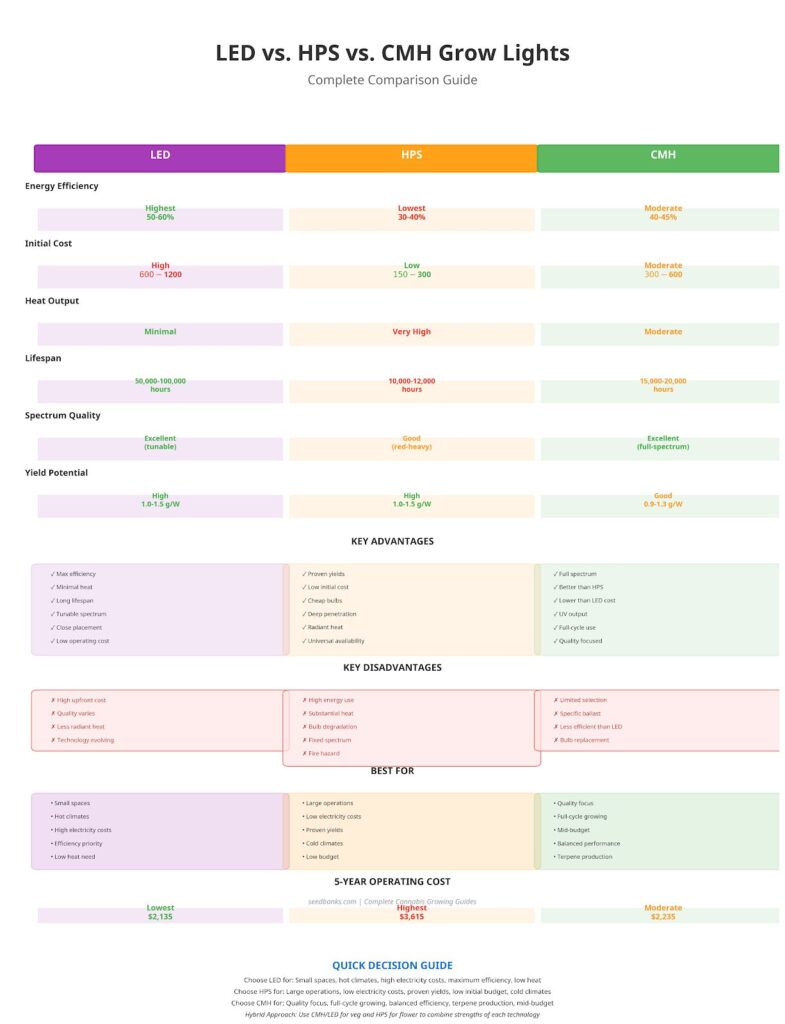
Comprehensive three-way comparison of LED, HPS, and CMH grow lights across all key factors
| Aspect | LED | HPS | CMH |
| Energy Efficiency | Highest (50-60%) | Lowest (30-40%) | Moderate (40-45%) |
| Initial Cost | High ($600-$1200) | Low ($150-$300) | Moderate ($300-$600) |
| Operating Cost | Lowest | Highest | Moderate |
| Heat Output | Minimal | Very High | Moderate |
| Lifespan | 50,000-100,000 hrs | 10,000-12,000 hrs | 15,000-20,000 hrs |
| Spectrum Quality | Excellent (tunable) | Good (red-heavy) | Excellent (full-spectrum) |
| Vegetative Growth | Excellent | Poor (needs MH) | Excellent |
| Flowering Performance | Excellent | Excellent | Very Good |
| Yield Potential | High (1.0-1.5 g/W) | High (1.0-1.5 g/W) | Good (0.9-1.3 g/W) |
| Canopy Distance | 12-18 inches | 24-36 inches | 18-24 inches |
| Cooling Requirements | Minimal | Substantial (AC often needed) | Moderate (good ventilation) |
| Bulb Replacement | None (50,000+ hrs) | Annual ($20-$60) | Annual ($60-$120) |
| Spectrum Control | Yes (some models) | No | No |
| UV Output | Minimal (unless added) | Minimal | Moderate (beneficial) |
| Light Penetration | Good (with proper design) | Excellent | Very Good |
| Technology Maturity | Evolving rapidly | Fully mature | Moderately mature |
| Availability | Widely available online | Universally available | Limited availability |
| Best For | Efficiency, small spaces, hot climates | Large operations, proven yields, cold climates | Quality focus, balanced performance, mid-budget |
Energy Efficiency and Operating Costs
Energy efficiency directly impacts long-term operating costs, making it a critical factor for most growers. The differences between LED, HPS, and CMH efficiency are substantial and accumulate significantly over years of cultivation.
Electrical Efficiency Comparison
LED Efficiency: The best LED grow lights achieve photosynthetic photon efficacy (PPE) of 2.7 to 3.0 μmol/J, meaning they produce 2.7 to 3.0 micromoles of photosynthetically active photons per joule of electricity consumed. This represents fifty to sixty percent efficiency in converting electricity to usable light. Budget LED fixtures may achieve only 2.0-2.3 μmol/J, while older models fall below 2.0 μmol/J.
HPS Efficiency: Standard single-ended HPS lights achieve PPE of approximately 1.7 to 1.9 μmol/J, representing thirty to forty percent efficiency. Double-ended HPS improves to about 2.0-2.1 μmol/J. While this is respectable for HID technology, it lags significantly behind modern LED.
CMH Efficiency: CMH lights achieve PPE of approximately 1.9 to 2.1 μmol/J, representing forty to forty-five percent efficiency. This positions CMH between HPS and LED, offering meaningful improvement over HPS without reaching LED’s maximum efficiency.
Real-World Cost Comparison
To understand practical cost implications, consider a grow room requiring 1000W of HPS lighting:
HPS System (1000W):
- Actual power draw: 1100W (including ballast losses)
- Hours per year (18/6 veg + 12/12 flower): ~5,475 hours
- Annual electricity: 6,023 kWh
- Annual cost at $0.12/kWh: $723
- Five-year electricity cost: $3,615
LED System (600W equivalent):
- Actual power draw: 650W (LED draws less for equivalent output)
- Hours per year: 5,475 hours
- Annual electricity: 3,559 kWh
- Annual cost at $0.12/kWh: $427
- Five-year electricity cost: $2,135
- Five-year savings vs HPS: $1,480
CMH System (630W equivalent):
- Actual power draw: 680W
- Hours per year: 5,475 hours
- Annual electricity: 3,723 kWh
- Annual cost at $0.12/kWh: $447
- Five-year electricity cost: $2,235
- Five-year savings vs HPS: $1,380
These calculations don’t include cooling costs, which further favor LED due to its minimal heat output. In hot climates requiring air conditioning, LED’s advantage increases substantially.
Total Cost of Ownership (5 Years)
LED System:
•Initial investment: $900 (quality 600W fixture)
•Electricity (5 years): $2,135
•Bulb replacements: $0
•Total: $3,035
HPS System:
- Initial investment: $250 (1000W system)
- Electricity (5 years): $3,615
- Bulb replacements (5 years): $200 (5 bulbs × $40)
- Total: $4,065
CMH System:
- Initial investment: $500 (630W system)
- Electricity (5 years): $2,235
- Bulb replacements (5 years): $400 (5 bulbs × $80)
- Total: $3,135
Over five years, LED and CMH show similar total costs despite LED’s higher initial investment. HPS costs significantly more due to electricity consumption. These calculations assume $0.12/kWh electricity; in regions with higher rates, LED’s advantage increases proportionally.
Break-Even Analysis
For growers comparing LED to HPS, the break-even point (where cumulative savings equal the additional upfront cost) typically occurs after 18-30 months depending on electricity rates and usage patterns. In regions with electricity costs above $0.15/kWh, LED breaks even in 12-18 months. For commercial operations running lights continuously, break-even can occur in under a year.
Light Spectrum and Plant Response
Light spectrum—the distribution of wavelengths in the light source—profoundly influences plant development, morphology, and secondary metabolite production. Understanding how LED, HPS, and CMH spectrums affect cannabis helps growers choose appropriate technology for their goals.
Photosynthetically Active Radiation (PAR)
Plants use light in the 400-700nm range for photosynthesis, termed Photosynthetically Active Radiation (PAR). However, not all wavelengths within PAR are equally effective:
Blue Light (400-500nm): Drives vegetative growth, promotes compact structure with short internodes, stimulates stomatal opening, and may enhance terpene production. Blue light is essential for healthy vegetative development.
Green Light (500-600nm): Once thought useless for photosynthesis, green light is now known to penetrate deeper into canopies and drive photosynthesis in lower leaves. Green light also influences plant morphology and may enhance overall efficiency.
Red Light (600-700nm): The most efficient wavelength for photosynthesis, red light drives flowering, promotes stem elongation, and supports bud development. Cannabis responds strongly to red light during flowering.
Far-Red Light (700-750nm): Just beyond visible red, far-red light influences flowering timing, promotes stem elongation, and may enhance yields through the Emerson effect (synergy between red and far-red photosynthesis).
Spectrum Comparison
LED Spectrum: Modern full-spectrum LEDs produce complete coverage across PAR plus some far-red. Quality fixtures use white LEDs (typically 3000K-3500K) supplemented with red and far-red diodes. This creates a spectrum similar to CMH but with enhanced red for flowering. Some LED fixtures offer adjustable spectrum, allowing growers to increase blue during veg and red during flower.
HPS Spectrum: HPS produces a red-heavy spectrum peaked around 600nm with substantial output in yellow and orange (560-620nm) and strong red (620-700nm). However, HPS lacks blue wavelengths (400-500nm), producing weak vegetative growth if used alone. The red-heavy spectrum excels for flowering but is suboptimal for vegetative stages.
CMH Spectrum: CMH produces the most natural, sun-like spectrum with substantial output across all visible wavelengths. The spectrum peaks in the blue-green range (450-550nm) with strong output extending through red (600-700nm) and some far-red (700-750nm). CMH also produces small amounts of UV-A and UV-B that may stimulate trichome production.
Plant Response to Different Spectrums
Vegetative Growth: CMH and LED excel for vegetative growth due to their substantial blue light content, producing compact plants with short internodes and strong stems. HPS alone produces stretchy, weak vegetative growth and is typically replaced with Metal Halide for veg stages.
Flowering Performance: All three technologies support excellent flowering, though through different mechanisms. HPS’s red-heavy spectrum directly drives bud development and has proven itself over decades. LED’s tunable spectrum can be optimized for flowering by increasing red and far-red output. CMH’s full-spectrum output supports vigorous flowering while potentially enhancing terpene complexity.
Terpene Production: Limited research suggests that full-spectrum light including UV may enhance terpene production through stress responses. Many growers report superior terpene profiles under CMH and full-spectrum LED compared to HPS, though controlled studies are lacking. The difference may also relate to reduced heat stress under cooler-running technologies.
Cannabinoid Content: Studies show that light spectrum can influence cannabinoid ratios, with some evidence that UV exposure increases THC content. However, the effects are modest (typically less than ten percent variation), and proper cultivation technique matters more than spectrum for cannabinoid production.
Spectrum Recommendations
For Vegetative Growth: CMH or full-spectrum LED with substantial blue content (3500K-5000K) produces optimal vegetative development. HPS should be avoided or supplemented with Metal Halide for veg stages.
For Flowering: All three technologies work well. HPS’s proven red-heavy spectrum maximizes bud development. LED with enhanced red (3000K-3500K plus red diodes) matches HPS performance. CMH’s full spectrum produces excellent flowers with potentially enhanced terpenes.
For Full-Cycle Growing: CMH and full-spectrum LED work well from seed to harvest. HPS requires bulb changes (MH for veg, HPS for flower) or supplemental lighting for optimal results throughout the cycle.
Heat Output and Climate Control
Heat management represents one of the most significant practical differences between LED, HPS, and CMH technologies. The amount of heat each technology produces fundamentally shapes grow room design, ventilation requirements, and operating costs.
Heat Production Comparison
All grow lights convert some electrical energy into heat rather than light. The efficiency differences between technologies directly determine heat output:
LED Heat Output: LED fixtures convert fifty to sixty percent of electricity into light, with the remaining forty to fifty percent becoming heat. However, because LED uses less total power for equivalent light output, absolute heat production is much lower than HPS. A 600W LED produces about 2,050 BTU/hr of heat.
HPS Heat Output: HPS converts only thirty to forty percent of electricity into light, with sixty to seventy percent becoming heat. Additionally, HPS uses more total power for equivalent light output. A 1000W HPS system produces about 3,750 BTU/hr of heat—nearly twice as much as an equivalent LED system.
CMH Heat Output: CMH converts forty to forty-five percent of electricity into light, with fifty-five to sixty percent becoming heat. A 630W CMH system produces about 2,400 BTU/hr of heat, falling between LED and HPS.
Practical Heat Management Implications
LED Climate Control: LED’s minimal heat output simplifies climate control dramatically. In small spaces like tents, LED often eliminates temperature problems entirely, with simple exhaust fans sufficient for climate control. In moderate climates, LED grows may not require air conditioning even in summer. LED’s low heat also allows closer canopy placement (12-18 inches), increasing effective light intensity without heat stress.
HPS Climate Control: HPS’s substantial heat output demands robust ventilation and often air conditioning. Commercial HPS operations typically require 1 ton (12,000 BTU) of cooling capacity per 3,000-4,000W of lighting. In small spaces, HPS can cause severe temperature spikes requiring expensive cooling solutions. The 24-36 inch canopy distance required to prevent heat stress reduces effective light intensity.
CMH Climate Control: CMH’s moderate heat output requires good ventilation but is more manageable than HPS. In moderate climates with proper ventilation, CMH may not require air conditioning. The 18-24 inch canopy distance is a compromise between LED and HPS, allowing reasonable light intensity without excessive heat stress.
Cooling Cost Implications
Cooling costs can equal or exceed lighting costs in HPS grows in hot climates:
Example: 4,000W Grow Room in Hot Climate
HPS Cooling:
- Heat output: 15,000 BTU/hr
- AC required: 1.5 tons (18,000 BTU/hr capacity)
- AC power consumption: ~1,800W
- Annual cooling cost (6 months): ~$780 at $0.12/kWh
- Total annual cost (lights + cooling): $3,483
LED Cooling:
- Heat output: 8,200 BTU/hr (2,400W equivalent lighting)
- AC required: 0.75 tons (9,000 BTU/hr capacity)
- AC power consumption: ~900W
- Annual cooling cost (6 months): ~$390 at $0.12/kWh
- Total annual cost (lights + cooling): $1,817
CMH Cooling:
- Heat output: 9,600 BTU/hr (2,520W equivalent lighting)
- AC required: 1 ton (12,000 BTU/hr capacity)
- AC power consumption: ~1,200W
- Annual cooling cost (6 months): ~$520 at $0.12/kWh
- Total annual cost (lights + cooling): $2,267
These calculations demonstrate that in hot climates, LED’s efficiency advantage extends far beyond lighting electricity to include substantial cooling cost savings.
Cold Climate Considerations
In cold climates, HPS’s heat output can be beneficial, providing “free” warmth that reduces heating costs. Some growers in northern regions specifically choose HPS to take advantage of this heat. However, this advantage applies only during cold months and may become a liability during warmer seasons.
LED grows in cold climates may require supplemental heating, partially offsetting efficiency gains. However, modern heating systems are more efficient than using grow lights for heat, and LED’s lower electricity costs typically still result in overall savings.
Yield Comparison
Yield potential is a primary concern for most growers, making it essential to understand how LED, HPS, and CMH compare in actual production. While all three technologies can produce excellent yields, subtle differences exist.
Controlled Study Results
Multiple controlled studies have compared yields between lighting technologies:
A 2020 study published in HortScience compared LED, HPS, and CMH growing identical cannabis clones in controlled conditions. Results showed LED and HPS produced statistically equivalent yields (1.2 g/W average), while CMH produced slightly lower yields (1.0 g/W average). However, CMH-grown cannabis showed higher terpene concentrations, suggesting quality advantages despite modest yield reduction.
Research from Wageningen University (2021) found that optimized LED spectrum could produce five to ten percent higher yields than HPS when light intensity and environmental conditions were carefully controlled. The study attributed this to LED’s spectrum optimization and reduced heat stress allowing closer canopy placement.
A 2022 meta-analysis in Frontiers in Plant Science reviewing 23 studies across various crops (including cannabis) found that LED and HPS produced equivalent yields on average, with LED showing slight advantages in controlled environments and HPS maintaining advantages in large-scale commercial settings where proven cultivation techniques are well-established.
Real-World Observations
Commercial cultivation experience generally aligns with research findings:
HPS Yields: Experienced HPS growers consistently achieve 1.0 to 1.5 grams per watt, with commercial operations averaging 1.2 g/W. Decades of optimization have refined HPS cultivation techniques, and the technology’s proven track record provides confidence in yield expectations.
LED Yields: Modern full-spectrum LED produces yields equivalent to HPS (1.0-1.5 g/W) when properly implemented. Some growers report slightly higher yields with LED due to reduced heat stress and optimized spectrum, though results vary by strain and growing conditions. LED’s main advantage is achieving these yields with thirty to fifty percent less electricity.
CMH Yields: CMH typically produces 0.9 to 1.3 grams per watt, slightly lower than HPS or LED. However, many CMH growers accept modest yield reductions in exchange for superior terpene profiles and flower quality. The yield difference is typically ten to fifteen percent, not dramatic enough to disqualify CMH for quality-focused cultivation.
Factors Affecting Yield Comparisons
Several factors complicate direct yield comparisons:
Growing Technique: Yields depend more on growing skill, training techniques, and environmental control than lighting technology. An experienced grower with HPS will likely out-yield a beginner with LED, regardless of LED’s theoretical advantages.
Strain Variation: Different cannabis strains respond differently to light spectrum and intensity. Some strains may perform better under specific lighting technologies, though most modern hybrids adapt well to any quality light source.
Environmental Optimization: LED’s low heat allows tighter environmental control, potentially enabling higher yields through optimized temperature and humidity. HPS’s heat makes environmental control more challenging, potentially limiting yields in suboptimal setups.
Light Intensity: Yields correlate strongly with light intensity (PPFD – Photosynthetic Photon Flux Density). LED’s ability to be placed closer to canopies can increase effective PPFD, potentially improving yields. However, proper HPS placement with good reflectors can achieve similar PPFD levels.
Yield Recommendations
For maximum yields, all three technologies can produce excellent results:
Choose HPS if: You have experience with HPS, adequate cooling capacity, and want proven, reliable yields using well-established techniques.
Choose LED if: You want equivalent yields to HPS with lower electricity costs, reduced heat, and potential quality improvements from spectrum optimization.
Choose CMH if: You prioritize flower quality and terpene production over maximum yields and want better efficiency than HPS without LED’s high cost.
Lifespan and Replacement Costs
The longevity of grow lights and frequency of replacement significantly impacts long-term operating costs and maintenance requirements.
LED Lifespan
Quality LED fixtures are rated for 50,000 to 100,000 hours of operation before light output degrades to seventy percent of original intensity (L70 rating). This represents approximately:
- 50,000 hours: 11 years of 12/12 flowering schedule
- 100,000 hours: 22 years of 12/12 flowering schedule
In practice, most LED fixtures will outlast the grower’s interest in using them, with technology improvements making replacement desirable before failure. LED’s long lifespan means:
- No bulb replacements: LED fixtures have no user-replaceable bulbs, eliminating replacement costs and maintenance
- Consistent output: LED maintains stable light output over its lifespan with minimal degradation
- Long-term reliability: Quality fixtures from reputable manufacturers typically last 5-10 years of continuous use without issues
HPS Lifespan
HPS bulbs degrade significantly over time, with light output declining fifteen to thirty percent over 10,000-12,000 hours of use. This represents approximately:
- 10,000 hours: 2.3 years of 12/12 flowering schedule
- 12,000 hours: 2.7 years of 12/12 flowering schedule
Most growers replace HPS bulbs annually to maintain optimal yields, as degraded output directly reduces harvest weight. HPS maintenance includes:
- Annual bulb replacement: $20-$60 per bulb for single-ended, $60-$100 for double-ended
- Ballast replacement: Magnetic ballasts last 3-5 years, digital ballasts 5-10 years
- Reflector maintenance: Reflectors should be cleaned regularly and replaced every 2-3 years as reflective surfaces degrade
CMH Lifespan
CMH bulbs maintain output better than HPS, retaining ninety percent of initial output after 10,000 hours and eighty percent after 20,000 hours. This represents:
- 20,000 hours: 4.6 years of 12/12 flowering schedule
However, most growers replace CMH bulbs every 12-18 months to maintain optimal spectrum and intensity. CMH maintenance includes:
- Annual bulb replacement: $60-$120 per bulb
- Ballast replacement: CMH ballasts typically last 5-10 years
- Reflector maintenance: Similar to HPS, clean regularly and replace every 2-3 years
Long-Term Replacement Cost Comparison (10 Years)
LED System:
- Bulb replacements: $0
- Fixture replacement: $900 (one replacement at year 8 due to technology improvements)
- Total: $900
HPS System:
- Bulb replacements: $400 (10 bulbs × $40)
- Ballast replacement: $150 (one replacement at year 6)
- Reflector replacement: $100 (one replacement at year 5)
- Total: $650
CMH System:
- Bulb replacements: $800 (10 bulbs × $80)
- Ballast replacement: $150 (one replacement at year 7)
- Reflector replacement: $100 (one replacement at year 5)
- Total: $1,050
While LED has no bulb replacement costs, the higher initial fixture cost and potential technology-driven replacement partially offset this advantage. HPS has the lowest long-term replacement costs, though this doesn’t account for higher electricity expenses.
Decision Guide: Which Grow Light Is Right for You?
Use this comprehensive framework to determine the optimal lighting technology for your specific situation.
Question 1: What is your grow space size?
Small spaces (2×2 to 4×4 tents): LED is ideal. Low heat output prevents temperature problems in confined spaces, and efficiency reduces electricity costs. A 240-480W LED fixture provides adequate light for small tents without overwhelming ventilation.
Medium spaces (4×8 to 8×8 rooms): All three technologies work. LED offers best efficiency and heat management. CMH provides quality-focused middle ground. HPS works if you have adequate cooling.
Large spaces (commercial warehouses): HPS remains popular due to proven yields and low initial cost, though many commercial operations are transitioning to LED for long-term savings. CMH is less common at commercial scale due to limited high-wattage options.
Question 2: What is your budget?
Limited budget ($500 or less): HPS offers the lowest entry cost at $150-$300 for complete systems. Accept higher operating costs as the trade-off for low initial investment.
Moderate budget ($500-$1,000): CMH provides the best balance at $300-$600, offering efficiency improvements over HPS without LED’s premium pricing.
Flexible budget ($1,000+): LED provides the best long-term value despite high upfront cost. Premium fixtures pay for themselves through electricity savings over 2-4 years.
Question 3: What are your electricity costs?
Low electricity costs (under $0.10/kWh): All technologies are economically viable. HPS becomes more attractive when electricity is cheap, as efficiency matters less.
Moderate electricity costs ($0.10-$0.15/kWh): LED and CMH offer meaningful savings over HPS. LED breaks even in 2-3 years, CMH in 3-4 years.
High electricity costs (over $0.15/kWh): LED is strongly recommended. Efficiency savings are substantial, with break-even in 12-24 months. CMH is second choice.
Question 4: What is your climate?
Hot climates or inadequate cooling: LED is essential. Low heat output may eliminate air conditioning requirements, providing massive savings beyond lighting efficiency.
Moderate climates with good ventilation: All technologies work. CMH offers excellent balance of efficiency and performance. HPS works with proper ventilation.
Cold climates requiring heating: HPS or CMH provide beneficial radiant heat that reduces heating costs. LED’s efficiency advantage is partially offset by heating needs.
Question 5: What are your cultivation goals?
Maximum yields: HPS and LED produce equivalent maximum yields. Choose based on other factors like efficiency and heat management.
Quality and terpene production: CMH and full-spectrum LED may enhance terpene profiles and flower quality compared to HPS, though evidence is largely anecdotal.
Efficiency and low operating costs: LED provides lowest long-term operating costs through maximum efficiency and minimal cooling requirements.
Proven, reliable results: HPS offers decades of proven performance with well-established cultivation techniques and predictable results.
Question 6: What is your experience level?
Beginners: LED simplifies cultivation by eliminating heat management challenges. HPS is also beginner-friendly with extensive documentation, though heat management requires attention.
Intermediate growers: All technologies are accessible. Choose based on priorities like efficiency (LED), cost (HPS), or quality (CMH).
Experienced growers: Any technology works. Experienced growers can maximize yields with any light source through proper technique and environmental control.
Question 7: Do you grow vegetatively and flower in the same space?
Yes, full-cycle in one space: CMH and full-spectrum LED work excellently for full-cycle growing. HPS requires bulb changes (MH for veg, HPS for flower) or produces suboptimal vegetative growth.
No, separate veg and flower spaces: Any technology works. Many growers use CMH or LED for veg and HPS for flower, combining technologies for optimal results.
Recommendation Summary
Choose LED if:
- You grow in small spaces or hot climates
- Electricity costs are high
- You want lowest long-term operating costs
- Heat management is a priority
- You have budget for quality fixtures
Choose HPS if:
- You have limited initial budget
- You grow in large spaces with adequate cooling
- Electricity costs are low
- You want proven, reliable yields
- You grow in cold climates and appreciate radiant heat
Choose CMH if:
- You prioritize flower quality and terpene production
- You want better efficiency than HPS without LED’s high cost
- You grow full-cycle in one space
- You want natural, full-spectrum light
- You have moderate budget ($300-$600)
Consider Hybrid Approaches: Many experienced growers combine technologies, using CMH or LED for vegetative growth and HPS for flowering. This captures the advantages of each technology while minimizing disadvantages.
Frequently Asked Questions
Can LED really match HPS yields?
Yes, modern full-spectrum LED produces yields equivalent to HPS when properly implemented. Multiple controlled studies show LED and HPS producing 1.0-1.5 grams per watt with no statistically significant difference. LED’s advantage is achieving these yields with thirty to fifty percent less electricity and significantly less heat. Early LED technology (blurple lights from the 2010s) was inferior to HPS, but modern full-spectrum LED has closed the gap completely.
Why is LED so much more expensive than HPS?
LED fixtures contain sophisticated components including hundreds of individual diodes, precision drivers, substantial heatsinks, and often advanced features like spectrum control. Quality LED manufacturers use premium Samsung or Osram diodes with rigorous quality control, driving up costs. In contrast, HPS is mature technology with simple components (bulb, ballast, reflector) manufactured at massive scale for decades. However, LED’s higher upfront cost is offset by lower operating costs, with break-even typically occurring in 18-36 months.
Do CMH lights really improve terpene production?
Many growers report enhanced terpene profiles and superior flavor from CMH-grown cannabis compared to HPS. While controlled scientific studies are limited, the anecdotal evidence is substantial. CMH’s full-spectrum light including UV may stimulate terpene production as a plant defense response. Additionally, CMH’s lower heat output reduces terpene degradation from heat stress. However, proper cultivation technique matters more than lighting technology for terpene production.
Can I use HPS for vegetative growth?
HPS can be used for vegetative growth, but it’s suboptimal. HPS’s red-heavy spectrum lacks the blue wavelengths that promote compact, bushy vegetative growth. Plants grown under HPS alone during veg tend to stretch with long internodes and weak stems. Most growers use Metal Halide (MH) bulbs for veg and switch to HPS for flower, or use CMH/LED that work well for both stages.
How close can I place different lights to the canopy?
LED can typically be placed 12-18 inches from the canopy without heat stress, though some high-intensity LEDs require 18-24 inches. HPS must maintain 24-36 inches distance due to intense heat, with larger wattage bulbs requiring greater distance. CMH falls between at 18-24 inches. Proper distance depends on specific fixture wattage, reflector design, and environmental conditions. Always monitor plants for signs of light stress (bleaching, tacoing leaves) and adjust accordingly.
Do I need to replace LED bulbs like HPS?
No, LED fixtures have no user-replaceable bulbs. The diodes are integrated into the fixture and rated for 50,000-100,000 hours before significant degradation. When LED fixtures eventually fail (typically after 5-10 years), the entire fixture is replaced rather than individual bulbs. This eliminates ongoing bulb replacement costs but means eventual fixture replacement is more expensive than HPS bulb changes.
Can I mix different lighting technologies?
Yes, many growers successfully combine technologies. Common approaches include using CMH or LED for vegetative growth and HPS for flowering, or supplementing HPS with LED to add blue spectrum. Some growers use HPS as primary lighting with LED supplements for spectrum enhancement. Mixing technologies can capture advantages of each while minimizing disadvantages, though it adds complexity to setup and management.
Why do some growers still prefer HPS over LED?
HPS remains popular for several reasons: proven track record with decades of documented results, low initial cost making it accessible for budget-conscious growers, beneficial heat in cold climates, excellent flowering spectrum, and deep canopy penetration. Many experienced commercial growers have optimized HPS cultivation and see no compelling reason to change. Additionally, some growers distrust LED due to early poor-quality products, though modern LED has largely overcome these issues.
How do I calculate the right amount of light for my space?
Cannabis requires approximately 600-1000 μmol/m²/s PPFD (Photosynthetic Photon Flux Density) for optimal flowering. To determine required wattage:
- LED: 30-40W per square foot (320-430W per square meter)
- HPS: 50-60W per square foot (540-645W per square meter)
- CMH: 40-50W per square foot (430-540W per square meter)
For example, a 4×4 foot (16 square foot) space requires approximately 480-640W of LED, 800-960W of HPS, or 640-800W of CMH. These are general guidelines; actual requirements vary by fixture efficiency and growing technique.
10. Are cheap LED lights worth it?
Cheap LED fixtures (typically under $200 for 600W equivalent) usually use low-quality diodes, inadequate drivers, and poor thermal management. These fixtures often fail prematurely, produce inferior spectrum, and deliver disappointing yields. While budget LEDs can grow cannabis, they typically underperform quality fixtures significantly. If budget is limited, a quality HPS system often provides better results than a cheap LED. For LED, investing in reputable brands using Samsung or Osram diodes is essential for good results.
References
1.Bugbee, B. (2021). Toward an optimal spectral quality for plant growth and development: The importance of radiation capture. HortScience, 56(12), 1378-1386. https://doi.org/10.21273/HORTSCI16223-21
2.Kusuma, P., Pattison, P. M., & Bugbee, B. (2020). From physics to fixtures to food: Current and potential LED efficacy. Horticulture Research, 7(1), 56. https://doi.org/10.1038/s41438-020-0283-7
3.Danziger, N., & Bernstein, N. (2021). Light matters: Effect of light spectra on cannabinoid profile and plant development of medical cannabis (Cannabis sativa L.). Industrial Crops and Products, 164, 113351. https://doi.org/10.1016/j.indcrop.2021.113351
4.Magagnini, G., Grassi, G., & Kotiranta, S. (2018). The effect of light spectrum on the morphology and cannabinoid content of Cannabis sativa L. Medical Cannabis and Cannabinoids, 1(1), 19-27. https://doi.org/10.1159/000489030
5.Westmoreland, F. M., Kusuma, P., & Bugbee, B. (2021). Cannabis lighting: Decreasing blue photon fraction increases yield but efficacy is more important for cost effective production of cannabinoids. PLoS ONE, 16(3), e0248988. https://doi.org/10.1371/journal.pone.0248988
6.Rodriguez-Morrison, V., Llewellyn, D., & Zheng, Y. (2021). Cannabis yield, potency, and leaf photosynthesis respond differently to increasing light levels in an indoor environment. Frontiers in Plant Science, 12, 646020. https://doi.org/10.3389/fpls.2021.646020
7.Hawley, D., Graham, T., Stasiak, M., & Dixon, M. (2018). Improving cannabis bud quality and yield with subcanopy lighting. HortScience, 53(11), 1593-1599. https://doi.org/10.21273/HORTSCI13173-18
8.Caplan, D., Dixon, M., & Zheng, Y. (2019). Increasing inflorescence dry weight and cannabinoid content in medical cannabis using controlled drought stress. HortScience, 54(5), 964-969. https://doi.org/10.21273/HORTSCI13510-18
9.Chandra, S., Lata, H., Khan, I. A., & ElSohly, M. A. (2017). Light dependence of photosynthesis and water vapor exchange characteristics in different high Δ9-THC yielding varieties of Cannabis sativa L. Journal of Applied Research on Medicinal and Aromatic Plants, 7, 39-47. https://doi.org/10.1016/j.jarmap.2017.05.004
10.Lydon, J., Teramura, A. H., & Coffman, C. B. (1987). UV-B radiation effects on photosynthesis, growth and cannabinoid production of two Cannabis sativa chemotypes. Photochemistry and Photobiology, 46(2), 201-206. https://doi.org/10.1111/j.1751-1097.1987.tb04757.x
11.Nelson, J. A., & Bugbee, B. (2014). Economic analysis of greenhouse lighting: Light emitting diodes vs. high intensity discharge fixtures. PLoS ONE, 9(6), e99010. https://doi.org/10.1371/journal.pone.0099010
12.Pattison, P. M., Tsao, J. Y., Brainard, G. C., & Bugbee, B. (2018). LEDs for photons, physiology and food. Nature, 563(7732), 493-500. https://doi.org/10.1038/s41586-018-0706-x
13.Zhen, S., & Bugbee, B. (2020). Far-red photons have equivalent efficiency to traditional photosynthetic photons: Implications for redefining photosynthetically active radiation. Plant, Cell & Environment, 43(5), 1259-1272. https://doi.org/10.1111/pce.13730