
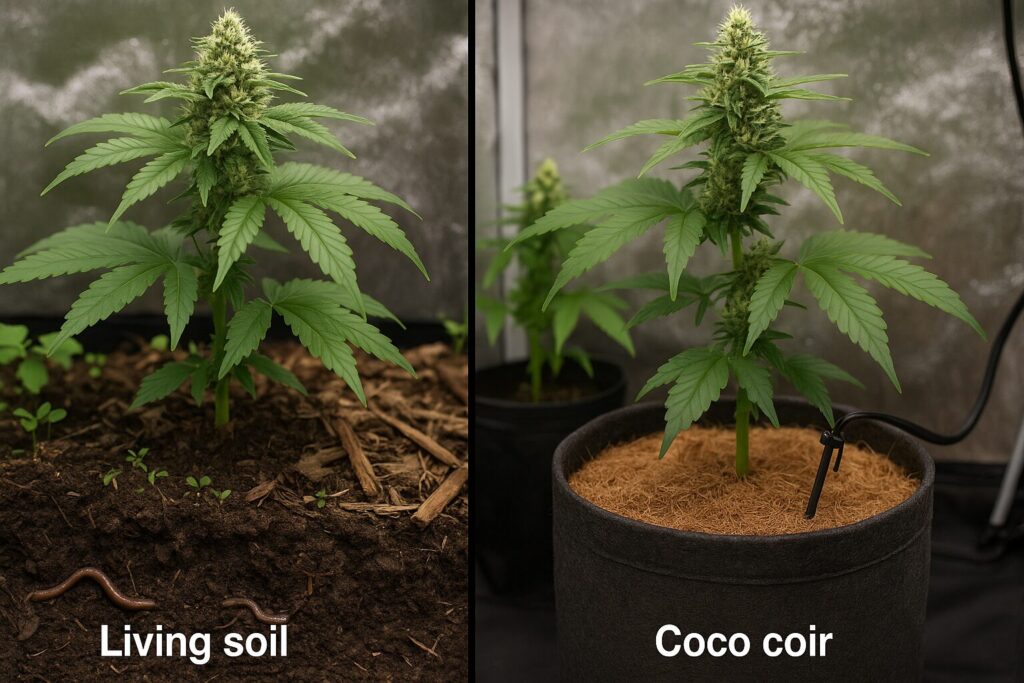
Split-screen comparison: Living soil with rich organic ecosystem and visible earthworm on soil vs. Coco coir with clean hydroponic-style setup and drip irrigation (right)
Table of Contents
Key Takeaways
- Living Soil Creates a Self-Sustaining Ecosystem: Living soil cultivation mimics natural forest ecosystems, creating a complex food web of beneficial bacteria, fungi, protozoa, nematodes, and other microorganisms that break down organic matter and make nutrients available to plants. This biological approach requires minimal intervention once established—growers simply top-dress with compost and amendments while the soil food web handles nutrient cycling. Living soil improves over time as microbial populations establish and organic matter accumulates, creating increasingly fertile growing medium across multiple cycles.
- Coco Coir Provides Hydroponic-Style Control: Coco coir is an inert growing medium made from coconut husk fibers that provides excellent aeration and water retention while remaining biologically inactive. This inert nature gives growers complete control over nutrition through precise liquid feeding, similar to hydroponics but with the forgiveness and simplicity of soil-like growing. Coco coir allows rapid growth rates approaching hydroponic systems while maintaining easier management than true hydroponics, making it popular for growers seeking maximum yields with moderate complexity.
- Living Soil Excels in Flavor and Terpene Complexity: Multiple studies and widespread grower experience suggest living soil produces superior flavor profiles and more complex terpene expressions compared to synthetic feeding methods. The diverse microbial population in living soil creates a broader spectrum of available nutrients and secondary metabolites that plants incorporate into terpene production. Many connoisseurs and competition growers choose living soil specifically for flavor quality, accepting potentially lower yields in exchange for exceptional taste and aroma.
- Coco Coir Delivers Maximum Growth Speed and Yields: Coco coir’s excellent aeration and precise nutrient control enable growth rates and yields comparable to hydroponics—typically 20-30% higher than living soil. The constant availability of optimal nutrition and oxygen at the root zone maximizes photosynthesis and biomass production. Indoor coco coir grows commonly yield 500-700 grams per square meter compared to 400-500 grams for living soil, making coco the choice for yield-focused cultivation.
- Living Soil Requires Initial Investment but Lower Ongoing Costs: Building quality living soil requires significant upfront investment in compost, amendments, and beneficial organisms ($200-400 for initial setup). However, ongoing costs are minimal—simple top-dressing with compost and occasional amendments costs $20-50 per cycle. The soil improves and becomes more productive over time, providing increasing returns. Coco coir has lower initial costs ($50-100) but requires continuous liquid nutrient purchases ($50-100 per cycle), making it more expensive long-term.
- Choose Based on Growing Philosophy and Priorities: Living soil suits growers who value organic cultivation, superior flavor, environmental sustainability, and minimal intervention, accepting longer learning curves and potentially lower yields. Coco coir suits growers prioritizing maximum yields, rapid growth, precise control, and proven results, accepting ongoing nutrient costs and less complex flavors. Neither approach is inherently superior—each excels in different aspects of cannabis cultivation.
Introduction: Understanding Growing Media Philosophy
The choice between living soil and coco coir represents more than selecting a growing medium—it reflects fundamentally different cultivation philosophies. Living soil embraces biological complexity, creating self-sustaining ecosystems where plants and microorganisms work synergistically. Coco coir embraces precision and control, providing inert media where growers directly manage all nutrition. Understanding these philosophical differences helps growers choose the approach aligned with their values, goals, and growing style.
The Biological Approach (Living Soil): Living soil cultivation views the growing medium as a living ecosystem rather than simply a physical support structure. This approach mimics natural forest soils where complex food webs of bacteria, fungi, protozoa, nematodes, and other organisms break down organic matter, cycle nutrients, protect against pathogens, and create soil structure. Plants actively participate in this ecosystem, exuding sugars and compounds that feed beneficial microbes in exchange for nutrients and protection. The grower’s role shifts from direct nutrient provider to ecosystem manager, maintaining conditions that support beneficial organisms.
This biological approach requires patience and ecological understanding. Living soil takes weeks to months to fully establish as microbial populations colonize and organic matter begins decomposing. Growers must understand nutrient cycling, composting, and soil biology rather than simply following feeding schedules. However, once established, living soil becomes increasingly self-sufficient, requiring minimal intervention while producing exceptional quality.
The Precision Approach (Coco Coir): Coco coir cultivation treats the growing medium as an inert physical substrate that holds water and provides root support while remaining biologically inactive. This inert nature gives growers complete control—every nutrient the plant receives comes directly from liquid fertilizers in precise ratios and concentrations. This precision enables optimization for maximum growth rates and yields, as growers can adjust nutrition in real-time based on plant response.
This precision approach requires less ecological knowledge but more attention to feeding schedules and nutrient management. Coco coir responds immediately to nutritional changes—both improvements and deficiencies manifest quickly. Growers must understand plant nutrition, pH management, and electrical conductivity (EC) monitoring. However, this responsiveness allows rapid problem-solving and optimization, making coco coir forgiving of mistakes while rewarding skillful management.
Historical Context: Living soil represents the traditional approach to cannabis cultivation, used for thousands of years before synthetic fertilizers existed. Modern living soil methods incorporate scientific understanding of soil biology, but the fundamental approach remains unchanged—feed the soil, and the soil feeds the plant. Coco coir represents modern innovation, developed in the 1980s-1990s as growers sought alternatives to peat moss and rockwool. Its popularity exploded in the 2000s as hydroponic growing techniques advanced and growers recognized coco’s unique combination of hydroponic performance with soil-like simplicity.
Current Landscape: Both approaches have passionate advocates and proven track records. Living soil dominates organic cultivation, small-batch artisan growing, and situations where flavor quality is paramount. Coco coir dominates commercial cultivation, yield-focused growing, and situations requiring rapid turnaround and consistent results. Many experienced growers use both methods strategically—living soil for premium small-batch products and coco coir for high-volume production.
This comprehensive guide examines living soil and coco coir from scientific, practical, and philosophical perspectives. We’ll explore the biological mechanisms underlying each approach, compare yields and quality, analyze costs and complexity, and provide decision frameworks to help you choose the method aligned with your specific situation and priorities.
For premium genetics suitable for both growing methods, explore quality seeds at seedbanks.com and weed.de, featuring selections from Official Cannabis Seeds, Blue Dream, and Sour Diesel.
Understanding Living Soil
Living soil represents a holistic approach to cannabis cultivation that creates self-sustaining ecosystems mimicking natural forest soils. Rather than directly feeding plants with synthetic nutrients, living soil growers cultivate beneficial microorganisms that break down organic matter and make nutrients available to plants through natural biological processes.
What is Living Soil?
Living soil is a growing medium that contains active populations of beneficial microorganisms including bacteria, fungi, protozoa, nematodes, and other organisms that form complex food webs. These organisms break down organic matter (compost, plant residues, amendments), cycle nutrients, improve soil structure, protect against pathogens, and create symbiotic relationships with plant roots.
Key Components:
Base Soil: High-quality compost or composted soil provides the foundation, containing diverse microbial populations and organic matter.
Aeration: Perlite, pumice, or rice hulls provide drainage and oxygen to roots and aerobic microorganisms (typically 30-40% by volume).
Organic Amendments: Diverse inputs provide slow-release nutrition:
- Nitrogen sources: Blood meal, feather meal, fish meal, alfalfa meal
- Phosphorus sources: Bone meal, rock phosphate, bat guano
- Potassium sources: Kelp meal, greensand, langbeinite
- Calcium/Magnesium: Oyster shell flour, dolomite lime, gypsum
- Trace minerals: Basalt rock dust, azomite, glacial rock dust
Biological Inoculants: Beneficial organisms added to accelerate establishment:
- Mycorrhizal fungi (form symbiotic root relationships)
- Beneficial bacteria (nitrogen fixers, nutrient cyclers)
- Trichoderma (beneficial fungus, pathogen protection)
- Compost teas (diverse microbial populations)
Living Mulch/Cover Crops: Some growers use clover or other cover crops that fix nitrogen, prevent soil compaction, and support beneficial insects.
The Soil Food Web
The soil food web represents the complex interactions between organisms in living soil. Understanding this web helps growers manage living soil effectively.
Primary Decomposers (Bacteria and Fungi): Bacteria and fungi are the primary decomposers, breaking down organic matter and making nutrients available. Bacteria excel at decomposing simple compounds and dominate in younger, more disturbed soils. Fungi excel at decomposing complex compounds (lignin, cellulose) and dominate in mature, undisturbed soils. The bacteria-to-fungi ratio shifts as soil matures, with fungal dominance indicating well-established living soil.
Mycorrhizal Fungi: Mycorrhizal fungi form symbiotic relationships with plant roots, extending hyphal networks that dramatically increase the plant’s effective root surface area. In exchange for plant-produced sugars, mycorrhizae provide water, phosphorus, and other nutrients while protecting against pathogens. Research shows mycorrhizal plants grow 20-40% larger and show improved stress tolerance compared to non-mycorrhizal plants.
Protozoa and Nematodes: Protozoa (single-celled organisms) and beneficial nematodes feed on bacteria and fungi, releasing nitrogen and other nutrients in plant-available forms through their waste. This “microbial loop” is crucial for nutrient cycling—many nutrients locked in microbial biomass become available only when microbes are consumed by predators.
Arthropods and Larger Organisms: Springtails, mites, and other arthropods shred organic matter, increasing surface area for microbial decomposition. Earthworms (in outdoor or large container growing) create channels that improve aeration and water infiltration while their castings provide excellent nutrition.
Plant-Microbe Communication: Plants actively manage their rhizosphere (root zone) by exuding sugars, amino acids, and other compounds that feed specific beneficial microbes. Research shows plants can “recruit” beneficial organisms or suppress pathogens by adjusting root exudates. This sophisticated communication allows plants to shape their own microbial environment.
Building Living Soil
Creating quality living soil requires careful recipe formulation and adequate time for biological establishment.
Basic Living Soil Recipe (Per Cubic Foot):
Base Mix:
- 33% high-quality compost or composted soil
- 33% peat moss or coco coir (water retention)
- 33% aeration (perlite, pumice, or rice hulls)
Amendments (Per Cubic Foot):
- ½ cup kelp meal (potassium, trace minerals, growth hormones)
- ½ cup neem meal (nitrogen, pest deterrent)
- ½ cup crustacean meal (chitin, beneficial organism food)
- ½ cup fish bone meal (phosphorus, calcium)
- ½ cup gypsum (calcium, sulfur, soil structure)
- 1 cup rock dust (basalt or glacial, trace minerals)
- ½ cup oyster shell flour (slow-release calcium, pH buffer)
Biological Inoculants:
Mycorrhizal fungi (per package directions)
Beneficial bacteria blend
Compost tea (optional, accelerates establishment)
Preparation Process:
- Mix Thoroughly: Combine all ingredients in large container or tarp, mixing thoroughly to distribute amendments evenly.
- Moisten: Add water until mix reaches “sponge-squeezed” moisture—moist but not waterlogged. Proper moisture is critical for microbial activity.
- Cook: Allow mix to “cook” (compost) for 2-4 weeks before planting. During this period, microbes colonize, begin breaking down amendments, and stabilize pH. Mix periodically to maintain aeration.
- Test: After cooking, test pH (should be 6.0-7.0) and plant a test seedling to ensure no nutrient burn from fresh amendments.
- Plant: Once stable, plant directly into living soil. No additional nutrients needed for 4-6 weeks as plants access slow-release amendments.
Advantages of Living Soil
Superior Flavor and Terpene Profiles: Living soil consistently produces cannabis with more complex flavor profiles and richer terpene expressions compared to synthetic feeding. The diverse microbial population creates a broader spectrum of available nutrients and secondary metabolites that plants incorporate into terpene production. Many cannabis cups and competitions show living soil entries dominating flavor categories.
Minimal Ongoing Intervention: Once established, living soil requires minimal management. Growers simply water (no nutrient mixing) and occasionally top-dress with compost or amendments. The soil food web handles nutrient cycling, pH buffering, and pathogen protection automatically. This “water-only” approach saves time and simplifies cultivation.
Improves Over Time: Living soil becomes more productive with each cycle as microbial populations establish, organic matter accumulates, and soil structure improves. Many growers report their best results in soil’s third or fourth cycle after the ecosystem fully matures. This improving performance contrasts with coco coir, which must be replaced or heavily amended between cycles.
Environmental Sustainability: Living soil uses renewable organic inputs (compost, plant meals, rock dusts) rather than petroleum-derived synthetic fertilizers. The biological approach sequesters carbon, builds soil organic matter, and creates no chemical runoff. For environmentally conscious growers, living soil aligns with sustainable agriculture principles.
pH Buffering: The diverse microbial population and organic matter in living soil provide excellent pH buffering, maintaining stable pH even with varying water pH. This buffering eliminates the need for constant pH adjustment that coco coir and hydroponics require.
Drought Tolerance: The organic matter and improved soil structure in living soil increase water retention and drought tolerance. Plants in living soil tolerate irregular watering better than coco coir, which requires frequent irrigation.
Beneficial Organism Protection: The diverse microbial population in living soil provides natural pathogen protection through competitive exclusion and antibiotic production. Beneficial organisms occupy ecological niches that would otherwise be available to pathogens, while some beneficial fungi and bacteria produce compounds that directly suppress diseases.
Organic Certification: For growers seeking organic certification or marketing organic products, living soil provides a cultivation method that meets organic standards without synthetic inputs.
Disadvantages of Living Soil
Longer Learning Curve: Living soil requires understanding soil biology, composting, nutrient cycling, and ecosystem management—more complex than following a feeding schedule. Beginners often struggle with the biological concepts and patience required for soil establishment.
Slower Initial Growth: Plants in living soil typically show slower early vegetative growth compared to coco coir with synthetic nutrients. The soil food web takes time to break down organic amendments into plant-available forms, while synthetic nutrients provide immediate availability. Growth rates equalize later in the cycle as the soil food web matures.
Lower Maximum Yields: Living soil typically yields 10-20% less than optimized coco coir cultivation. The slower nutrient availability and less precise control limit maximum growth rates. Indoor living soil yields typically range 400-500 grams per square meter compared to 500-700 grams for coco coir.
Requires Preparation Time: Quality living soil requires 2-4 weeks of “cooking” before use as amendments break down and microbial populations establish. This preparation time delays growing compared to coco coir’s immediate usability.
Larger Container Requirements: Living soil works best in larger containers (minimum 7-10 gallons, ideally 15+ gallons) that provide sufficient volume for diverse microbial populations and organic matter. Small containers limit the soil food web’s complexity and productivity. Coco coir performs well in smaller containers (3-5 gallons).
Difficult Problem Diagnosis: When problems occur in living soil, diagnosis and correction are challenging. The complex biological interactions make it difficult to determine whether issues stem from nutrient imbalances, microbial problems, or other factors. Corrections take time as amendments must be broken down by microbes before affecting plants.
Initial Cost: Building quality living soil requires significant upfront investment in diverse amendments, inoculants, and quality compost ($200-400 for initial setup). While ongoing costs are low, the initial investment exceeds coco coir’s startup costs.
Weight and Portability: Living soil is heavy and difficult to move, especially in large containers. This weight complicates training techniques requiring plant repositioning and makes growing in upper-floor apartments challenging.
Maintenance and Management
Watering: Water living soil when the top 1-2 inches become dry. Unlike coco coir, living soil should not be kept constantly moist—periodic drying promotes beneficial aerobic organisms and prevents anaerobic conditions. Use dechlorinated water when possible, as chlorine can harm beneficial microbes.
Top-Dressing: Every 3-4 weeks during vegetative growth and early flowering, top-dress with:
- 1-2 inches of quality compost, or
- Balanced amendment blend (kelp meal, neem meal, rock dust)
Gently work top-dressing into the soil surface and water thoroughly. This provides ongoing nutrition as the soil food web breaks down amendments.
Compost Teas: Optional but beneficial, compost teas provide microbial inoculations that boost soil food web populations. Brew quality compost with molasses for 24-48 hours, then apply as soil drench. Use monthly during vegetative and early flowering stages.
Mulching: Apply 1-2 inches of straw or other organic mulch to soil surface. Mulch prevents moisture loss, moderates soil temperature, prevents soil compaction from watering, and provides slow-release nutrition as it decomposes.
Cover Crops: Some growers plant clover or other cover crops that fix atmospheric nitrogen, prevent soil compaction, and support beneficial insects. Cover crops are cut back before they compete significantly with cannabis.
pH Management: Living soil typically requires no pH adjustment due to biological buffering. If pH drifts outside 6.0-7.0 range, add oyster shell flour (raises pH) or sulfur (lowers pH) as top-dress amendments.
Reusing Living Soil: After harvest, remove root mass, add fresh compost and amendments, and allow soil to rest for 2-4 weeks before replanting. Living soil improves with reuse as microbial populations mature and organic matter accumulates.
Understanding Coco Coir
Coco coir is an inert growing medium made from coconut husk fibers that provides excellent physical properties (aeration, water retention) while remaining biologically inactive. This inert nature gives growers complete control over nutrition through precise liquid feeding.
What is Coco Coir?
Coco coir is produced from the fibrous material between coconut shells and outer husks—a waste product of coconut processing. The fibers are extracted, aged, washed, and processed into growing media in various forms:
- Coco Fiber: Long fibers providing excellent aeration and drainage, similar to perlite.
- Coco Pith: Fine particles providing water retention, similar to peat moss.
- Coco Chips: Chunky pieces providing maximum aeration, often mixed with fiber and pith.
Most cannabis growers use blended coco products combining fiber and pith in ratios optimized for cannabis cultivation (typically 70% pith, 30% fiber). These blends provide excellent water retention while maintaining sufficient aeration for healthy root development.
Properties and Characteristics
Physical Properties:
Excellent Aeration: Coco coir’s fibrous structure creates air pockets that provide oxygen to roots even when saturated. This high air-filled porosity (10-15% even when wet) prevents overwatering and supports rapid root growth.
High Water Retention: Despite excellent aeration, coco coir holds 8-9 times its weight in water, providing consistent moisture between irrigations. This combination of aeration and water retention is ideal for cannabis cultivation.
Neutral pH: Quality coco coir has pH around 5.5-6.5, ideal for cannabis. Unlike peat moss (pH 3.5-4.5), coco requires minimal pH adjustment.
Renewable and Sustainable: Coco coir is a renewable byproduct of coconut processing, making it more environmentally sustainable than peat moss (harvested from ancient peat bogs).
Chemical Properties:
Cation Exchange Capacity (CEC): Coco coir has moderate CEC, meaning it can hold and exchange nutrients. However, coco naturally binds calcium and magnesium while releasing potassium and sodium. This characteristic requires buffering before use and supplemental calcium-magnesium during growing.
Inert and Sterile: Quality coco coir contains no nutrients and minimal biological activity, giving growers complete nutritional control. This inertness prevents nutrient interactions and allows precise feeding.
Preparation and Buffering
Raw coco coir contains high levels of sodium and potassium that must be removed through buffering before use. Most commercial coco products are pre-buffered, but understanding the process helps growers choose quality products and troubleshoot problems.
Buffering Process:
- Rinse: Flush coco thoroughly with water to remove excess salts and tannins.
- Calcium Buffer: Soak coco in calcium-magnesium solution for 8-24 hours. Calcium displaces sodium and potassium bound to coco’s cation exchange sites, preventing future nutrient lockout.
- Final Rinse: Rinse buffered coco to remove displaced salts.
- pH Adjustment: Adjust coco to pH 5.8-6.2 before use.
Pre-Buffered Products: Most commercial coco products (Canna Coco, Mother Earth, Botanicare) are pre-buffered and ready to use. However, some cheaper products are unbuffered and require preparation. Always verify buffering status before purchasing.
Hydrating Compressed Coco: Many coco products come compressed into bricks or blocks. Hydrate by adding water (follow package directions for volume), allowing 15-30 minutes for full expansion, then fluff to incorporate air.
Advantages of Coco Coir
Maximum Growth Rates and Yields: Coco coir enables growth rates approaching true hydroponics—typically 20-30% faster than living soil. The constant availability of optimal nutrition and excellent root zone aeration maximize photosynthesis and biomass production. Indoor coco coir grows commonly yield 500-700 grams per square meter, among the highest yields for container growing.
Precise Nutritional Control: The inert nature of coco coir gives growers complete control over nutrition. Every nutrient the plant receives comes directly from liquid fertilizers in precise ratios and concentrations. This precision enables real-time optimization based on plant response, growth stage, and strain requirements.
Rapid Problem Correction: Because coco responds immediately to nutritional changes, problems can be diagnosed and corrected quickly. Deficiencies or toxicities manifest within days, and corrections take effect within days. This responsiveness contrasts with living soil, where problems develop slowly and corrections take weeks.
Forgiving of Overwatering: Coco coir’s excellent aeration makes overwatering nearly impossible. Even when saturated, coco maintains sufficient air-filled porosity for healthy root development. This forgiveness helps beginners who struggle with watering management.
Reusable: Quality coco coir can be reused for multiple grows with proper preparation. After harvest, remove root mass, flush thoroughly, re-buffer with calcium-magnesium, and coco is ready for replanting. Some growers reuse coco 3-5 times before replacement.
No Cooking Time: Coco coir is ready to use immediately—no preparation or waiting period required. This immediate usability allows starting grows without delay.
Smaller Container Compatibility: Coco coir performs excellently in smaller containers (3-5 gallons) that would limit living soil performance. The precise nutrition and excellent aeration compensate for limited root volume.
Pest and Disease Resistance: The inert, sterile nature of coco coir provides no food source for pests or pathogens. While not immune to problems, coco starts with a clean slate that reduces pest and disease pressure compared to soil-based media.
Consistent Results: Coco coir’s inert nature and precise nutritional control provide consistent, predictable results. This consistency helps growers dial in feeding schedules and optimize cultivation techniques.
Lower Initial Cost: Starting with coco coir requires less initial investment than building living soil. A 50-liter compressed coco brick costs $15-30, sufficient for several plants. Total startup costs including nutrients run $50-150 compared to $200-400 for living soil.
Disadvantages of Coco Coir
Requires Constant Feeding: Coco coir’s inert nature means plants receive no nutrition except what growers provide through liquid fertilizers. This requires mixing nutrients for every watering (or nearly every watering), adding time and complexity compared to living soil’s water-only approach.
Calcium-Magnesium Requirements: Coco coir’s cation exchange properties create constant calcium and magnesium demand. Growers must supplement cal-mag throughout the grow cycle, typically at 3-5ml per gallon. Failure to provide adequate cal-mag causes deficiencies even with complete base nutrients.
pH and EC Monitoring: Coco coir requires regular pH monitoring and adjustment (target 5.8-6.2) plus electrical conductivity (EC) monitoring to prevent nutrient buildup or deficiency. This monitoring adds equipment costs (pH and EC meters) and management complexity.
Higher Ongoing Costs: While initial costs are low, coco coir requires continuous liquid nutrient purchases. Quality nutrients cost $50-100 per grow cycle, accumulating to $200-400 annually. Over multiple years, ongoing costs exceed living soil’s minimal maintenance expenses.
Environmental Concerns: While coco itself is renewable, most coco coir is imported from tropical regions (primarily Sri Lanka and India), creating significant transportation carbon footprint. Additionally, some coco production involves poor labor practices and environmental damage to coconut-growing regions.
Less Complex Flavor Profiles: Many growers and consumers report coco coir (and synthetic nutrients generally) produces less complex flavor profiles compared to living soil. While coco-grown cannabis can be potent and beautiful, it often lacks the subtle terpene complexity of living soil products.
Salt Buildup: Synthetic nutrients leave mineral salts in coco that accumulate over time, potentially causing nutrient lockout or toxicity. Growers must periodically flush coco with plain water to remove salt buildup, especially late in flowering.
No Biological Benefits: The inert nature that provides control also eliminates beneficial organism activity. Coco provides no natural pathogen protection, nutrient cycling, or other biological benefits that living soil offers.
Disposal Challenges: Used coco coir disposal can be problematic. While technically compostable, coco takes years to break down and may contain synthetic nutrient residues. Many growers dispose of used coco in trash, contributing to landfill waste.
Feeding and Management
Base Nutrients: Use coco-specific base nutrients or hydroponic nutrients designed for inert media. These formulations account for coco’s calcium-magnesium binding properties. Popular options include:
- Canna Coco A+B (coco-specific)
- General Hydroponics Flora Series (hydroponic, works well in coco)
- Advanced Nutrients pH Perfect (automatic pH adjustment)
Calcium-Magnesium Supplementation: Add cal-mag supplement at 3-5ml per gallon to every feeding throughout the grow cycle. This supplementation prevents calcium and magnesium deficiencies caused by coco’s cation exchange properties.
Feeding Schedule:
- Seedlings (weeks 1-2): Plain water or very dilute nutrients (EC 0.4-0.6)
- Early vegetative (weeks 3-4): Light feeding (EC 0.8-1.2)
- Late vegetative (weeks 5+): Full strength (EC 1.4-1.8)
- Early flowering (weeks 1-4): Full strength (EC 1.6-2.0)
- Mid flowering (weeks 5-7): Maximum feeding (EC 1.8-2.2)
- Late flowering (weeks 8+): Reduced feeding (EC 1.2-1.6)
- Final week: Flush with plain water
pH Management: Maintain nutrient solution pH at 5.8-6.2 (optimal 5.9-6.0). Check pH after mixing nutrients and adjust with pH up/down solutions. Check runoff pH periodically to ensure coco itself maintains proper pH.
Watering Frequency: Water coco coir frequently—daily or multiple times daily in small containers or during flowering. Coco performs best when kept consistently moist (not waterlogged, not dry). The excellent aeration prevents overwatering even with frequent irrigation.
Runoff Management: Water until 10-20% runoff drains from container bottom. This runoff prevents salt accumulation by flushing excess nutrients. Collect and measure runoff EC periodically to monitor nutrient levels in coco.
Flushing: Flush coco with plain pH-adjusted water every 2-3 weeks during vegetative growth and every 1-2 weeks during flowering to prevent salt buildup. Final flush (last week before harvest) removes residual nutrients for smoother smoke.
Side-by-Side Comparison Table
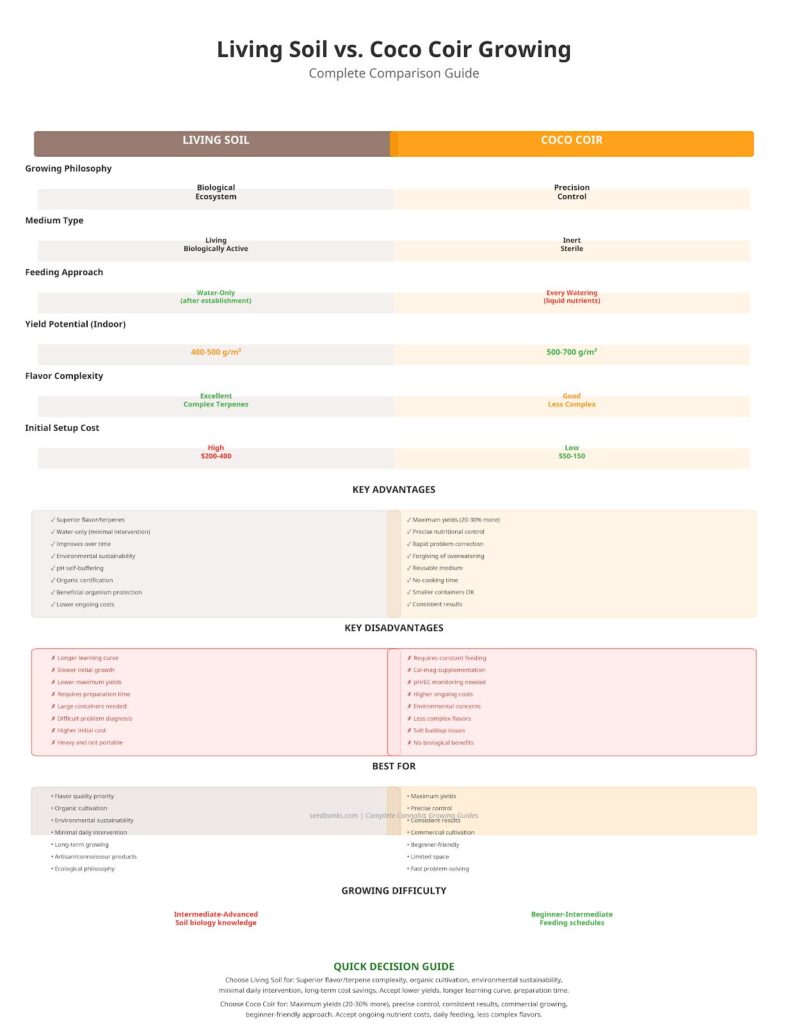
Comprehensive comparison of Living Soil and Coco Coir growing methods across all key factors
| Aspect | Living Soil | Coco Coir |
| Growing Philosophy | Biological ecosystem | Precision control |
| Medium Type | Living, biologically active | Inert, sterile |
| Nutrient Source | Organic amendments + soil food web | Liquid synthetic nutrients |
| Feeding Approach | Water-only (after establishment) | Every watering |
| pH Management | Self-buffering (minimal adjustment) | Requires monitoring and adjustment |
| Growth Rate | Moderate (slower early, faster late) | Fast (consistent throughout) |
| Yield Potential (Indoor) | 400-500 g/m² | 500-700 g/m² |
| Flavor Complexity | Excellent (complex terpenes) | Good (less complex) |
| Initial Setup Cost | High ($200-400) | Low ($50-150) |
| Ongoing Cost Per Cycle | Low ($20-50) | Moderate ($50-100) |
| Preparation Time | 2-4 weeks (cooking) | None (immediate use) |
| Container Size | Large (15+ gallons ideal) | Flexible (3-5+ gallons) |
| Learning Curve | Steep (soil biology) | Moderate (feeding schedules) |
| Problem Diagnosis | Difficult (complex interactions) | Easy (direct cause-effect) |
| Problem Correction | Slow (weeks) | Fast (days) |
| Reusability | Improves with reuse | Reusable with prep |
| Environmental Impact | Low (sustainable, local) | Moderate (imported, synthetic nutrients) |
| Organic Certification | Yes (meets standards) | No (synthetic nutrients) |
| Watering Frequency | Moderate (every 2-4 days) | High (daily or more) |
| Overwatering Risk | Moderate | Very low |
| Monitoring Requirements | Minimal (visual observation) | High (pH, EC, runoff) |
| Weight | Heavy | Light |
| Portability | Difficult (heavy, messy) | Easy (light, clean) |
| Best For | Flavor quality, organic growing, sustainability, minimal intervention | Maximum yields, precise control, consistent results, commercial growing |
Yield and Quality Comparison
Yield and quality represent key decision factors when choosing between living soil and coco coir. Each approach excels in different aspects of production.
Yield Comparison
Indoor Yields:
Living Soil:
- Per square meter: 400-500 grams (typical)
- Per plant: 100-200 grams (15-gallon container)
- Factors: Soil maturity, amendment quality, container size
- Timeline: 12-16 weeks (seed to harvest)
Coco Coir:
- Per square meter: 500-700 grams (typical)
- Per plant: 150-250 grams (5-gallon container)
- Factors: Feeding precision, strain genetics, environmental control
- Timeline: 11-15 weeks (seed to harvest)
Yield Advantage: Coco coir typically yields 20-30% more than living soil due to faster growth rates and more precise nutritional control.
Outdoor Yields:
Living Soil:
- Per plant: 500-1500 grams (depending on size and season)
- Advantages: Drought tolerance, soil improvement over season
- Challenges: Requires large containers or ground planting
Coco Coir:
- Per plant: 400-1200 grams (depending on size and season)
- Advantages: Precise control, consistent results
- Challenges: Requires frequent watering, potential salt buildup in heat
Outdoor Context: Yield differences narrow outdoors, with living soil sometimes matching or exceeding coco coir due to superior drought tolerance and larger practical container sizes.
Quality Comparison
Flavor and Terpene Profiles:
Living Soil:
- Complex, rich terpene profiles
- Subtle flavor nuances
- “Full-spectrum” taste
- Preferred by connoisseurs and competition growers
- Scientific basis: Diverse microbial metabolites incorporated into plant chemistry
Coco Coir:
- Clean, potent flavors
- Less complex terpene profiles
- “One-dimensional” taste (according to some growers)
- Excellent for potency-focused products
- Scientific basis: Synthetic nutrients provide complete but limited nutritional spectrum
Potency (THC/CBD): Both methods can produce maximum potency. Cannabinoid content depends primarily on genetics, environmental conditions, and harvest timing rather than growing medium. Well-grown cannabis in either medium can reach 25-30%+ THC.
Bag Appeal: Coco coir often produces denser buds with more uniform appearance, providing superior bag appeal for commercial markets. Living soil sometimes produces slightly airier buds, though this varies by strain and growing technique.
Smoothness: Many consumers report living soil cannabis produces smoother smoke with less harshness, possibly due to more complete nutrient uptake and less residual synthetic nutrients. However, proper flushing of coco-grown cannabis eliminates most smoothness differences.
Quality Recommendations
Choose Living Soil for Flavor: If flavor quality and terpene complexity are paramount (artisan products, personal use, competition entries), living soil consistently produces superior results.
Choose Coco Coir for Yield: If maximum production is the priority (commercial growing, personal supply maximization), coco coir’s 20-30% yield advantage is significant.
Consider Market: Commercial markets often prioritize potency and bag appeal over subtle flavor differences, favoring coco coir. Connoisseur markets value flavor complexity, favoring living soil.
Cost Analysis
Long-term costs differ significantly between living soil and coco coir due to different initial investments and ongoing expenses.
Initial Setup Costs
Living Soil Setup:
•Base ingredients (compost, peat/coco, perlite): $80-120
•Amendments (kelp, neem, rock dust, etc.): $60-100
•Biological inoculants (mycorrhizae, bacteria): $30-50
•Large containers (15-20 gallon fabric pots): $30-60
•Mulch and cover crop seeds: $20-30
•Total: $220-360
Coco Coir Setup:
- Coco coir (50L compressed brick): $15-30
- Base nutrients (1L bottles): $30-60
- Cal-mag supplement: $15-25
- pH adjustment solutions: $15-25
- pH meter: $15-50
- EC meter (optional but recommended): $20-60
- Containers (5-gallon fabric pots): $15-30
- Total: $125-280
Initial Cost Advantage: Coco coir costs $95-80 less initially, primarily due to smaller container requirements and no amendment purchases.
Ongoing Costs Per Cycle
Living Soil Ongoing:
- Compost for top-dressing: $10-20
- Amendment refreshment: $10-20
- Compost tea ingredients (optional): $5-10
- Water (dechlorinated if needed): $5-10
- Total per cycle: $30-60
Coco Coir Ongoing:
- Base nutrients: $30-60
- Cal-mag supplement: $10-20
- pH adjustment solutions: $5-10
- Replacement coco (every 3-5 cycles): $5-10 per cycle
- Water: $5-10
- Total per cycle: $55-110
Ongoing Cost Advantage: Living soil costs $25-50 less per cycle due to minimal nutrient purchases.
Long-Term Cost Comparison (5 Years, 15 Cycles)
Living Soil (5 Years):
- Initial setup: $220-360
- Ongoing costs (15 cycles × $45 average): $675
- Equipment replacement: $50
- Total 5-year cost: $945-1,085
- Cost per gram (assuming 450g average per cycle): $0.14-0.16
Coco Coir (5 Years):
- Initial setup: $125-280
- Ongoing costs (15 cycles × $82.50 average): $1,238
- Equipment replacement (pH/EC meters): $100
- Total 5-year cost: $1,463-1,618
- Cost per gram (assuming 600g average per cycle): $0.16-0.18
Long-Term Advantage: Living soil saves $518-533 over five years despite higher initial costs. However, when accounting for coco’s higher yields, cost per gram is similar.
Cost Recommendations
Choose Living Soil for Long-Term Savings: If you plan to grow continuously for years, living soil’s lower ongoing costs provide substantial savings despite higher initial investment.
Choose Coco Coir for Low Initial Investment: If upfront costs are a concern or you’re uncertain about long-term growing commitment, coco coir requires less initial capital.
Consider Cost Per Gram: When factoring in yield differences, cost per gram is similar between methods. Choose based on other priorities rather than cost alone.
Growing Difficulty and Learning Curve
The complexity and learning requirements differ significantly between living soil and coco coir cultivation.
Living Soil Learning Curve
Skill Level: Intermediate to Advanced
Required Knowledge:
- Soil biology and the soil food web
- Composting and organic matter decomposition
- Nutrient cycling and organic amendments
- Mycorrhizal relationships and beneficial organisms
- Soil structure and water management
- Ecological thinking and systems management
Key Challenges:
- Understanding biological processes rather than direct feeding
- Patience during soil establishment (2-4 weeks cooking, slower early growth)
- Diagnosing problems in complex biological systems
- Building quality soil from diverse ingredients
- Managing soil moisture without overwatering
- Accepting less precise control over nutrition
Time to Proficiency: Most growers achieve competence with living soil after 2-4 complete grows as they learn soil biology, amendment management, and ecosystem dynamics.
Advantages for Learning:
- Forgiving of minor mistakes (biological buffering)
- Improves over time (rewards patience and learning)
- Teaches ecological thinking applicable beyond cannabis
- Minimal daily management once established
Disadvantages for Learning:
- Steep initial learning curve (biological concepts)
- Slow feedback (problems develop and resolve slowly)
- Difficult to diagnose specific issues
- Requires patience (results take time)
Coco Coir Learning Curve
Skill Level: Beginner to Intermediate
Required Knowledge:
- Plant nutrition and NPK ratios
- pH management and adjustment
- EC monitoring and interpretation
- Feeding schedules and growth stages
- Runoff management and flushing
- Calcium-magnesium requirements in coco
Key Challenges:
- Mixing nutrients for every watering
- Monitoring pH and EC regularly
- Preventing calcium-magnesium deficiencies
- Managing salt buildup through flushing
- Adjusting feeding based on plant response
- Maintaining consistent watering schedule
Time to Proficiency: Most growers achieve competence with coco coir after 1-2 complete grows as they learn feeding schedules, pH management, and nutrient adjustment.
Advantages for Learning:
- Straightforward cause-and-effect (direct nutritional control)
- Fast feedback (problems and corrections manifest quickly)
- Easy problem diagnosis (nutrient-specific symptoms)
- Proven feeding schedules available
- Forgiving of overwatering
Disadvantages for Learning:
- Requires consistent attention (daily feeding and monitoring)
- Equipment requirements (pH and EC meters)
- Less forgiving of nutrient mistakes (no biological buffering)
- Ongoing management throughout grow cycle
Recommendations by Experience Level
Complete Beginners: Start with coco coir. The straightforward feeding approach, fast feedback, and proven schedules help beginners achieve success quickly. Once comfortable with basic cultivation, consider transitioning to living soil to expand skills.
Intermediate Growers: Either method works. Choose based on growing philosophy—coco coir for precision and yields, living soil for flavor and sustainability.
Advanced Growers: Many advanced growers use both methods strategically—living soil for premium small-batch products and coco coir for high-volume production.
Organic-Focused Growers: Living soil is the clear choice for growers committed to organic cultivation and sustainable practices.
Environmental Impact
Environmental considerations increasingly influence growing medium choices as cannabis cultivation’s ecological footprint receives scrutiny.
Living Soil Environmental Impact
Positive Impacts:
Carbon Sequestration: Living soil builds organic matter that sequesters atmospheric carbon. Each grow cycle adds organic matter to soil, creating a carbon sink rather than carbon source.
Renewable Inputs: Organic amendments (plant meals, rock dusts, compost) are renewable and often locally sourced, reducing transportation emissions.
No Chemical Runoff: Living soil produces no chemical runoff that could contaminate water supplies. Excess nutrients remain bound in organic matter or microbial biomass.
Biodiversity Support: The diverse microbial populations in living soil support broader ecosystem health and biodiversity.
Waste Reduction: Used living soil can be composted or used in gardens, creating no waste. The soil improves with use rather than requiring disposal.
Negative Impacts:
Initial Resource Use: Building living soil requires diverse inputs that may be shipped from distant locations, creating transportation emissions.
Water Use: Living soil in large containers requires significant water, though less than coco coir due to better water retention.
Coco Coir Environmental Impact
Positive Impacts:
Renewable Resource: Coco coir is a waste product of coconut processing, utilizing material that would otherwise be discarded or burned.
Peat Moss Alternative: Coco coir provides a sustainable alternative to peat moss, which is harvested from ancient peat bogs that take millennia to form.
Reusability: Coco coir can be reused for multiple grows, reducing resource consumption.
Negative Impacts:
Transportation Emissions: Most coco coir is imported from tropical regions (Sri Lanka, India, Philippines), creating significant transportation carbon footprint.
Synthetic Nutrient Production: The synthetic nutrients required for coco cultivation are petroleum-derived and energy-intensive to produce.
Chemical Runoff: Nutrient runoff from coco cultivation can contaminate water supplies with nitrogen, phosphorus, and other chemicals.
Labor Concerns: Some coco production involves poor labor practices and low wages in producing countries.
Disposal Challenges: Used coco coir disposal is problematic—while technically compostable, it takes years to break down and may contain synthetic nutrient residues.
Salt Accumulation: Synthetic nutrient salts can accumulate in soil if used coco is disposed of in gardens or compost.
Environmental Recommendations
Choose Living Soil for Sustainability: If environmental impact is a priority, living soil’s renewable inputs, carbon sequestration, and zero chemical runoff make it the clear choice.
Mitigate Coco’s Impact: If using coco coir, choose products from reputable sources with fair labor practices, reuse coco multiple times, and properly dispose of used coco.
Consider Local Sourcing: For both methods, prioritize locally-sourced inputs to reduce transportation emissions.
Flavor and Terpene Profiles
Flavor quality represents one of the most debated differences between living soil and coco coir cultivation, with passionate advocates on both sides.
The Flavor Debate
Living Soil Advocates Claim: Living soil produces superior flavor with more complex terpene profiles, subtle nuances, and “full-spectrum” taste. Many competition growers and artisan cultivators choose living soil specifically for flavor quality, accepting lower yields in exchange for exceptional taste.
Coco Coir Advocates Claim: Well-grown coco coir cannabis can match living soil flavor when properly flushed and cured. Any flavor differences are subtle and subjective, not justifying living soil’s lower yields and higher complexity.
Scientific Perspective: Limited scientific research directly compares flavor between growing methods. However, research on organic versus synthetic agriculture in other crops shows organic production sometimes increases secondary metabolite (including terpene) production due to plant stress responses and diverse microbial interactions.
Mechanisms for Flavor Differences
Diverse Microbial Metabolites: The complex microbial population in living soil produces diverse metabolites (organic acids, enzymes, hormones) that plants absorb and potentially incorporate into their own chemistry. This broader spectrum of available compounds may enable more complex terpene synthesis.
Nutrient Uptake Patterns: Living soil provides nutrients in organic forms that plants and microbes must break down, creating gradual, varied nutrient availability. This variability may trigger plant responses that increase secondary metabolite production. Coco coir provides consistent, optimal nutrition that maximizes growth but may not trigger these responses.
Stress Responses: Mild nutrient stress in living soil (compared to optimal nutrition in coco) may trigger plant defense responses that increase terpene production. Plants produce terpenes partially as defense compounds, and mild stress can enhance production.
Mycorrhizal Influences: Mycorrhizal fungi in living soil produce hormones and signaling compounds that influence plant metabolism. Research shows mycorrhizal plants sometimes produce different secondary metabolite profiles compared to non-mycorrhizal plants.
Consumer Perception Studies
Blind taste tests show mixed results. Some studies find consumers prefer living soil cannabis, while others find no significant preference. Preferences may depend on:
- Consumer experience level (connoisseurs more likely to detect differences)
- Specific strains tested (some strains show more pronounced differences)
- Growing skill (poorly grown living soil may taste worse than well-grown coco)
- Curing quality (proper curing reduces method differences)
Flavor Recommendations
Choose Living Soil for Maximum Flavor: If flavor quality is paramount and you’re willing to accept lower yields, living soil provides the best opportunity for exceptional taste.
Coco Coir Can Produce Excellent Flavor: Well-grown and properly flushed coco coir cannabis can be delicious and potent, satisfying most consumers.
Consider Your Market: Commercial markets often can’t justify living soil’s lower yields for subtle flavor improvements. Artisan markets and personal use can justify the trade-off.
Proper Technique Matters More: Growing skill, genetics, environmental control, harvest timing, and curing quality affect flavor more than growing medium. Master your chosen method rather than assuming medium alone determines flavor.
Choosing Between Living Soil and Coco Coir
The choice between living soil and coco coir depends on your specific priorities, constraints, and growing philosophy.
Decision Framework
What is your primary goal?
Maximum Yields:
- Choose Coco Coir: 20-30% higher yields make coco the clear choice for production-focused growing.
Maximum Flavor Quality:
- Choose Living Soil: Superior terpene complexity and flavor nuances make living soil ideal for connoisseur products.
Simplicity and Minimal Intervention:
- Choose Living Soil: Water-only approach after establishment requires minimal daily management.
Precise Control and Consistency:
- Choose Coco Coir: Direct nutritional control provides consistent, predictable results.
What is your experience level?
Beginner:
- Choose Coco Coir: Straightforward feeding approach and fast feedback help beginners succeed quickly.
Intermediate:
- Either Works: Choose based on other priorities.
Advanced:
- Consider Both: Many advanced growers use both methods strategically for different purposes.
What is your growing philosophy?
Organic and Sustainable:
- Choose Living Soil: Meets organic standards and provides sustainable cultivation.
Scientific and Precision-Focused:
- Choose Coco Coir: Provides measurable control and optimization opportunities.
Ecological and Holistic:
- Choose Living Soil: Ecosystem approach aligns with holistic growing philosophy.
What are your space constraints?
Limited Space (Small Containers):
- Choose Coco Coir: Performs well in 3-5 gallon containers.
Ample Space (Large Containers Possible):
- Either Works: Living soil benefits from 15+ gallon containers but both methods work.
What is your time availability?
Limited Daily Time:
- Choose Living Soil: Water-only approach requires minimal daily management after establishment.
Willing to Invest Daily Time:
- Choose Coco Coir: Daily feeding and monitoring optimize results.
What is your budget?
Limited Initial Budget:
- Choose Coco Coir: Lower startup costs ($125-280 vs $220-360).
Long-Term Growing Planned:
- Choose Living Soil: Lower ongoing costs provide savings over multiple years.
What is your market?
Commercial/Dispensary:
- Choose Coco Coir: Higher yields and consistent results suit commercial production.
Artisan/Connoisseur:
- Choose Living Soil: Superior flavor quality justifies lower yields for premium markets.
Personal Use:
- Either Works: Choose based on personal priorities and preferences.
Hybrid Approaches
Many growers successfully combine both methods:
Living Soil for Mother Plants: Maintain mother plants in living soil for superior health and vigor, while growing production plants in coco coir for maximum yields.
Living Soil for Small Batches: Use living soil for small-batch artisan products while using coco coir for volume production.
Seasonal Switching: Some growers use living soil outdoors (large containers practical, water-only convenient) and coco coir indoors (precise control, smaller containers).
Frequently Asked Questions
Can I use synthetic nutrients in living soil?
Technically yes, but it defeats the purpose and can harm beneficial organisms. Synthetic nutrients provide immediately available nutrition that bypasses the soil food web, making the biological ecosystem unnecessary. Additionally, high salt concentrations in synthetic nutrients can harm or kill beneficial microbes. If you want to use synthetic nutrients, choose coco coir or another inert medium designed for that approach.
Can I add beneficial microbes to coco coir?
Yes, and many growers do. Adding mycorrhizal fungi and beneficial bacteria to coco coir can improve nutrient uptake, root health, and pathogen resistance. However, coco coir doesn’t provide the organic matter and ecosystem complexity that supports diverse microbial populations like living soil. Beneficial organisms in coco require regular reapplication and may not establish permanent populations.
How long does living soil last?
Indefinitely with proper maintenance. Living soil improves with each cycle as microbial populations mature and organic matter accumulates. Many growers use the same living soil for 5-10+ years, simply adding compost and amendments between cycles. The soil becomes increasingly productive over time rather than degrading.
Can I mix coco coir with living soil?
Yes, many living soil recipes include coco coir (or peat moss) as the water-retention component (typically 30-40% by volume). Coco coir in living soil provides physical structure and water retention while the compost and amendments provide nutrition and biology. However, don’t try to use this mix with synthetic nutrients—choose either the living soil approach (organic amendments) or pure coco with synthetic nutrients.
Why does coco coir need cal-mag supplementation?
Coco coir’s cation exchange capacity naturally binds calcium and magnesium while releasing potassium and sodium. This means coco constantly removes calcium and magnesium from nutrient solution, making these elements unavailable to plants even when present in base nutrients. Supplemental cal-mag at 3-5ml per gallon compensates for this binding, ensuring adequate calcium and magnesium availability.
Can I grow organic cannabis in coco coir?
Technically yes, using organic liquid nutrients (fish emulsion, kelp extracts, etc.) instead of synthetic nutrients. However, this approach combines coco’s disadvantages (ongoing nutrient costs, frequent feeding) with organic nutrients’ disadvantages (less precise control, potential odor) while losing coco’s main advantage (precision). If you want organic cultivation, living soil provides better results with less complexity.
How do I know when to water living soil?
Water when the top 1-2 inches of soil become dry. Stick your finger into the soil—if it feels dry at finger depth, water thoroughly until slight runoff. Living soil should not be kept constantly moist like coco coir. Allow periodic drying to promote beneficial aerobic organisms and prevent anaerobic conditions. Container weight is also a good indicator—lift containers when dry and when freshly watered to learn the weight difference.
Can I reuse coco coir?
Yes, quality coco coir can be reused for 3-5 grows with proper preparation. After harvest, remove root mass, flush thoroughly with water to remove salt buildup, re-buffer with calcium-magnesium solution, adjust pH, and coco is ready for replanting. Some growers add 20-30% fresh coco each cycle to maintain structure. Eventually coco breaks down and should be replaced.
Why does living soil grow slower initially?
Living soil provides nutrients in organic forms that must be broken down by microorganisms before plants can absorb them. This biological process takes time, resulting in slower early growth compared to synthetic nutrients’ immediate availability. However, growth rates equalize later in the cycle as the soil food web matures and nutrient cycling accelerates. Many growers report living soil plants show stronger growth in late vegetative and flowering stages.
What pH should I use for living soil vs coco coir?
Living soil: 6.0-7.0 (optimal 6.3-6.8). The diverse microbial population and organic matter provide excellent pH buffering, so precise pH management is unnecessary. Most growers simply use water without pH adjustment unless their source water is extremely acidic or alkaline.
Coco coir: 5.8-6.2 (optimal 5.9-6.0). Coco requires precise pH management as it has minimal buffering capacity. Always pH-adjust nutrient solution after mixing nutrients, and periodically check runoff pH to ensure coco itself maintains proper pH.
References
1.Rillig, M. C., & Mummey, D. L. (2006). Mycorrhizas and soil structure. New Phytologist, 171(1), 41-53. https://doi.org/10.1111/j.1469-8137.2006.01750.x
2.Bender, S. F., Wagg, C., & van der Heijden, M. G. (2016). An underground revolution: Biodiversity and soil ecological engineering for agricultural sustainability. Trends in Ecology & Evolution, 31(6), 440-452. https://doi.org/10.1016/j.tree.2016.02.016
3.Ingham, E. R. (2009). The Soil Food Web. In Soil Biology and Agriculture in the Tropics (pp. 77-97). Springer, Berlin, Heidelberg.
4.Prasad, M., & Maher, M. J. (2001). The use of composted green waste (CGW) as a growing medium component. Acta Horticulturae, 549, 107-114. https://doi.org/10.17660/ActaHortic.2001.549.11
5.Noguera, P., Abad, M., Puchades, R., Maquieira, A., & Noguera, V. (2000). Influence of particle size on physical and chemical properties of coconut coir dust as container medium. Communications in Soil Science and Plant Analysis, 31(5-6), 795-811. https://doi.org/10.1080/00103620009370473
6.Abad, M., Noguera, P., Puchades, R., Maquieira, A., & Noguera, V. (2002). Physico-chemical and chemical properties of some coconut coir dusts for use as a peat substitute for containerised ornamental plants. Bioresource Technology, 82(3), 241-245. https://doi.org/10.1016/S0960-8524(01)00189-4
7.Awang, Y., Shaharom, A. S., Mohamad, R. B., & Selamat, A. (2009). Chemical and physical characteristics of cocopeat-based media mixtures and their effects on the growth and development of Celosia cristata. American Journal of Agricultural and Biological Sciences, 4(1), 63-71.
8.Caplan, D., Dixon, M., & Zheng, Y. (2017). Optimal rate of organic fertilizer during the vegetative-stage for cannabis grown in two coir-based substrates. HortScience, 52(9), 1307-1312. https://doi.org/10.21273/HORTSCI11903-17
9.Caplan, D., Dixon, M., & Zheng, Y. (2019). Increasing inflorescence dry weight and cannabinoid content in medical cannabis using controlled drought stress. HortScience, 54(5), 964-969. https://doi.org/10.21273/HORTSCI13510-18
10.Magagnini, G., Grassi, G., & Kotiranta, S. (2018). The effect of light spectrum on the morphology and cannabinoid content of Cannabis sativa L. Medical Cannabis and Cannabinoids, 1(1), 19-27. https://doi.org/10.1159/000489030
11.Shiponi, S., & Bernstein, N. (2021). The highs and lows of P supply in medical cannabis: Effects on cannabinoids, the ionome, and morpho-physiology. Frontiers in Plant Science, 12, 657323. https://doi.org/10.3389/fpls.2021.657323
12.Saloner, A., & Bernstein, N. (2021). Nitrogen supply affects cannabinoid and terpenoid profile in medical cannabis (Cannabis sativa L.). Industrial Crops and Products, 167, 113516. https://doi.org/10.1016/j.indcrop.2021.113516
13.Bernstein, N., Gorelick, J., & Koch, S. (2019). Interplay between chemistry and morphology in medical cannabis (Cannabis sativa L.). Industrial Crops and Products, 129, 185-194. https://doi.org/10.1016/j.indcrop.2018.11.039