
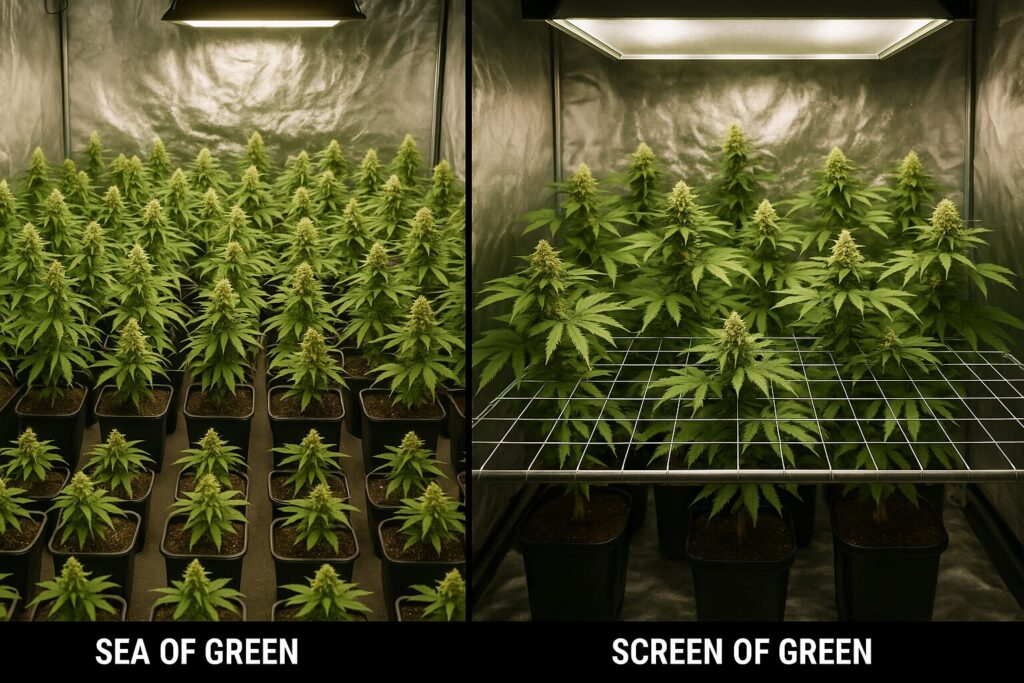
Split-screen comparison: SOG vs SCROG
Table of Contents
Key Takeaways
- SOG Maximizes Plant Numbers, SCROG Maximizes Plant Size: Sea of Green (SOG) achieves high yields by growing many small plants (9-16 per square meter) with minimal vegetative time, creating a uniform canopy of single-cola plants. Screen of Green (SCROG) achieves similar yields by growing fewer large plants (1-4 per square meter) trained horizontally under a screen to create multiple colas per plant. Both methods optimize light distribution and canopy uniformity, but through opposite approaches—SOG uses quantity, SCROG uses training.
- SOG Provides Faster Harvests, SCROG Provides Flexibility: SOG’s minimal vegetative period (1-2 weeks from rooted clone) enables harvests in 9-11 weeks total, making it the fastest high-yield method for photoperiod cannabis. However, SOG requires continuous clone production and offers no recovery time for mistakes. SCROG’s extended vegetative period (4-6 weeks) allows time for training, stress recovery, and problem correction, providing flexibility that SOG lacks. Choose SOG for speed, SCROG for forgiveness.
- Plant Count Limits Favor SCROG in Restrictive Jurisdictions: In jurisdictions with strict plant count limits (6-12 plants), SCROG provides legal compliance while maintaining high yields through intensive training of few plants. SOG’s 9-16+ plants per square meter often exceeds legal limits, making it impractical in restrictive areas. For legal home growers in most jurisdictions, SCROG offers the only viable high-yield approach within plant count restrictions.
- SOG Requires Cloning, SCROG Works from Seed: SOG depends on uniform genetics from clones—growing from seed produces inconsistent plant sizes that disrupt canopy uniformity. This cloning requirement means maintaining mother plants and mastering propagation. SCROG tolerates genetic variation better, as training compensates for size differences between plants. Growers can SCROG from seed, though clones still provide more predictable results.
- SCROG Maximizes Light Efficiency, SOG Maximizes Turnover: SCROG creates a perfectly level canopy where every bud site receives optimal light, maximizing photosynthetic efficiency and bud development. The horizontal training exposes lower branches to direct light, converting them into substantial colas. SOG accepts some light penetration loss to lower buds in exchange for rapid turnover—harvest every 9-11 weeks versus 12-16 weeks for SCROG. Choose SCROG for maximum quality per plant, SOG for maximum harvests per year.
- Both Methods Require Photoperiod Cannabis: SOG and SCROG work exclusively with photoperiod cannabis that allows vegetative control. Autoflowers’ age-based flowering prevents the vegetative manipulation both methods require—SOG needs brief vegetative periods with uniform timing, SCROG needs extended vegetative periods for training. For autoflowers, use simple low-stress training instead of SOG or SCROG.
Introduction: Understanding Canopy Management Techniques
Cannabis cultivation success depends heavily on canopy management—how growers arrange plants to maximize light exposure, optimize space utilization, and achieve uniform bud development. Two advanced canopy management techniques dominate high-yield indoor cultivation: Sea of Green (SOG) and Screen of Green (SCROG). Despite similar names and shared goals (uniform canopy, maximum yields), these methods represent fundamentally different approaches to cannabis cultivation.
The Canopy Management Challenge:
Indoor cannabis growing faces a fundamental constraint: artificial lighting provides limited penetration compared to the sun. HID and LED grow lights deliver maximum intensity at canopy level, with light intensity dropping dramatically with distance (following the inverse square law). Buds more than 12-18 inches below the canopy receive insufficient light for proper development, producing small, airy “popcorn buds” with minimal value.
Traditional growing methods—allowing plants to grow naturally with minimal training—produce Christmas tree-shaped plants with a dominant central cola and progressively smaller buds on lower branches. This natural structure wastes light and space, as the lower two-thirds of the plant receives inadequate illumination while the upper canopy blocks light from reaching lower growth.
Advanced growers solve this problem through canopy management techniques that create level, uniform canopies where every bud site receives optimal light. Both SOG and SCROG achieve this goal but through opposite strategies.
The SOG Approach: Quantity Over Size
Sea of Green creates uniform canopies by growing many small plants with minimal vegetative time. Instead of allowing plants to develop into large, branchy structures, SOG growers flower clones after just 1-2 weeks of vegetative growth. This brief vegetative period produces small plants (12-18 inches tall) dominated by a single main cola with minimal side branching.
By packing many of these single-cola plants closely together (9-16 per square meter), SOG creates a “sea” of uniform colas at canopy level. The high plant density eliminates wasted space, and the minimal vegetative time enables rapid harvests. SOG trades individual plant size for plant numbers and turnover speed.
The SCROG Approach: Training Over Numbers
Screen of Green creates uniform canopies by training fewer large plants horizontally under a screen or net. During an extended vegetative period (4-6 weeks), growers weave growing branches through screen openings, forcing horizontal growth. This training creates a level canopy where dozens of branch tips reach the screen and receive direct light.
When flowering begins, these trained branch tips develop into substantial colas—a single SCROG plant might produce 20-40 cola-sized buds instead of one dominant cola. By maximizing individual plant productivity through intensive training, SCROG achieves high yields with few plants. SCROG trades plant numbers and speed for training time and per-plant productivity.
Historical Context:
Both methods emerged in the 1990s as indoor cannabis cultivation evolved. SOG developed first, borrowed from commercial horticulture techniques used for crops like strawberries. SCROG emerged later as growers in restrictive legal environments sought high yields while respecting plant count limits. Today, both methods remain popular in different contexts—SOG dominates commercial cultivation where plant counts aren’t restricted, while SCROG dominates home growing in jurisdictions with plant limits.
Current Applications:
Modern cannabis cultivation uses both methods strategically. Commercial operations often prefer SOG for its rapid turnover and scalability. Home growers typically prefer SCROG for legal compliance and lower plant numbers. Some growers combine elements of both approaches, creating hybrid techniques optimized for specific situations.
This comprehensive guide examines SOG and SCROG from practical and scientific perspectives. We’ll explore implementation details, compare yields and efficiency, analyze legal implications, and provide decision frameworks to help you choose the method best suited to your specific situation and constraints.
For premium genetics suitable for both training methods, explore quality seeds at seedbanks.com and weed.de, featuring selections from Official Cannabis Seeds, Blue Dream, and Sour Diesel.
Understanding Sea of Green (SOG)
Sea of Green represents a high-density, rapid-turnover cultivation method that maximizes yields through plant numbers rather than individual plant size.
What is Sea of Green?
Sea of Green (SOG) is a cultivation technique where many small cannabis plants are grown in close proximity with minimal vegetative time, creating a uniform canopy of single-cola plants. Instead of growing a few large plants, SOG grows many small plants (typically 9-16 per square meter) that flower after just 1-2 weeks of vegetative growth.
Key Characteristics:
High Plant Density: 9-16 plants per square meter (1-2 plants per square foot)
Minimal Vegetative Time: 1-2 weeks from rooted clone to flowering
Single-Cola Dominance: Plants develop one main cola with minimal side branching
Uniform Genetics: Requires clones from a single mother plant for consistent growth
Rapid Turnover: Total cycle of 9-11 weeks from rooted clone to harvest
No Training Required: Plants grow naturally without topping, FIMing, or other interventions
How SOG Works
SOG exploits cannabis’s apical dominance—the tendency for the main growing tip to dominate growth and suppress side branches. By flowering plants while still small (12-18 inches tall), SOG prevents significant side branch development, channeling all growth energy into a single dominant cola.
The SOG Process:
Step 1: Clone Production (2-3 weeks) Take cuttings from a mother plant maintained in vegetative state. Root clones in propagation dome or tray. This step occurs continuously to maintain supply for perpetual harvests.
Step 2: Brief Vegetative Period (1-2 weeks) Once rooted, transplant clones to small containers (1-2 gallons). Provide 18/6 light schedule for 1-2 weeks, allowing plants to establish root systems and reach 6-8 inches tall. Minimal vegetative time prevents side branch development.
Step 3: Flowering (8-9 weeks) Switch to 12/12 light schedule to trigger flowering. Plants stretch to 12-18 inches final height while developing a single dominant cola. High plant density ensures complete canopy coverage despite small individual plant size.
Step 4: Harvest Harvest entire canopy when mature (typically 8-9 weeks into flowering). Total time from rooted clone to harvest: 9-11 weeks.
Step 5: Replant Immediately replant with new rooted clones to begin next cycle. Perpetual SOG operations harvest every 8-9 weeks continuously.
Light Distribution:
SOG’s uniform canopy height ensures all colas receive similar light intensity. The high plant density eliminates gaps where light would reach the floor, maximizing light utilization. However, light penetration to lower growth is minimal—SOG accepts this trade-off for rapid turnover.
Space Efficiency:
SOG maximizes space utilization through high plant density. Every square inch of grow space contains productive canopy. Small containers (1-2 gallons) allow tight spacing without root competition.
Ideal Strains for SOG
Indica-Dominant Strains: Indica genetics naturally exhibit compact structure, minimal side branching, and short flowering times—ideal for SOG. Recommended indica-dominant strains:
- Northern Lights (classic SOG strain, 7-8 week flower)
- Critical Mass (heavy yields, 8 week flower)
- Afghani (pure indica, dense buds, 8 week flower)
- Bubba Kush (compact structure, 8-9 week flower)
Hybrid Strains with Indica Dominance:
- White Widow (60% indica, 8-9 week flower)
- AK-47 (65% sativa but compact, 8-9 week flower)
- Girl Scout Cookies (60% indica, 9-10 week flower)
Avoid:
- Pure sativas (excessive stretch, long flowering, heavy branching)
- Stretchy hybrids (exceed height limits, uneven canopy)
- Long-flowering strains (negate SOG’s speed advantage)
Clone Consistency: SOG requires uniform genetics. All plants must grow at identical rates and reach the same height to maintain canopy uniformity. Clones from a single mother plant provide this consistency—growing from seed produces variation that disrupts SOG.
Advantages of SOG
Fastest Harvest Cycles: SOG provides the shortest time from start to harvest for photoperiod cannabis—just 9-11 weeks from rooted clone to harvest. This rapid turnover enables 4-5 harvests per year compared to 2-3 for traditional methods.
No Training Required: SOG plants grow naturally without topping, FIMing, LST, or other training techniques. This simplicity saves time and eliminates training-related stress or mistakes.
Efficient Light Utilization: The uniform, level canopy ensures all colas receive optimal light. No light is wasted penetrating to lower growth or reaching the floor between plants.
Predictable, Consistent Results: Using clones from proven mother plants provides genetic consistency and predictable results. Every plant performs identically, simplifying management and harvest planning.
Scalable: SOG scales easily to any space size. Simply multiply plant numbers proportionally—a 2×2 tent might hold 16 plants, while a commercial room might hold hundreds.
Lower Individual Plant Value: If a single plant experiences problems (disease, pests, accidents), it represents a small fraction of total yield. This distributed risk contrasts with SCROG where losing one plant significantly impacts harvest.
Continuous Harvests: With proper planning, SOG enables perpetual harvests. Stagger planting dates so a new batch reaches harvest every 2-3 weeks, providing continuous supply.
Easier Pest Management: Small plants in small containers can be easily moved, inspected, and treated for pests. Isolation of affected plants prevents spread to the entire crop.
Disadvantages of SOG
High Plant Counts: SOG’s 9-16 plants per square meter often exceeds legal plant count limits. In jurisdictions restricting cultivation to 6-12 plants, SOG is impractical or illegal for home growers.
Cloning Requirement: SOG requires maintaining mother plants and continuously producing clones. This adds complexity, requires separate vegetative space, and demands cloning skills. Growing from seed is impractical due to genetic variation.
No Mistake Recovery Time: The brief 1-2 week vegetative period provides no time to recover from problems. Nutrient issues, pests, or other problems directly impact yields with no opportunity for correction.
Higher Initial Plant Costs: Starting SOG requires many plants (16-32+ for a small tent). If purchasing clones, costs accumulate quickly at $10-20 per clone.
Container Management: Managing 16+ small containers requires more effort than managing 4 large containers. Watering, feeding, and monitoring multiply with plant numbers.
Genetic Limitation: SOG commits you to a single strain (the mother plant genetics). Variety requires maintaining multiple mother plants or switching entire operations between strains.
Lower Per-Plant Yields: Individual SOG plants yield only 25-50 grams each. While total yields per square meter are high, per-plant productivity is low compared to SCROG’s 100-200+ grams per plant.
Waste of Vegetative Growth Potential: Cannabis can grow much larger than SOG allows. Some growers view SOG as wasteful, not fully utilizing each plant’s genetic potential.
SOG Setup and Implementation
Space Requirements:
- Minimum: 2×2 feet (4 square feet) = 9-16 plants
- Typical: 4×4 feet (16 square feet) = 36-64 plants
- Commercial: Any size, scale proportionally
Container Size:
- 1-2 gallon pots (small containers sufficient for brief growth)
- Fabric pots recommended for better aeration
- Square pots maximize space utilization
Plant Spacing:
- 9 plants per square meter: 12×12 inch spacing
- 16 plants per square meter: 9×9 inch spacing
- Closer spacing increases yields but complicates management
Lighting:
- 400-600W HPS or LED per square meter
- Lights positioned close to canopy (12-18 inches)
- Even light distribution critical for uniform growth
Vegetative Space:
- Separate space for mother plants (18/6 light schedule)
- Propagation area for rooting clones
- Can be small (2×2 feet sufficient for home operations)
Timeline:
- Week 0: Take clones from mother
- Weeks 1-2: Root clones in propagation dome
- Weeks 3-4: Brief vegetative growth (18/6)
- Weeks 5-13: Flowering (12/12)
- Week 13: Harvest, replant immediately
Nutrient Management:
- Light feeding during brief vegetative period
- Standard flowering nutrients
- Small containers require frequent watering/feeding
Understanding Screen of Green (SCROG)
Screen of Green represents a low-density, training-intensive cultivation method that maximizes yields through horizontal canopy development and intensive plant training.
What is Screen of Green?
Screen of Green (SCROG) is a cultivation technique where few cannabis plants (typically 1-4 per square meter) are trained horizontally under a screen or net during an extended vegetative period, creating a level canopy of multiple colas per plant. The screen forces horizontal growth, exposing lower branches to direct light and converting them into substantial bud sites.
Key Characteristics:
- Low Plant Density: 1-4 plants per square meter
- Extended Vegetative Time: 4-6 weeks of vegetative growth
- Intensive Training: Daily weaving of branches through screen openings
- Multiple Colas Per Plant: 20-40+ cola-sized buds per plant
- Longer Total Cycle: 12-16 weeks from seed/clone to harvest
- Screen Infrastructure: Horizontal net or screen 8-12 inches above pots
How SCROG Works
SCROG exploits cannabis’s ability to redirect growth hormones when branches are bent horizontally. Normally, apical dominance concentrates growth in the main growing tip. When this tip is bent below horizontal, the plant redistributes growth hormones to lower branches, causing them to grow upward toward light.
The SCROG Process:
Step 1: Vegetative Growth (4-6 weeks) Grow plants in vegetative state (18/6 light) for 4-6 weeks, allowing substantial size development. During this period, install screen 8-12 inches above container tops.
Step 2: Training (Weeks 3-6 of Vegetative) As plants grow through screen openings, gently bend and weave branches horizontally under the screen, forcing them to grow through adjacent openings. This creates a horizontal canopy where dozens of branch tips reach screen level.
Step 3: Canopy Filling (Weeks 5-6 of Vegetative) Continue training until screen is 70-80% filled with evenly distributed branch tips. Ensure uniform spacing—each screen opening should contain one growing tip.
Step 4: Flowering (8-10 weeks) Switch to 12/12 light schedule. Plants stretch during early flowering (weeks 1-2), with all trained branch tips growing vertically through screen openings. Continue tucking new growth under screen during stretch period.
Step 5: Bud Development (Weeks 3-10 of Flowering) Stop training once stretch ends. All branch tips above screen develop into substantial colas. Lower growth below screen receives minimal light and produces small buds.
Step 6: Harvest (Week 12-16 total) Harvest when mature. Total time from seed/clone to harvest: 12-16 weeks.
Light Distribution:
SCROG creates a perfectly level canopy where every cola receives equal light intensity. The horizontal training exposes lower branches to direct light, converting them into productive colas instead of shaded popcorn buds. Light penetration below the screen is minimal, but this is acceptable since all productive growth occurs above the screen.
Space Efficiency:
SCROG maximizes space utilization through horizontal canopy development. A single plant can fill an entire square meter of screen space, eliminating gaps and ensuring complete light utilization.
Ideal Strains for SCROG
Sativa-Dominant Strains: Sativa genetics naturally exhibit vigorous branching, stretch, and flexibility—ideal for SCROG training. Recommended sativa-dominant strains:
- Sour Diesel (stretchy, responds well to training)
- Jack Herer (vigorous branching, 9-10 week flower)
- Amnesia Haze (extreme stretch, perfect for SCROG)
- Super Silver Haze (heavy branching, 10-11 week flower)
Hybrid Strains:
- Blue Dream (balanced hybrid, excellent for SCROG)
- Girl Scout Cookies (responds well to training despite indica dominance)
- Gorilla Glue #4 (vigorous growth, heavy yields)
- Wedding Cake (good branching, dense buds)
Avoid:
- Extremely compact indicas (minimal branching limits SCROG effectiveness)
- Autoflowers (age-based flowering prevents extended vegetative training)
- Brittle strains (branches snap during training)
Flexibility Matters: SCROG requires flexible branches that bend without breaking. Some indica strains have brittle branches that snap during training, making them unsuitable for SCROG.
Advantages of SCROG
Legal Compliance: SCROG’s low plant count (1-4 plants per square meter) complies with plant limits in most jurisdictions. Home growers can achieve high yields while respecting legal restrictions.
Maximum Light Efficiency: The level canopy ensures every bud site receives optimal light. SCROG arguably provides the most efficient light utilization of any growing method.
High Per-Plant Yields: Individual SCROG plants yield 100-200+ grams each—far exceeding SOG’s 25-50 grams per plant. This high per-plant productivity maximizes yields within plant count limits.
Works from Seed: While clones provide more predictable results, SCROG tolerates genetic variation better than SOG. Training compensates for size differences between plants, making seed growing viable.
Stress Recovery Time: The extended vegetative period (4-6 weeks) provides ample time to recover from stress, correct nutrient problems, or address pest issues before flowering begins.
Genetic Variety: With only 1-4 plants per grow, you can easily grow multiple strains simultaneously. This variety suits personal growers who want diverse products.
Lower Ongoing Plant Costs: Growing from seed eliminates the need for continuous clone production and mother plant maintenance. Purchase seeds once and grow, rather than maintaining perpetual clone operations.
Impressive Results: A well-executed SCROG produces visually impressive results—a perfectly level canopy of uniform colas. Many growers find SCROG aesthetically satisfying.
Disadvantages of SCROG
Labor Intensive: SCROG requires daily training during vegetative growth—weaving branches through screen openings, adjusting growth direction, and maintaining canopy uniformity. This hands-on management demands significant time.
Longer Time to Harvest: SCROG’s 12-16 week total cycle is significantly longer than SOG’s 9-11 weeks. This extended timeline reduces annual harvest frequency to 2-3 crops per year.
Difficult Problem Management: Once plants are woven through the screen, moving them becomes nearly impossible. Pest treatment, container repositioning, or plant removal requires either cutting the screen or carefully unweaving branches—both time-consuming and risky.
All Eggs in Few Baskets: With only 1-4 plants, losing a single plant to disease, pests, or accidents significantly impacts total yield. This concentrated risk contrasts with SOG’s distributed risk across many plants.
Requires Training Skills: Effective SCROG demands understanding of plant training, growth patterns, and canopy management. Beginners often struggle with proper weaving technique and canopy filling.
Screen Infrastructure: SCROG requires installing screens or nets, adding setup complexity and equipment costs. Screens must be sturdy enough to support heavy flowering buds without sagging.
Strain-Dependent Results: SCROG effectiveness varies significantly by strain. Compact indicas with minimal branching produce fewer colas than stretchy sativas, reducing SCROG’s yield advantage.
Vegetative Space Requirements: The extended vegetative period requires maintaining 18/6 light schedule for 4-6 weeks. Growers using a single space must wait longer between harvests compared to SOG’s rapid turnover.
SCROG Setup and Implementation
Space Requirements:
- Minimum: 2×2 feet (4 square feet) = 1-2 plants
- Typical: 4×4 feet (16 square feet) = 2-4 plants
- Any size works, scale plant numbers proportionally
Container Size:
- 5-10 gallon pots (large containers support extended growth)
- Fabric pots recommended for aeration
- Larger containers produce larger plants and higher yields
Screen Setup:
- Install screen 8-12 inches above container tops
- Use trellis netting (4-6 inch squares) or DIY PVC frame with string
- Ensure screen is level and securely anchored
- Screen must support heavy flowering buds without sagging
Plant Spacing:
- 1 plant per square meter: Maximum per-plant size
- 2-4 plants per square meter: Faster canopy filling
- More plants = faster filling but more training complexity
Lighting:
- 400-600W HPS or LED per square meter
- Position lights 18-24 inches above screen during flowering
- Adjust height as canopy develops
Timeline:
- Weeks 1-2: Seedling or clone establishment
- Weeks 3-6: Vegetative growth with training (18/6)
- Weeks 7-8: Flowering stretch with continued training (12/12)
- Weeks 9-16: Bud development (12/12)
- Week 16: Harvest
Training Technique:
- When branch grows 2-3 inches above screen, gently bend it horizontally under screen
- Weave branch through adjacent screen opening
- Repeat daily, spreading growth evenly across screen
- Maintain 70-80% screen coverage (don’t overfill)
- Stop training when flowering stretch ends (week 2-3 of flower)
Defoliation:
- Remove large fan leaves blocking light to lower canopy
- Defoliate during early flowering to improve light penetration
- Don’t over-defoliate—leaves drive photosynthesis
Side-by-Side Comparison Table
Comprehensive comparison of Sea of Green and Screen of Green training methods across all key factors
| Aspect | Sea of Green (SOG) | Screen of Green (SCROG) |
| Plants Per Square Meter | 9-16 plants | 1-4 plants |
| Container Size | 1-2 gallons | 5-10 gallons |
| Vegetative Time | 1-2 weeks | 4-6 weeks |
| Flowering Time | 8-9 weeks | 8-10 weeks |
| Total Time (Clone/Seed to Harvest) | 9-11 weeks | 12-16 weeks |
| Training Required | None (natural growth) | Intensive (daily weaving) |
| Colas Per Plant | 1 main cola | 20-40+ colas |
| Yield Per Plant | 25-50 grams | 100-200+ grams |
| Yield Per Square Meter | 400-600 grams | 400-600 grams |
| Harvests Per Year | 4-5 | 2-3 |
| Annual Yield Per Square Meter | 1600-3000 grams | 800-1800 grams |
| Ideal Strains | Indica-dominant | Sativa-dominant |
| Clone vs Seed | Requires clones | Works with either |
| Legal Plant Count | High (9-16+) | Low (1-4) |
| Setup Complexity | Low (just containers) | Moderate (screen installation) |
| Daily Labor | Low (watering only) | High (training required) |
| Mistake Recovery Time | None (no time) | Excellent (4-6 weeks veg) |
| Problem Management | Easy (move individual plants) | Difficult (plants woven in screen) |
| Risk Distribution | Distributed (many plants) | Concentrated (few plants) |
| Genetic Variety | Single strain | Multiple strains possible |
| Mother Plant Requirement | Yes (continuous clones) | No (can grow from seed) |
| Space for Mothers | Required | Not required |
| Skill Level | Intermediate | Advanced |
| Best For | Commercial growing, rapid turnover, no plant limits | Home growing, legal compliance, plant count limits |
Yield Comparison
Both SOG and SCROG can produce similar yields per square meter (400-600 grams), but through different mechanisms and with different implications for annual productivity.
Per Square Meter Yields
SOG Yields:
- Plants per square meter: 9-16
- Yield per plant: 25-50 grams
- Total per square meter: 400-600 grams (typical)
- Factors: Plant density, vegetative time, strain selection
- Consistency: High (clones provide uniform results)
SCROG Yields:
- Plants per square meter: 1-4
- Yield per plant: 100-200+ grams
- Total per square meter: 400-600 grams (typical)
- Factors: Training effectiveness, vegetative time, strain selection
- Consistency: Moderate (varies with training skill)
Single Harvest Comparison: For a single harvest, SOG and SCROG produce similar yields per square meter. The methods achieve equivalent results through opposite approaches—SOG through plant numbers, SCROG through per-plant productivity.
Annual Productivity
The time difference between methods significantly impacts annual yields:
SOG Annual Production:
- Cycle time: 9-11 weeks
- Harvests per year: 4-5
- Yield per harvest: 500 grams per square meter (average)
- Annual yield: 2000-2500 grams per square meter
SCROG Annual Production:
- Cycle time: 12-16 weeks
- Harvests per year: 2-3
- Yield per harvest: 500 grams per square meter (average)
- Annual yield: 1000-1500 grams per square meter
Annual Advantage: SOG produces 40-60% more total yield per year due to faster turnover, despite similar per-harvest yields.
Yield Quality
Bud Quality: Both methods produce high-quality buds at canopy level. SCROG’s superior light distribution may produce slightly more uniform bud quality across all colas.
Popcorn Buds:
- SOG: Minimal lower growth due to small plant size and high density
- SCROG: Significant lower growth below screen, though most is removed during defoliation
Bag Appeal: Both methods produce visually impressive colas. SCROG’s larger individual colas may have superior bag appeal compared to SOG’s smaller but numerous colas.
Yield Optimization
SOG Optimization:
- Maximize plant density (16 per square meter)
- Minimize vegetative time (1 week from rooted clone)
- Choose fast-flowering indica strains (7-8 weeks)
- Maintain uniform genetics (proven mother plant)
SCROG Optimization:
- Extend vegetative time (6 weeks for maximum canopy filling)
- Choose vigorous, branchy strains
- Master training technique (even canopy distribution)
- Use larger containers (10+ gallons)
Time and Efficiency Analysis
Time efficiency represents a crucial difference between SOG and SCROG, affecting harvest frequency, annual productivity, and growing flexibility.
Cycle Time Breakdown
SOG Timeline:
- Clone production: 2-3 weeks (ongoing, parallel to flowering)
- Vegetative growth: 1-2 weeks
- Flowering: 8-9 weeks
- Total: 9-11 weeks from rooted clone to harvest
- Perpetual operations: Harvest every 8-9 weeks continuously
SCROG Timeline:
- Seedling/clone establishment: 1-2 weeks
- Vegetative growth and training: 4-6 weeks
- Flowering: 8-10 weeks
- Total: 12-16 weeks from seed/clone to harvest
- Sequential operations: Harvest every 12-16 weeks
Time Advantage: SOG saves 3-5 weeks per cycle, enabling 1-2 additional harvests per year.
Labor Time Investment
SOG Labor:
- Clone production: 2-4 hours per batch (cutting, rooting, transplanting)
- Daily maintenance: 15-30 minutes (watering, monitoring)
- Training: None required
- Harvest: 2-4 hours (many small plants)
- Total labor per cycle: 20-30 hours
SCROG Labor:
- Daily training: 15-30 minutes during vegetative (4-6 weeks)
- Daily maintenance: 10-20 minutes (fewer plants)
- Training: 15-20 hours total (daily weaving over 4-6 weeks)
- Harvest: 1-2 hours (few large plants)
- Total labor per cycle: 25-35 hours
Labor Comparison: Similar total labor investment, but distributed differently. SOG requires brief daily maintenance, SCROG requires intensive daily training during vegetative growth.
Efficiency Metrics
Yield Per Day:
- SOG: 500g per harvest ÷ 70 days = 7.1g per day
- SCROG: 500g per harvest ÷ 100 days = 5.0g per day
Yield Per Labor Hour:
- SOG: 500g ÷ 25 hours = 20g per labor hour
- SCROG: 500g ÷ 30 hours = 16.7g per labor hour
Efficiency Advantage: SOG provides superior time and labor efficiency, producing more yield per day and per labor hour invested.
Flexibility Considerations
SOG Flexibility:
- Committed to continuous clone production
- Requires perpetual operations for maximum efficiency
- Difficult to take breaks (mother plants require maintenance)
- Strain changes require replacing mother plant
SCROG Flexibility:
- Can grow single batches with breaks between
- No ongoing clone production requirements
- Easy to take breaks or pause growing
- Strain changes simply require different seeds
Flexibility Advantage: SCROG provides more flexibility for home growers who want to grow intermittently or change strains frequently.
Space Requirements
Space considerations extend beyond grow room size to include vegetative areas, mother plant maintenance, and workflow efficiency.
Flowering Space
SOG:
- Minimum viable: 2×2 feet (9-16 plants)
- Typical home: 4×4 feet (36-64 plants)
- Commercial: Scalable to any size
- Height requirements: 4-5 feet total (plants stay small)
SCROG:
- Minimum viable: 2×2 feet (1-2 plants)
- Typical home: 4×4 feet (2-4 plants)
- Commercial: Less common (labor intensive)
- Height requirements: 5-6 feet total (plants grow larger)
Flowering Space Advantage: Tie—both methods work in similar flowering spaces.
Vegetative Space
SOG:
- Requires separate vegetative space for mother plants
- Propagation area for rooting clones
- Minimum: 2×2 feet for mother plants + propagation
- Ongoing space commitment
SCROG:
- No separate vegetative space required if growing from seed
- Can use flowering space for entire cycle
- If using clones, minimal mother plant space needed (1-2 mothers)
Vegetative Space Advantage: SCROG requires less total space, especially when growing from seed.
Total Space Comparison
SOG Total Space:
- Flowering room: 4×4 feet
- Mother plant area: 2×2 feet
- Propagation area: 2×2 feet
- Total: ~32 square feet
SCROG Total Space:
- Flowering room: 4×4 feet
- No additional space required (if from seed)
- Total: ~16 square feet
Total Space Advantage: SCROG requires 50% less total space when growing from seed.
Vertical Space
SOG:
- Final plant height: 12-18 inches
- Container height: 6-8 inches
- Light clearance: 12-18 inches
- Total height needed: 4-5 feet
SCROG:
- Final plant height: 24-36 inches (above screen)
- Container height: 10-12 inches
- Screen height: 8-12 inches above containers
- Light clearance: 18-24 inches
- Total height needed: 5-6 feet
Vertical Space Advantage: SOG works in shorter spaces (4-5 feet vs 5-6 feet for SCROG).
Skill Level and Complexity
The learning curve and skill requirements differ significantly between SOG and SCROG.
SOG Skill Requirements
Required Skills:
- Cloning technique (taking cuttings, rooting, transplanting)
- Mother plant maintenance
- Basic growing fundamentals (watering, feeding, light schedules)
- Harvest timing
Skill Level: Intermediate
Learning Curve: Moderate—cloning is the primary skill barrier. Once cloning is mastered, SOG is straightforward.
Common Mistakes:
- Inconsistent clone sizes disrupting canopy uniformity
- Excessive vegetative time (plants grow too large)
- Insufficient plant density (gaps in canopy)
- Poor mother plant health affecting clone quality
Time to Proficiency: 2-3 grows to master cloning and timing.
SCROG Skill Requirements
Required Skills:
- Plant training and canopy management
- Understanding of plant growth patterns and hormone distribution
- Defoliation technique
- Screen installation and maintenance
- Patience and attention to detail
Skill Level: Advanced
Learning Curve: Steep—effective SCROG requires understanding plant responses to training and developing feel for proper weaving technique.
Common Mistakes:
- Overfilling screen (too dense, poor air circulation)
- Underfilling screen (wasted space, lower yields)
- Stopping training too early (uneven canopy)
- Breaking branches during training
- Poor screen height (too high or too low)
Time to Proficiency: 3-5 grows to master training technique and canopy management.
Complexity Comparison
SOG Complexity:
- Lower training complexity (no training required)
- Higher plant management complexity (many plants to monitor)
- Moderate setup complexity (requires mother plant area)
- Lower ongoing decision-making (follow established schedule)
SCROG Complexity:
- Higher training complexity (daily weaving decisions)
- Lower plant management complexity (few plants to monitor)
- Moderate setup complexity (screen installation)
- Higher ongoing decision-making (training adjustments based on growth)
Beginner Recommendations
For Beginners: Neither method is ideal for complete beginners. Start with simple low-stress training (LST) to learn basics, then progress to SOG or SCROG after 2-3 successful grows.
SOG for Beginners: Suitable for beginners who have mastered cloning. The lack of training requirements simplifies growing, but clone production adds complexity.
SCROG for Beginners: Suitable for beginners willing to invest time in learning training techniques. Growing from seed eliminates cloning complexity, but training requires patience and practice.
Legal Considerations (Plant Count Limits)
Legal plant count limits significantly impact the viability of SOG versus SCROG in different jurisdictions.
Plant Count Limits by Jurisdiction
Restrictive Jurisdictions (1-6 plants):
- Examples: Many U.S. states (6 plants), some European countries
- SOG: Impractical or illegal (requires 9-16+ plants)
- SCROG: Ideal (1-4 plants provides legal compliance)
Moderate Jurisdictions (6-12 plants):
- Examples: Some U.S. states, Canadian provinces
- SOG: Possible with reduced density (6-9 plants per square meter)
- SCROG: Comfortable (2-4 plants per square meter)
Permissive Jurisdictions (12+ plants or no limits):
- Examples: Some U.S. states, Spain (private cultivation)
- SOG: Fully viable (16+ plants per square meter)
- SCROG: Viable but less advantageous (SOG’s speed becomes attractive)
Commercial Licenses:
- Usually allow high plant counts
- SOG becomes attractive for rapid turnover and scalability
- SCROG less common commercially due to labor intensity
Legal Risk Analysis
SOG Legal Risks:
- High plant counts may trigger enhanced penalties in restrictive jurisdictions
- Even where legal, high plant counts may attract unwanted attention
- Difficult to argue “personal use” with 50+ plants
SCROG Legal Risks:
- Low plant counts clearly indicate personal use
- Compliance with limits in most jurisdictions
- Lower legal risk profile overall
Recommendation: In restrictive jurisdictions, SCROG is the only viable high-yield method for legal home cultivation.
Plant Count Optimization
Maximizing SCROG Within Limits:
- 6-plant limit: 2 plants per square meter in 3 square meters = 6 plants total
- 12-plant limit: 4 plants per square meter in 3 square meters = 12 plants total
- Use larger containers (10+ gallons) to maximize per-plant yields
Minimizing SOG Plant Counts:
- Reduce density to 6-9 plants per square meter
- Use slightly longer vegetative time (2-3 weeks)
- Accept lower annual yields for legal compliance
Choosing Between SOG vs SCROG
The choice between SOG and SCROG depends on legal constraints, growing goals, available space, and personal preferences.
Decision Framework
What are your legal plant count limits?
1-6 Plants:
- Choose SCROG: SOG is impractical or illegal within these limits.
6-12 Plants:
- Either Works: SCROG is safer legally, SOG is possible with reduced density.
12+ Plants or No Limits:
- Either Works: Choose based on other priorities.
What is your primary goal?
Maximum Annual Yield:
- Choose SOG: 40-60% more annual production due to rapid turnover.
Maximum Yield Within Plant Limits:
- Choose SCROG: Maximizes per-plant productivity.
Fastest Harvests:
- Choose SOG: 9-11 week cycles vs 12-16 weeks for SCROG.
Genetic Variety:
- Choose SCROG: Easy to grow multiple strains with only 2-4 plants.
What is your available space?
Limited Total Space (No Room for Mothers):
- Choose SCROG: No separate vegetative space required.
Ample Space (Room for Mothers and Propagation):
- Either Works: Choose based on other priorities.
Short Vertical Space (Under 5 feet):
- Choose SOG: Works in 4-5 feet, SCROG needs 5-6 feet.
What is your skill level?
Beginner (1-2 Grows):
- Neither Ideal: Start with simple LST, progress to SOG or SCROG later.
Intermediate (Cloning Mastered):
- Choose SOG: Straightforward once cloning is mastered.
Advanced (Training Experience):
- Choose SCROG: Rewards training skills with high per-plant yields.
How much time can you invest daily?
Limited Daily Time (10-15 minutes):
- Choose SOG: Minimal daily maintenance after setup.
Willing to Invest Time (30+ minutes daily):
- Choose SCROG: Daily training during vegetative growth.
Do you want continuous or batch growing?
Continuous Harvests:
- Choose SOG: Perpetual operations harvest every 8-9 weeks.
Batch Growing with Breaks:
- Choose SCROG: Easier to pause between grows.
What strains do you prefer?
Indica-Dominant:
- Choose SOG: Compact structure and fast flowering ideal for SOG.
Sativa-Dominant:
- Choose SCROG: Stretch and branching ideal for SCROG training.
Mixed Variety:
- Choose SCROG: Easier to grow multiple strains simultaneously.
Hybrid Approaches
SOG-SCROG Hybrid: Some growers combine elements of both methods:
- 4-6 plants per square meter (moderate density)
- Light training (topping but no screen)
- 2-3 week vegetative period
- Produces 4-8 colas per plant
This hybrid approach provides faster turnover than pure SCROG while maintaining legal plant counts better than pure SOG.
Frequently Asked Questions
Can I use autoflowers for SOG or SCROG?
No, neither method works effectively with autoflowers. SOG requires controlling vegetative duration (1-2 weeks), which is impossible with autoflowers’ age-based flowering. SCROG requires extended vegetative periods (4-6 weeks) for training, which autoflowers don’t provide. For autoflowers, use simple low-stress training (LST) instead.
Can I SCROG from seed or do I need clones?
You can SCROG from seed, though clones provide more predictable results. SCROG tolerates genetic variation better than SOG because training compensates for size differences between plants. However, growing multiple strains from seed in the same SCROG may produce uneven canopy if strains have different growth rates or stretch characteristics.
How many plants do I need for a 4×4 tent with SOG?
For a 4×4 tent (16 square feet), use 36-64 plants for SOG:
- 9 plants per square meter × 1.5 square meters = 36 plants (lower density)
- 16 plants per square meter × 1.5 square meters = 64 plants (higher density)
Higher density produces better results but increases management complexity.
How many plants do I need for a 4×4 tent with SCROG?
For a 4×4 tent (16 square feet), use 2-4 plants for SCROG:
- 1 plant per square meter × 1.5 square meters = 2 plants (maximum per-plant size)
- 4 plants per square meter × 1.5 square meters = 6 plants (faster canopy filling)
Fewer plants = larger individual plants but slower canopy filling.
What screen material works best for SCROG?
Trellis netting with 4-6 inch squares works best. Available at garden centers or online, trellis netting is inexpensive, easy to install, and provides proper spacing. Alternatively, build a PVC frame with string grid. Avoid chicken wire (sharp edges) or very small mesh (difficult to weave branches through).
When do I stop training in SCROG?
Stop training when the flowering stretch ends, typically 2-3 weeks into flowering (12/12 schedule). After stretch, plants focus on bud development rather than vertical growth. Continuing to train during mid-late flowering risks breaking branches heavy with developing buds.
Can I combine SOG and SCROG in the same grow?
Not effectively in the same space. SOG requires high plant density and minimal vegetative time, while SCROG requires low plant density and extended vegetative time. These requirements are mutually exclusive. However, you can run SOG in one tent and SCROG in another, or use a hybrid approach with moderate density and light training.
How do I maintain SOG mother plants?
Keep mother plants in perpetual vegetative state (18/6 light schedule) in a separate space. Take cuttings every 2-3 weeks to maintain continuous clone supply. Prune mothers regularly to encourage new growth suitable for clones. Replace mother plants every 6-12 months to maintain vigor, starting new mothers from your best clones.
What happens if I overfill the SCROG screen?
Overfilling (more than 80% coverage) creates problems:
- Poor air circulation increases mold and pest risk
- Difficulty accessing plants for maintenance
- Uneven light distribution to interior growth
- Excessive canopy density reduces bud quality
Aim for 70-80% screen coverage, leaving some gaps for air circulation and access.
10. Which method produces better quality buds?
Both methods produce high-quality buds when executed properly. SCROG’s superior light distribution may produce slightly more uniform bud quality across all colas. SOG’s rapid turnover may result in slightly less mature terpene profiles due to shorter total cycle time. However, strain genetics, environmental conditions, and growing skill affect quality more than training method.
References
1.Chandra, S., Lata, H., ElSohly, M. A., Walker, L. A., & Potter, D. (2017). Cannabis cultivation: Methodological issues for obtaining medical-grade product. Epilepsy & Behavior, 70, 302-312. https://doi.org/10.1016/j.yebeh.2016.11.029
2.Potter, D. J., & Duncombe, P. (2012). The effect of electrical lighting power and irradiance on indoor-grown cannabis potency and yield. Journal of Forensic Sciences, 57(3), 618-622. https://doi.org/10.1111/j.1556-4029.2011.02024.x
3.Hawley, D., Graham, T., Stasiak, M., & Dixon, M. (2018). Improving cannabis bud quality and yield with subcanopy lighting. HortScience, 53(11), 1593-1599. https://doi.org/10.21273/HORTSCI13173-18
4.Danziger, N., & Bernstein, N. (2021). Plant architecture manipulation increases cannabinoid standardization in ‘drug-type’ medical cannabis. Industrial Crops and Products, 167, 113528. https://doi.org/10.1016/j.indcrop.2021.113528
5.Westmoreland, F. M., Kusuma, P., & Bugbee, B. (2021). Cannabis lighting: Decreasing blue photon fraction increases yield but efficacy is more important for cost effective production of cannabinoids. PLoS ONE, 16(3), e0248988. https://doi.org/10.1371/journal.pone.0248988
6.Rodriguez-Morrison, V., Llewellyn, D., & Zheng, Y. (2021). Cannabis yield, potency, and leaf photosynthesis respond differently to increasing light levels in an indoor environment. Frontiers in Plant Science, 12, 646020. https://doi.org/10.3389/fpls.2021.646020
7.Caplan, D., Dixon, M., & Zheng, Y. (2017). Optimal rate of organic fertilizer during the vegetative-stage for cannabis grown in two coir-based substrates. HortScience, 52(9), 1307-1312. https://doi.org/10.21273/HORTSCI11903-17
8.Magagnini, G., Grassi, G., & Kotiranta, S. (2018). The effect of light spectrum on the morphology and cannabinoid content of Cannabis sativa L. Medical Cannabis and Cannabinoids, 1(1), 19-27. https://doi.org/10.1159/000489030
9.Shiponi, S., & Bernstein, N. (2021). The highs and lows of P supply in medical cannabis: Effects on cannabinoids, the ionome, and morpho-physiology. Frontiers in Plant Science, 12, 657323. https://doi.org/10.3389/fpls.2021.657323
10.Stack, G. M., Toth, J. A., Carlson, C. H., Cala, A. R., Marrero-González, M. I., Wilk, R. L., … & Smart, L. B. (2021). Season-long characterization of high-cannabinoid hemp (Cannabis sativa L.) reveals variation in cannabinoid accumulation, flowering time, and disease resistance. GCB Bioenergy, 13(4), 546-561. https://doi.org/10.1111/gcbb.12793
11.Saloner, A., & Bernstein, N. (2021). Nitrogen supply affects cannabinoid and terpenoid profile in medical cannabis (Cannabis sativa L.). Industrial Crops and Products, 167, 113516. https://doi.org/10.1016/j.indcrop.2021.113516
12.Bernstein, N., Gorelick, J., & Koch, S. (2019). Interplay between chemistry and morphology in medical cannabis (Cannabis sativa L.). Industrial Crops and Products, 129, 185-194. https://doi.org/10.1016/j.indcrop.2018.11.039
13.Caplan, D., Dixon, M., & Zheng, Y. (2019). Increasing inflorescence dry weight and cannabinoid content in medical cannabis using controlled drought stress. HortScience, 54(5), 964-969. https://doi.org/10.21273/HORTSCI13510-18