
🏆 Key Takeaway
Veazie et al. (2025) found that growing cannabis at extremely acidic pH (3.0-4.0) resulted in significantly reduced growth and should be avoided [1]. Their research demonstrated that substrate pH directly affects both plant morphology and leaf tissue nutrient concentrations.
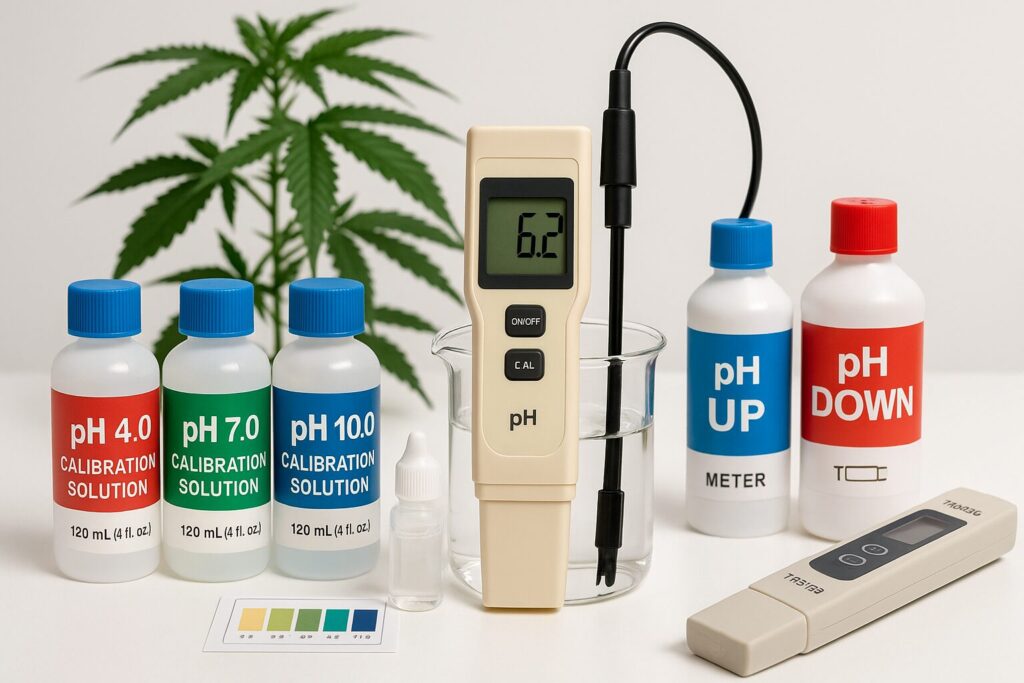
Table of Contents
🌱 Understanding pH in Cannabis Cultivation
Cannabis pH (potential of hydrogen) is a measure of how acidic or alkaline a solution is, expressed on a scale from 0 to 14. A pH of 7.0 is neutral, values below 7.0 are acidic, and values above 7.0 are alkaline (basic). In cannabis cultivation, pH directly affects nutrient availability and uptake, making it one of the most critical parameters to monitor and control [1, 2].
The pH of your growing medium and nutrient solution determines which nutrients are available for plant uptake. When pH drifts outside the optimal range, certain nutrients become “locked out”—chemically bound in forms that plant roots cannot absorb. This leads to deficiencies even when adequate nutrients are present in the medium [3, 4].
Understanding and managing pH is essential for both novice and experienced growers. Even premium nutrients and perfect environmental conditions cannot compensate for improper pH. Fortunately, with the right testing equipment and knowledge, pH management becomes a simple routine that ensures your plants can access all the nutrients they need for vigorous growth and maximum yields.
🔬 Why pH Matters: The Science
Nutrient Availability and pH
The relationship between pH and nutrient availability is well-established in plant science. Different nutrients are soluble and available to plants at different pH levels. Research has consistently demonstrated that cannabis performs best within specific pH ranges that maximize the availability of all essential nutrients [1, 2, 5].
Nutrient Availability by pH Range:
Acidic Range (pH 5.0-6.0):
- More Available: Iron (Fe), Manganese (Mn), Zinc (Zn), Copper (Cu), Boron (B)
- Less Available: Nitrogen (N), Phosphorus (P), Calcium (Ca), Magnesium (Mg)
- Risk: Micronutrient toxicity if pH too low
Optimal Range (pH 6.0-6.5 soil, 5.5-6.0 hydro):
- Balanced Availability: All essential nutrients accessible
- Maximum Uptake: Nitrogen, Phosphorus, Potassium
- Ideal Conditions: Best overall plant performance
Alkaline Range (pH 7.0-8.0):
- More Available: Nitrogen, Phosphorus, Calcium, Magnesium
- Less Available: Iron, Manganese, Zinc, Copper, Boron
- Risk: Micronutrient deficiencies
Veazie et al. (2025) found that growing cannabis at extremely acidic pH (3.0-4.0) resulted in significantly reduced growth and should be avoided [1]. Their research demonstrated that substrate pH directly affects both plant morphology and leaf tissue nutrient concentrations.
pH Effects on Root Function
Beyond nutrient availability, pH affects root health and function. Extreme pH levels can damage root cell membranes, reduce beneficial microbial activity, and increase susceptibility to root diseases. Research shows that maintaining pH within the optimal range supports healthy root development and maximizes nutrient uptake efficiency [2, 4].
Barrow (2023) demonstrated that the effects of pH on nutrient availability depend on both soil properties and plant-specific uptake mechanisms [3]. This research highlights why cannabis-specific pH recommendations differ slightly from general agricultural guidelines.
🌱 Optimal pH Ranges by Growing Medium
Different growing mediums require different pH ranges for optimal cannabis cultivation. Understanding these differences is crucial for success [1, 2, 5].
Soil Growing
Optimal pH Range: 6.0-7.0 Sweet Spot: 6.3-6.8 Acceptable Range: 5.8-7.2
Soil-grown cannabis thrives in slightly acidic to neutral pH. The broader acceptable range in soil is due to the buffering capacity of organic matter and minerals, which help stabilize pH fluctuations [5]. Research consistently demonstrates that pH 6.0-7.0 ensures maximum nutrient uptake and healthy root function for soil-grown cannabis [2].
Why This Range:
- Optimal availability of macronutrients (N, P, K)
- Good availability of secondary nutrients (Ca, Mg, S)
- Adequate micronutrient access
- Supports beneficial soil microorganisms
- Natural buffering prevents rapid pH swings
Hydroponic and Soilless Growing
Optimal pH Range: 5.5-6.5 Sweet Spot: 5.8-6.2 Acceptable Range: 5.5-6.5
Hydroponic systems and soilless mediums (coco coir, rockwool, perlite) require slightly more acidic pH than soil. The narrower range reflects the lack of natural buffering and the need for precise nutrient availability [2, 5].
Why This Range:
- Maximum phosphorus availability (critical for flowering)
- Optimal iron and micronutrient uptake
- Prevents calcium and magnesium lockout
- Reduces risk of nutrient precipitation
- Matches commercial nutrient formulations
Wielgusz et al. (2022) demonstrated that both fertilization and soil pH significantly affect plant morphology and nutrient uptake in cannabis cultivation [4]. Their research emphasizes the importance of coordinating pH management with nutrient programs.
pH Drift and Fluctuation
Slight pH fluctuations within the optimal range are actually beneficial. As pH drifts between 5.8 and 6.5 in hydroponics (or 6.0-7.0 in soil), different nutrients become more or less available, allowing plants to access a full spectrum of nutrition over time. This natural variation prevents single-nutrient lockouts and promotes balanced growth.
🔧 Types of pH Testing Equipment
Several types of pH testing equipment are available, each with distinct advantages and limitations. Choosing the right tool depends on your growing scale, budget, and accuracy requirements.
Digital pH Meters
Accuracy: ±0.01 to ±0.1 pH Price Range: $15-$200+ Best For: All growers, especially hydroponic systems
Digital pH meters provide the most accurate and convenient pH testing. They feature electronic sensors that measure pH and display results on a digital screen. Quality varies significantly by price point, with professional meters offering better accuracy, durability, and features.
Advantages:
- High accuracy and precision
- Easy to read digital display
- Fast results (seconds)
- Reusable indefinitely with proper care
- Some models include temperature compensation
- Advanced models store calibration data
Disadvantages:
- Requires regular calibration
- Probe requires proper storage and maintenance
- Initial cost higher than test kits
- Batteries or charging required
- Can be damaged by improper storage
pH Test Kits (Liquid Reagent)
Accuracy: ±0.2 to ±0.5 pH Price Range: $5-$20 Best For: Beginners, backup testing, soil testing
Liquid pH test kits use chemical indicators that change color based on pH. You add drops of reagent to a sample and compare the resulting color to a reference chart.
Advantages:
- No calibration required
- Inexpensive
- No batteries needed
- Good for soil slurry testing
- Reliable backup method
- Long shelf life if stored properly
Disadvantages:
- Less accurate than digital meters
- Subjective color interpretation
- Difficult to read in certain lighting
- Consumable (runs out)
- Slower than digital meters
- Not suitable for colored solutions
pH Test Strips
Accuracy: ±0.5 to ±1.0 pH Price Range: $5-$15 Best For: Quick checks, beginners, emergency testing
pH test strips are paper strips impregnated with pH-sensitive dyes. You dip the strip in solution and compare the color change to a reference chart.
Advantages:
- Very inexpensive
- No calibration needed
- Portable and convenient
- No batteries required
- Quick results
- Good for approximate readings
Disadvantages:
- Lowest accuracy
- Single use (disposable)
- Color interpretation subjective
- Not suitable for precise hydroponic work
- Can be affected by solution color
- Limited shelf life once opened
Continuous pH Monitors
Accuracy: ±0.1 to ±0.2 pH Price Range: $100-$500+ Best For: Commercial operations, automated systems
Continuous pH monitors feature permanently installed probes that provide real-time pH monitoring and can integrate with automated dosing systems.
Advantages:
- Continuous monitoring
- Can trigger automated pH adjustment
- Data logging capabilities•Alerts for pH drift
- Professional-grade accuracy
- Reduces labor for large operations
Disadvantages:
- High initial investment
- Requires professional installation
- Regular calibration still needed
- Probe replacement costs
- Overkill for small grows
🛒 Digital pH Meters: Complete Buyer’s Guide
Digital pH meters are the gold standard for cannabis cultivation. Understanding the features and specifications helps you choose the right meter for your needs.
Key Specifications
Accuracy:
- Budget Meters: ±0.1 pH (adequate for most growers)
- Mid-Range Meters: ±0.05 pH (excellent for serious growers)
- Professional Meters: ±0.01 pH (laboratory-grade precision)
Resolution:
- Standard: 0.1 pH (displays one decimal place: 6.2)
- High Resolution: 0.01 pH (displays two decimal places: 6.24)
Calibration Points:
- 1-Point: Basic calibration at pH 7.0 (minimum acceptable)
- 2-Point: Calibration at pH 4.0 and 7.0 (recommended)
- 3-Point: Calibration at pH 4.0, 7.0, and 10.0 (professional standard)
Temperature Compensation:
- Manual (MTC): You enter temperature manually
- Automatic (ATC): Built-in sensor adjusts for temperature automatically (preferred)
Essential Features
Replaceable Probe: Look for meters with replaceable probes rather than integrated probes. Probes eventually wear out, and replaceable probes extend meter lifespan significantly.
Waterproof Rating: IP67 or higher rating protects against accidental submersion. Essential for grow room environments with high humidity.
Storage Solution Cap: A cap that holds storage solution keeps the probe hydrated when not in use. Proper storage is critical for probe longevity and accuracy.
Calibration Reminder: Advanced meters remind you when calibration is due, ensuring consistent accuracy.
Data Hold Function: Freezes the reading on screen so you can remove the meter from solution and record the value.
Recommended pH Meters by Budget
Budget Option ($15-$30):
- Basic digital pH meter with 0.1 pH accuracy
- 2-point calibration capability
- Manual temperature compensation
- Suitable for beginners and soil growers
Mid-Range Option ($30-$80):
- 0.05 pH accuracy
- Automatic temperature compensation (ATC)
- 3-point calibration
- Replaceable probe
- Waterproof design
- Ideal for most home growers
Professional Option ($80-$200):
- 0.01 pH accuracy
- Advanced ATC
- 3-point calibration with data storage
- Premium probe with long lifespan
- Data logging capabilities
- Calibration reminders
- Best for commercial operations and serious hobbyists
Top Brands
Apera Instruments: Known for reliability and accuracy. The PH20 and PH60 models are popular among cannabis growers.
Bluelab: Premium brand specifically marketed to hydroponic growers. Excellent accuracy and durability.
Hanna Instruments: Professional-grade meters with extensive features. Wide range of models for different applications.
Milwaukee Instruments: Good mid-range option with solid accuracy and features at reasonable prices.
🔧 pH Test Kits and Strips
While digital meters offer the best accuracy, test kits and strips remain valuable tools for cannabis growers.
Liquid pH Test Kits
How They Work:
1.Fill test tube with sample solution
2.Add specified drops of pH indicator reagent
3.Cap and shake to mix
4.Compare color to reference chart
5.Read pH value from closest color match
Best Practices:
- Use in good lighting conditions (natural light ideal)
- Ensure test tube is clean
- Add exact number of drops specified
- Mix thoroughly
- Read immediately after mixing
- Store reagent bottles tightly sealed
Accuracy Tips:
- Fresh reagent provides best accuracy
- Replace annually even if not empty
- Store in cool, dark location
- Don’t contaminate reagent bottle
Applications:
- Soil slurry testing (mix soil with distilled water)
- Backup testing when digital meter needs calibration
- Teaching tool for understanding pH
- Budget-friendly option for beginners
pH Test Strips
How They Work:
1.Dip strip in solution for 1-2 seconds
2.Remove and shake off excess liquid
3.Wait specified time (usually 15-30 seconds)
4.Compare color pads to reference chart
5.Read pH value from closest match
Limitations:
- Accuracy only ±0.5-1.0 pH
- Difficult with colored solutions
- Subjective color interpretation
- Not suitable for precise hydroponic work
Best Uses:
- Quick checks of water source pH
- Approximate soil pH testing
- Emergency backup testing
- Educational purposes
📂 Calibration and Maintenance
Proper calibration and maintenance are essential for accurate pH readings. Even the best digital meters require regular care.
Calibration Procedure
Frequency:
- Hydroponic Systems: Weekly minimum, daily for commercial operations
- Soil Growing: Every 2-4 weeks
- After Storage: Always calibrate after extended storage
- After Cleaning: Calibrate after probe cleaning
2-Point Calibration (Recommended for Cannabis):
1.Prepare Calibration Solutions:
- Use fresh pH 4.0 and pH 7.0 buffer solutions
- Bring solutions to room temperature (20-25°C)
- Use separate containers for each buffer
2.Calibrate at pH 7.0:
- Rinse probe with distilled water
- Immerse probe in pH 7.0 buffer
- Wait for reading to stabilize
- Adjust meter to read 7.0 (follow manufacturer instructions)
3.Calibrate at pH 4.0:
- Rinse probe thoroughly with distilled water
- Immerse probe in pH 4.0 buffer
- Wait for reading to stabilize
- Adjust meter to read 4.0
4.Verify Calibration:
- Rinse probe with distilled water
- Test in pH 7.0 buffer again
- Should read within ±0.1 of 7.0
- If not, repeat calibration
3-Point Calibration (Professional Standard): Add pH 10.0 buffer as a third calibration point for maximum accuracy across the full pH range. Recommended for commercial operations and when testing alkaline water sources.
Probe Storage and Maintenance
Proper Storage:
- Store probe in storage solution (usually pH 4.0 buffer or KCl solution)
- Never store in distilled or deionized water (damages probe)
- Keep storage solution cap filled
- Store vertically with probe tip down
Cleaning:
- Rinse probe with distilled water after each use
- For protein buildup: Soak in pepsin solution
- For salt deposits: Soak in 0.1M HCl solution
- For algae/organic matter: Gently wipe with soft cloth
- Never use abrasive materials on probe
Probe Lifespan:
- Budget probes: 6-12 months
- Quality probes: 1-2 years
- Professional probes: 2-3+ years
- Lifespan depends heavily on care and usage
Signs Probe Needs Replacement:
- Won’t calibrate accurately
- Slow response time
- Erratic readings
- Visible damage to glass bulb
- Readings drift constantly
Calibration Solution Care
Storage:
- Keep tightly sealed when not in use
- Store in cool, dark location
- Avoid temperature extremes
- Don’t refrigerate (can cause precipitation)
Replacement:
- Replace every 6-12 months
- Replace immediately if contaminated
- Use fresh solution for each calibration
- Don’t pour used solution back into bottle
📂 pH Adjustment Solutions
Maintaining optimal pH requires adjustment solutions to raise or lower pH as needed.
pH Down (Acid)
Common Formulations:
- Phosphoric Acid: Most common, adds phosphorus
- Nitric Acid: Adds nitrogen, good for vegetative growth
- Citric Acid: Organic option, less stable
- Sulfuric Acid: Industrial use, very strong
Usage:
- Add small amounts (1ml per gallon) and retest
- Mix thoroughly before retesting
- Wait 15-30 minutes for pH to stabilize
- Always add acid to water, never water to acid
Safety:
- Wear gloves and eye protection
- Store in original container
- Keep away from children and pets
- Have baking soda available to neutralize spills
pH Up (Base)
Common Formulations:
- Potassium Hydroxide: Most common, adds potassium
- Potassium Carbonate: Gentler, adds potassium
- Sodium Hydroxide: Avoid for cannabis (sodium buildup)
Usage:
- Add small amounts and retest
- Mix thoroughly
- Allow time to stabilize
- More stable than pH down (less drift)
Natural pH Adjustment
To Lower pH:
- Sulfur (slow-acting, for soil)
- Organic acids (citric, acetic)
- Sphagnum peat moss
- Pine needles (mulch)
To Raise pH:
- Dolomite lime (adds Ca and Mg)
- Garden lime (calcium carbonate)
- Wood ash (potassium carbonate)
- Oyster shell flour
Note: Natural amendments work slowly and are best for soil pH adjustment. Not suitable for rapid hydroponic pH correction.
pH Buffering
Buffering Capacity: Some growing mediums naturally resist pH changes. Soil has high buffering capacity due to organic matter and minerals. Hydroponic solutions have low buffering capacity and require more frequent monitoring.
Improving Buffer Capacity:
- Add silica supplements (also strengthens plants)
- Use quality nutrients with pH buffers
- Maintain adequate calcium and magnesium levels
- Add humic/fulvic acids in soil grows
📂 Common pH Problems and Solutions
Problem: pH Keeps Dropping (Acidifying)
Causes:
- Nitrification by beneficial bacteria
- Ammonium-based nitrogen sources
- Root exudates and organic matter breakdown
- Acidic water source
- Nutrient formulation
Solutions:
- Use pH up to raise pH to optimal range
- Switch to nitrate-based nitrogen sources
- Add potassium silicate for buffering
- Check and adjust water source pH
- Consider different nutrient line
Problem: pH Keeps Rising (Alkalizing)
Causes:
- Alkaline water source (high bicarbonates)
- Calcium carbonate in growing medium
- Algae growth (consumes CO₂)
- Nutrient imbalances
- Substrate breakdown
Solutions:
- Use pH down to lower pH
- Treat water source (RO system or acid injection)
- Control algae with light exclusion
- Flush medium and restart
- Add sulfur to soil for long-term correction
Problem: Rapid pH Swings
Causes:
- Low buffering capacity
- Insufficient nutrient solution volume
- Temperature fluctuations
- Contamination or algae
- Failing pH meter
Solutions:
- Increase reservoir size
- Add silica for buffering
- Stabilize temperature
- Clean system and replace solution
- Calibrate or replace pH meter
Problem: Can’t Stabilize pH
Causes:
- Incorrect calibration
- Failing probe
- Contaminated calibration solutions
- Extreme water source pH
- Chemical incompatibilities
Solutions:
- Recalibrate with fresh solutions
- Replace probe if old
- Use RO water and remineralize
- Check for nutrient precipitation
- Start with fresh water and nutrients
Problem: Nutrient Lockout Despite Correct pH
Causes:
- Nutrient imbalances (excess of one nutrient blocks others)
- Salt buildup in medium
- Root damage or disease
- Incorrect pH measurement
- Temperature extremes
Solutions:
- Flush medium with pH-adjusted water
- Reduce nutrient concentration
- Check root health
- Verify pH meter accuracy
- Optimize temperature (65-75°F root zone)
📂 Advanced pH Management
Automated pH Control
Dosing Systems: Commercial operations often use automated pH dosing systems that continuously monitor pH and inject pH up or down solutions as needed. These systems maintain precise pH control with minimal labor.
Components:
- Continuous pH monitor/controller
- Peristaltic dosing pumps
- pH adjustment solution reservoirs
- Mixing chamber
- Alarm system for failures
Benefits:
- Consistent pH 24/7
- Reduced labor
- Prevents pH-related crop losses
- Data logging for analysis
- Scalable for large operations
Considerations:
- High initial investment ($500-$2000+)
- Requires backup systems
- Regular calibration still needed
- Solution reservoirs must be refilled
pH and EC Relationship
pH and electrical conductivity (EC) are interconnected. High EC (nutrient concentration) can affect pH stability, and pH affects nutrient solubility which impacts EC readings.
Best Practices:
- Measure and adjust pH after adding nutrients
- Monitor both pH and EC together
- Reduce EC if pH won’t stabilize
- Flush if both pH and EC are problematic
Substrate-Specific pH Management
Coco Coir:
- Requires calcium and magnesium supplementation
- pH tends to rise initially, then stabilize
- Target pH 5.8-6.2
- Buffer coco before use
Rockwool:
- Naturally alkaline (pH 7-8)
- Must be pre-soaked in pH 5.5 solution
- Target pH 5.5-6.0
- Requires frequent pH monitoring
Soil:
- Test soil pH separately from runoff pH
- Amend soil before planting for best results
- Runoff pH may differ from root zone pH
- Target soil pH 6.3-6.8
Deep Water Culture (DWC):
- pH drifts more rapidly than other methods
- Check pH twice daily minimum
- Target pH 5.8-6.2
- Beneficial bacteria can affect pH
✅ Conclusion
pH management is one of the most critical yet often overlooked aspects of successful cannabis cultivation. Understanding the science behind pH, using quality testing equipment, and maintaining proper pH ranges ensures your plants can access all the nutrients they need for vigorous growth and maximum yields.
Research consistently demonstrates that cannabis performs best within specific pH ranges: 6.0-7.0 for soil and 5.5-6.5 for hydroponics [1, 2, 5]. Deviating from these ranges leads to nutrient lockout and deficiencies, even when adequate nutrients are present [3, 4].
Investing in a quality digital pH meter and learning proper calibration and maintenance procedures pays dividends throughout your growing career. Combined with regular monitoring and appropriate pH adjustment, you’ll eliminate one of the most common causes of cultivation problems and unlock your plants’ full genetic potential.
Whether you’re a beginner starting your first grow or an experienced cultivator optimizing your operation, seedbanks.com and our partners at weed.de and officialcannabisseeds.com offer the, knowledge, and support you need to master pH management and achieve consistent, high-quality results.
❓ Frequently Asked Questions
❓ How often should I check pH?
Hydroponics: Daily minimum, twice daily for DWC and small reservoirs. Commercial operations may check multiple times per day.
Soil: Every 2-3 waterings, or weekly minimum. More frequent during flowering when plants consume more nutrients.
Coco Coir: Every watering recommended, minimum every other watering.
❓ Should I adjust pH before or after adding nutrients?
Always add nutrients first, mix thoroughly, then check and adjust pH. Nutrients affect pH, so adjusting before adding nutrients will result in incorrect final pH.
❓ What’s the difference between runoff pH and root zone pH?
Runoff pH is the pH of water that drains from the bottom of pots. It indicates what’s happening in the root zone but may not exactly match root zone pH. In soil, root zone pH is typically 0.2-0.5 points higher than runoff pH.
❓ Can I use vinegar or lemon juice to lower pH?
While vinegar and lemon juice can lower pH, they’re not ideal for cannabis cultivation. They’re unstable (pH drifts back up quickly) and can promote microbial growth. Use proper pH down solutions for consistent results.
❓ Why does my pH meter give different readings each time?
Possible causes:
- Meter needs calibration
- Probe needs cleaning
- Not allowing reading to stabilize
- Temperature fluctuations
- Probe is failing and needs replacement
❓ Do I need to pH adjust my water if growing in soil?
Yes, even in soil you should pH adjust your water/nutrient solution. While soil has buffering capacity, consistently watering with incorrect pH will eventually overwhelm the buffer and cause problems.
❓ What pH should I use for foliar sprays?
Foliar sprays should be pH adjusted to 6.0-6.5 for optimal leaf absorption. Slightly acidic pH helps nutrients penetrate leaf surfaces.
❓ Can pH affect the taste of my final product?
Indirectly, yes. Proper pH ensures optimal nutrient uptake, which affects terpene production and overall plant health. Nutrient deficiencies caused by pH problems can reduce terpene content and affect flavor.
❓ How do I test soil pH accurately?
Soil Slurry Method:
1.Mix 1 part soil with 1 part distilled water
2.Stir thoroughly and let sit 15 minutes
3.Stir again and let settle 5 minutes
4.Test the liquid with pH meter or test kit
5.This gives approximate root zone pH
For most accurate results, use a soil pH probe or send samples to a laboratory.
❓ What’s the best pH for different growth stages?
Vegetative Stage:
- Soil: 6.3-6.8 (slightly higher for better nitrogen uptake)
- Hydro: 5.8-6.2
Flowering Stage:
- Soil: 6.0-6.5 (slightly lower for better phosphorus uptake)
- Hydro: 5.8-6.0
Slight variations within these ranges throughout each stage provide access to full nutrient spectrum.
📂 References
1.Veazie, P., Cockson, P., Smith, J. T., & Whipker, B. E. (2025). Impact of substrate pH and micronutrient fertility rates on Cannabis sativa. Agrosystems, Geosciences & Environment, 8(1), e70044. https://doi.org/10.1002/agg2.70044
2.Hershkowitz, J. A. (2024). Nutrient Management of Cannabis in Controlled Environments. Utah State University. https://digitalcommons.usu.edu/etd2023/178/
3.Barrow, N. J. (2023). The effects of pH on nutrient availability depend on both soils and plants. Plant and Soil, 487(1-2), 21-33. https://doi.org/10.1007/s11104-023-05960-5
4.Wielgusz, K., Praczyk, M., Irzykowska, L., & Świerk, D. (2022). Fertilization and soil pH affect seed and biomass yield, plant morphology, and cadmium uptake in hemp (Cannabis sativa L.). Industrial Crops and Products, 175, 114245. https://doi.org/10.1016/j.indcrop.2021.114245
5.Malík, M., & Tlustoš, P. (2025). Soilless Growing Media for Cannabis Cultivation. Agriculture, 15(18), 1955. https://doi.org/10.3390/agriculture15181955
6.Thawonkit, T., Insalud, N., Dangtungee, R., & Srisawat, U. (2025). Integrating Sustainable Cultivation Practices and Advanced Extraction Methods for Improved Cannabis Yield and Cannabinoid Production. Plants, 16(2), 38. https://doi.org/10.3390/plants16020038
7.Saragoça, A., Silva, A. C., Varanda, C. M. R., Materatski, P., & Félix, M. R. (2025). Current Context of Cannabis sativa Cultivation and Parameters Influencing Its Development. Agriculture, 15(15), 1635. https://doi.org/10.3390/agriculture15151635