
🏆 Key Takeaway
Choose the perfect grow media for your cannabis garden- from soil and coco coir to hydroponic systems.
Choose the perfect grow media for your cannabis garden- from soil and coco coir to hydroponic systems.
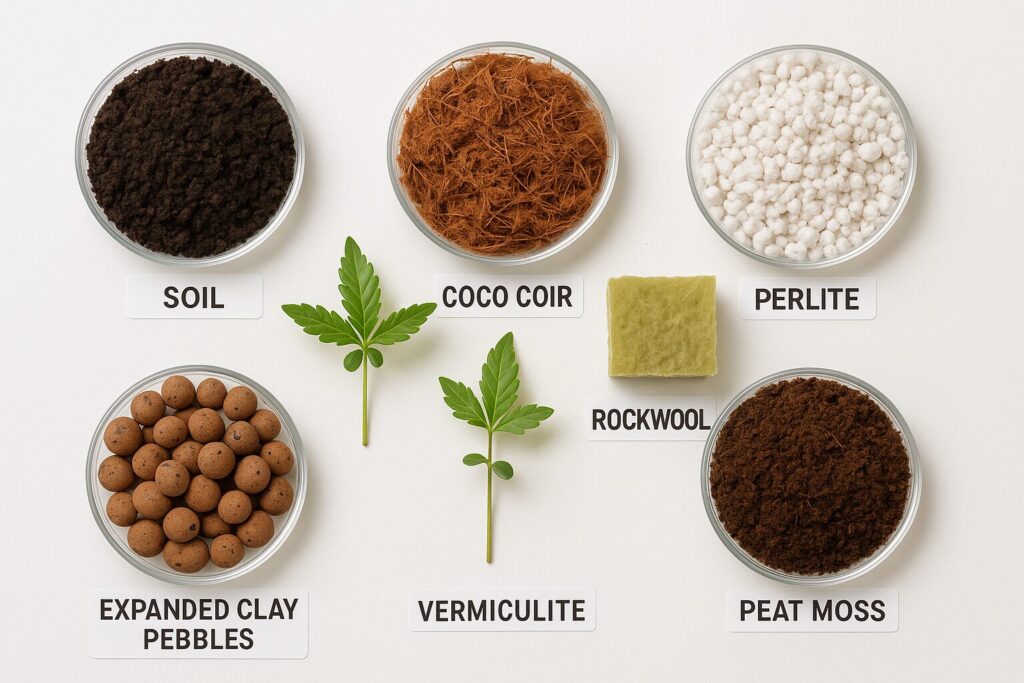
Table of Contents
🌱 Understanding Grow Media
The growing medium, or substrate, is the material in which cannabis roots grow and from which they obtain water, oxygen, and nutrients. The choice of growing medium profoundly affects plant health, growth rate, yield, and cultivation difficulty. Research demonstrates that different growing media create distinct physical and chemical environments that significantly influence cannabis development [1, 2, 3].
Growing media fall into two broad categories: soil-based and soilless. Soil-based media contain actual soil with organic matter, minerals, and beneficial microorganisms. Soilless media are inert or semi-inert materials that provide physical support and water/nutrient delivery without the biological complexity of soil [2, 3].
The ideal growing medium provides five essential functions: anchoring plant roots, delivering water and nutrients, supplying oxygen to roots, maintaining appropriate pH, and supporting beneficial microorganisms (in organic systems). No single medium excels at all functions, which is why many growers use custom blends or select media based on their specific growing style and goals [1, 2].
Recent research by Malík and Tlustoš (2025) provides comprehensive analysis of soilless growing media for cannabis cultivation, highlighting the importance of understanding physical properties like air porosity, water retention, and drainage characteristics [2]. Their work emphasizes that substrate selection should align with irrigation strategy, nutrient program, and cultivation goals.
📂 Soil: The Traditional Choice
Soil remains the most popular growing medium for cannabis cultivation, especially among home growers and organic cultivators. Quality soil provides a complete growing environment with minerals, organic matter, beneficial microorganisms, and natural buffering capacity [1, 3].
Composition and Properties
Cannabis soil typically contains three components: mineral particles (sand, silt, clay), organic matter (compost, humus, decomposed plant material), and living organisms (bacteria, fungi, protozoa, nematodes). The ratio of these components determines soil texture, water retention, drainage, and nutrient availability [3].
Soil Texture Classification:
Sandy Soil:
- Large particles with excellent drainage
- Low water and nutrient retention
- Warms quickly in spring
- Requires frequent watering and feeding
- Good for preventing overwatering
Loamy Soil (Ideal):
- Balanced mixture of sand, silt, and clay
- Excellent water retention and drainage
- Good nutrient-holding capacity
- Easy to work with
- Supports diverse microbial life
Clay Soil:
- Fine particles with high water retention
- Poor drainage and aeration
- Slow to warm in spring
- High nutrient-holding capacity
- Difficult to work, prone to compaction
Advantages of Soil Growing
Soil offers several unique advantages that make it the preferred choice for many cultivators. The natural buffering capacity of soil helps stabilize pH and protects against nutrient imbalances. Organic matter in soil releases nutrients gradually, reducing the risk of overfeeding. Beneficial microorganisms in living soil can suppress pathogens, improve nutrient availability, and enhance plant resilience [3].
Soil is forgiving for beginners because it doesn’t require precise nutrient management. The biological activity in soil processes nutrients and makes them available to plants over time. This “living” quality means plants grown in quality soil often produce superior terpene profiles and more complex flavors compared to hydroponic systems [1, 3].
Disadvantages and Challenges
Soil cultivation presents certain challenges. Quality soil is heavy and can be expensive to purchase or labor-intensive to create. Soil can harbor pests, diseases, and weed seeds that compete with cannabis. Drainage problems in soil can lead to root rot, especially with heavy clay soils or overwatering [3].
Soil requires longer vegetative periods compared to hydroponic systems because nutrient availability is lower. Yields in soil are typically 10-20% lower than optimized hydroponic systems, though many growers accept this trade-off for superior flavor and ease of cultivation [1].
Soil Selection and Preparation
Pre-Mixed Cannabis Soil: Commercial cannabis soils are formulated specifically for cannabis cultivation with appropriate texture, pH, and initial nutrients. Quality brands include Fox Farm Ocean Forest, Roots Organics Original, and Pro-Mix HP. These soils are ready to use and provide 3-4 weeks of nutrients before supplemental feeding is required.
DIY Soil Mix Recipe:
- 40% high-quality compost
- 30% peat moss or coco coir
- 20% perlite or pumice
- 10% worm castings
- Amendments: dolomite lime, kelp meal, bone meal, blood meal
Soil Conditioning: Before planting, condition soil by moistening it and allowing it to rest for 24-48 hours. This activates microbial life and allows amendments to begin breaking down. Test pH and adjust to 6.0-7.0 range using lime (to raise) or sulfur (to lower).
Living Soil and No-Till Growing
Living soil systems emphasize building and maintaining soil biology rather than relying on bottled nutrients. These systems use cover crops, mulching, and organic amendments to feed soil microorganisms, which in turn feed plants. Living soil can be reused indefinitely with proper maintenance, making it highly sustainable [3].
Benefits of Living Soil:
- Superior terpene production and flavor
- Reduced nutrient costs over time
- Environmentally sustainable
- Improved plant resilience
Water-only growing (no liquid nutrients)
Challenges:
- Requires understanding of soil biology
- Longer setup time (3-6 months to establish)
- Larger container sizes needed (15+ gallons)
- More difficult in small spaces
📂 Coco Coir: The Modern Alternative
Coco coir has become one of the most popular growing media for cannabis cultivation, combining the forgiving nature of soil with the growth rates of hydroponics. Made from coconut husk fibers, coco coir is renewable, sustainable, and provides excellent physical properties for cannabis cultivation [1, 2, 4].
Properties and Characteristics
Coco coir is a fibrous material with exceptional air porosity (20-30%) and water retention (60-70% by volume). This unique combination means roots receive abundant oxygen even when the medium is saturated, preventing overwatering issues common in soil. The fibrous structure promotes vigorous root development and allows for frequent fertigation [2, 4].
Research by Schober et al. (2023) compared rockwool and organic growing media mixtures for medical cannabis production, providing insights into how different substrates affect plant growth parameters [4]. While their study focused on rockwool versus organic mixes, the principles apply to understanding coco coir’s performance characteristics.
Physical Properties:
- pH: Naturally 5.5-6.5 (ideal for cannabis)
- EC: Low (requires full nutrient program)
- Air Porosity: 20-30%
- Water Retention: 60-70%
- Cation Exchange Capacity: Moderate
Advantages of Coco Coir
Coco coir offers numerous advantages that explain its popularity among commercial and home growers. The medium is completely inert, giving growers full control over nutrition. Plants grow 20-30% faster in coco compared to soil due to superior oxygenation and the ability to fertigate frequently. Coco is reusable for 2-3 cycles with proper buffering between uses [2, 4].
The fibrous structure of coco promotes explosive root growth. Roots can penetrate coco easily and the high air porosity ensures they receive adequate oxygen even with daily watering. This allows growers to feed plants multiple times per day if desired, accelerating growth rates significantly [2].
Coco is lightweight, clean, and easy to work with compared to soil. It’s pest and disease-free when purchased from reputable sources. The renewable nature of coco makes it environmentally preferable to peat moss, which is harvested from sensitive bog ecosystems [2].
Disadvantages and Challenges
Coco coir requires a complete nutrient program from seedling stage onward, as it contains no nutrients. The medium has a natural tendency to bind calcium and magnesium, requiring supplementation with Cal-Mag products. Unbuffered coco can cause calcium and magnesium deficiencies if not properly prepared [2, 4].
Quality varies significantly between brands. Low-quality coco may contain high salt levels from seawater exposure or inadequate rinsing. Some coco products are compressed into bricks and require rehydration before use, which can be labor-intensive for large operations [2].
Coco requires more frequent watering than soil, typically daily or multiple times per day in flowering. This demands reliable irrigation systems or daily attention. The medium dries faster than soil, which can stress plants if watering is missed [2, 4].
Coco Selection and Preparation
Coco Product Types:
Coco Fiber:
- Pure coconut fiber
- Excellent drainage
- Requires frequent watering
- Best for experienced growers
Coco Pith:
- Fine particles from coconut husks
- Higher water retention
- Good for beginners
- Mix with perlite for better drainage
Coco Chips:
- Larger chunks of coconut husk
- Excellent aeration
- Often used in hydroponic systems
- Good for orchids and epiphytes
Coco Blends:
- Pre-mixed with perlite (typical 70/30 ratio)
- Balanced water retention and drainage
- Ready to use
- Recommended for most growers
Buffering Coco: Proper coco preparation involves buffering to saturate cation exchange sites with calcium and magnesium. This prevents the medium from pulling these nutrients from your fertilizer solution.
Buffering Process:
1.Rinse coco thoroughly with clean water
2.Soak in calcium-magnesium solution (2-3 ml/L Cal-Mag) for 8-12 hours
3.Rinse again with plain water
4.pH adjust to 5.8-6.2
5.Ready for planting
Many premium coco products come pre-buffered, eliminating this step. Look for products labeled “buffered” or “ready to use.”
Coco Cultivation Best Practices
Nutrient Management: Use nutrients specifically formulated for coco coir. These products contain elevated calcium and magnesium levels to account for coco’s binding tendency. Start with half-strength nutrients for seedlings and gradually increase to full strength by week 3-4 of vegetative growth.
Watering Schedule: Water coco when the top inch feels dry, typically daily in flowering. Some growers fertigate multiple times per day using automated drip systems. Never allow coco to completely dry out, as this can damage fine root hairs and stress plants.
pH Management: Maintain pH between 5.8-6.2 for optimal nutrient availability. Check and adjust pH of nutrient solution before each watering. Coco’s natural buffering helps stabilize pH, but monitoring is still essential.
Reusing Coco: Coco can be reused 2-3 times with proper preparation. After harvest, remove root mass and flush coco with enzyme solution to break down remaining organic matter. Re-buffer with Cal-Mag solution and pH adjust before reuse.
📂 Rockwool: Hydroponic Standard
Rockwool (also called stone wool or mineral wool) is a manufactured growing medium made by melting basaltic rock and spinning it into fibers. It’s the most popular substrate for commercial hydroponic cannabis cultivation due to its consistency, sterility, and excellent performance characteristics [2, 4, 5].
Properties and Manufacturing
Rockwool is created by heating basaltic rock to 1,600°C (2,900°F) and spinning the molten material into fibers, similar to making cotton candy. The fibers are then compressed into various shapes—cubes, slabs, and blocks—with controlled density and orientation. This manufacturing process creates a sterile, uniform product with predictable properties [2, 5].
Physical Characteristics:
- pH: Naturally 7.0-8.0 (requires pre-soaking)
- Air Porosity: 15-20%
- Water Retention: 70-80%
- Completely inert (no CEC)
- Sterile (no pathogens or pests)
- Uniform density and structure
Research comparing rockwool to other substrates consistently shows excellent performance for cannabis cultivation. Schober et al. (2023) found that rockwool performed comparably to organic growing media mixtures for medical cannabis production, with some differences in growth dynamics [4].
Advantages of Rockwool
Rockwool offers unparalleled consistency and control. Every cube or slab has identical properties, eliminating variability between plants. The sterile nature prevents soil-borne diseases and pests. Rockwool’s structure provides excellent root support while maintaining high air porosity even when saturated [2, 4, 5].
The medium allows for precise nutrient and water management. Because rockwool is completely inert, growers have total control over plant nutrition. This precision enables optimization of feeding programs for maximum yields. Commercial operations favor rockwool for its reliability and scalability [2, 5].
Rockwool systems are clean and professional. There’s no soil mess, and the medium is lightweight when dry. Plants can be easily moved or transplanted by simply placing smaller cubes into larger blocks or slabs. This modularity is valuable for commercial operations [5].
Disadvantages and Challenges
Rockwool has several significant drawbacks. The naturally alkaline pH (7.0-8.0) requires pre-soaking in acidic solution (pH 5.5) for 24 hours before use. Failure to properly condition rockwool leads to pH problems and nutrient lockout [2, 5].
The medium is not environmentally friendly. Rockwool is not biodegradable and cannot be easily disposed of or recycled. Manufacturing is energy-intensive. Environmental concerns have led some regions to restrict or ban rockwool use in agriculture [2].
Rockwool fibers can irritate skin, eyes, and lungs. Growers should wear gloves and avoid breathing dust when handling dry rockwool. The material holds water very effectively, which can lead to overwatering if irrigation is not carefully managed. Root rot is a risk in rockwool if drainage is inadequate [5].
The medium requires a complete hydroponic nutrient program and precise pH management. There is zero margin for error—if you stop feeding, plants immediately show deficiencies. This makes rockwool unsuitable for beginners or anyone seeking a low-maintenance growing method [2, 5].
Rockwool Products and Sizes
Starter Cubes (1-1.5″): Used for germinating seeds or rooting clones. Small cubes fit into larger blocks for transplanting without disturbing roots.
Grow Blocks (4-6″): Medium-sized blocks for vegetative growth. Plants can spend 4-6 weeks in grow blocks before transplanting to final containers.
Grow Slabs (36″ x 8″ x 3″): Large slabs for final flowering containers. Multiple plants can be grown on a single slab, or slabs can be cut to size.
Loose Rockwool: Shredded rockwool fibers used as a growing medium component or for propagation.
Rockwool Preparation and Use
Pre-Soaking Procedure:
1.Prepare pH 5.5 solution (use pH down in water)
2.Submerge rockwool completely for 24 hours
3.Remove and allow to drain (do not squeeze)
4.Check pH of runoff (should be 5.5-6.0)
5.If pH still high, repeat soaking process
6.Ready for planting once pH is correct
Watering Rockwool: Rockwool holds water very effectively. Water only when the medium feels light and the top is dry. In vegetative growth, this may be every 2-3 days. In flowering, daily watering is typical. Always water until 10-20% runoff to prevent salt accumulation.
Nutrient Management: Use complete hydroponic nutrients formulated for inert media. Maintain EC between 1.2-1.8 mS/cm depending on growth stage. Monitor runoff EC—if it’s significantly higher than input EC, increase watering frequency to flush accumulated salts.
📂 Perlite and Vermiculite: Essential Amendments
Perlite and vermiculite are mineral-based amendments used to improve the physical properties of growing media. While rarely used alone, they’re essential components in custom media mixes and commercial potting soils [2, 3].
Perlite
Perlite is volcanic glass that has been heated to 1,600°F, causing it to expand like popcorn. The resulting material is lightweight, white, and filled with tiny air pockets. Perlite is chemically inert and has a neutral pH [2, 3].
Properties:
- Improves drainage and aeration
- Prevents soil compaction
- Lightweight
- Sterile
- pH neutral (7.0)
- Does not decompose
Uses in Cannabis Cultivation:
- Added to soil at 10-30% to improve drainage
- Mixed with coco coir (typical 70/30 coco/perlite)
- Component of soilless mixes
- Hydroponic medium when mixed with vermiculite
Advantages:
- Prevents overwatering
- Increases oxygen availability to roots
- Reduces medium weight
- Inexpensive
- Reusable
Disadvantages:
- Floats to surface when watering
- Dust can irritate lungs (wear mask when mixing)
- No nutrient value
- Not environmentally friendly (mining required)
Vermiculite
Vermiculite is a mineral (hydrated magnesium aluminum silicate) that expands when heated. Unlike perlite, vermiculite retains water and nutrients due to its high cation exchange capacity [2, 3].
Properties:
- Retains water and nutrients
- Improves soil structure
- Lightweight
- pH slightly alkaline (7.0-7.5)
- High CEC (holds nutrients)
Uses in Cannabis Cultivation:
•Added to soil at 10-20% to improve water retention
- Seed starting medium (retains moisture)
- Component of soilless mixes
- Hydroponic medium (mixed with perlite)
Advantages:
- Excellent water retention
- Holds nutrients (high CEC)
- Improves soil structure
- Good for seedlings
- Insulates roots from temperature fluctuations
Disadvantages:
- Can retain too much water if overused
- Compacts over time
- More expensive than perlite
- Contains asbestos in some sources (use horticultural grade only)
Perlite/Vermiculite Mix (Hempy Method)
A 50/50 perlite/vermiculite mix creates a passive hydroponic system known as the “Hempy bucket.” This simple system combines perlite’s drainage with vermiculite’s water retention, creating a medium that’s difficult to overwater while providing excellent aeration [2].
Hempy Bucket Setup:
1.Use 5-gallon bucket with drainage holes 2″ from bottom
2.Fill with 50/50 perlite/vermiculite mix
3.Water with nutrient solution from top
4.2″ reservoir provides water between feedings
5.Simple, effective, and inexpensive
📂 Expanded Clay Pebbles (Hydroton)
Expanded clay pebbles, commonly called Hydroton (a brand name), are made by heating clay to 1,200°C in a rotary kiln. The clay expands and forms lightweight, porous spheres that are ideal for hydroponic systems [2, 5].
Properties and Characteristics
Physical Properties:
- Size: 8-16mm diameter
- pH: Neutral (6.5-7.0)
- Completely inert
- Excellent drainage
- Good air porosity
- Reusable indefinitely
Clay pebbles provide excellent root support while allowing maximum oxygen exposure. The spherical shape creates large air pockets between pebbles, ensuring roots receive abundant oxygen. This makes clay pebbles ideal for flood-and-drain (ebb and flow) and deep water culture (DWC) systems [2, 5].
Advantages of Clay Pebbles
Clay pebbles are reusable indefinitely with proper cleaning. After harvest, rinse pebbles to remove root material and sterilize with hydrogen peroxide or bleach solution. This reusability makes clay pebbles cost-effective for long-term cultivation despite higher initial cost [2, 5].
The medium is completely inert and sterile. There’s no risk of pests, diseases, or nutrient interactions. The large air spaces between pebbles prevent overwatering and ensure roots receive maximum oxygen. This promotes rapid growth and large, healthy root systems [5].
Clay pebbles are clean and professional. There’s no dust or mess, and the medium is easy to work with. The pebbles can be used alone or as a top layer over other media to reduce algae growth and improve drainage [2].
Disadvantages and Challenges
Clay pebbles have poor water retention. They dry out quickly and require frequent watering, typically multiple times per day. This makes them unsuitable for hand-watering and requires automated irrigation systems [2, 5].
The medium provides no buffering capacity. pH can swing rapidly, requiring frequent monitoring and adjustment. Similarly, the lack of cation exchange capacity means nutrients must be provided in every watering [5].
Clay pebbles are expensive compared to other media. Initial cost is $30-50 for a 50-liter bag. While reusable, the upfront investment is significant. The pebbles are also heavy when wet, making them difficult to move or transport [2].
Using Clay Pebbles
Preparation:
1.Rinse pebbles thoroughly to remove dust
2.Soak in pH 5.5 solution for 6-8 hours
3.Rinse again until runoff is clear
4.Ready for use
Ideal Systems:
- Ebb and Flow (Flood and Drain)
- Deep Water Culture (DWC)
- Drip irrigation systems
- Dutch bucket systems
- Aquaponics
Best Practices:
- Use automated irrigation (hand watering impractical)
- Monitor pH daily
- Maintain EC at 1.2-1.8 mS/cm
- Ensure good drainage (standing water causes root rot)
- Clean and sterilize between grows for reuse
📂 Peat Moss and Sphagnum
Peat moss is partially decomposed sphagnum moss harvested from peat bogs. It’s a traditional component of potting soils and soilless mixes, valued for its water retention and acidic pH [2, 3].
Properties and Characteristics
Physical Properties:
- pH: Acidic (3.5-4.5)
- High water retention (70-80% by volume)
- Low air porosity
- Moderate CEC
- Slow to decompose
- Lightweight when dry
Peat moss can hold 10-20 times its weight in water while maintaining some air porosity. This makes it excellent for water retention but potentially problematic for drainage if used without amendments [2, 3].
Advantages of Peat Moss
Peat moss provides excellent water retention, reducing watering frequency. The acidic pH is beneficial for cannabis, which prefers slightly acidic conditions. Peat is sterile and free from pests, diseases, and weed seeds [3].
The material is lightweight and easy to work with. It improves soil structure when added to heavy clay soils. Peat has moderate cation exchange capacity, helping retain nutrients and reduce leaching [2, 3].
Disadvantages and Challenges
Peat moss is not environmentally sustainable. Peat bogs are sensitive ecosystems that take thousands of years to form. Harvesting peat destroys these habitats and releases stored carbon dioxide. Many growers are switching to coco coir as a renewable alternative [2, 3].
Peat is hydrophobic when completely dry, meaning it repels water. Once dried out, peat is difficult to re-wet and requires soaking to restore water absorption. The acidic pH requires liming to raise pH to appropriate levels for cannabis [3].
Peat provides no nutrients and requires a complete fertilizer program. The material compacts over time, reducing aeration. Peat-based mixes typically need replacement after one growing cycle [2, 3].
Using Peat Moss
As Soil Component: Add peat moss at 20-40% to improve water retention in sandy soils or lighten heavy clay soils. Always mix with perlite or vermiculite to maintain drainage.
In Soilless Mixes: Peat is the base of many commercial soilless mixes (Pro-Mix, Sunshine Mix). These products combine peat with perlite, vermiculite, and lime to create balanced growing media.
pH Adjustment: Peat’s natural pH (3.5-4.5) is too acidic for cannabis. Add dolomite lime at 5-10 lbs per cubic yard to raise pH to 6.0-6.5. Allow amended peat to rest for 2-4 weeks before use.
📂 Custom Media Mixes
Many experienced growers create custom media blends to optimize specific properties. Custom mixes allow fine-tuning of water retention, drainage, aeration, and nutrient-holding capacity [2, 3].
Popular Custom Mix Recipes
Super Soil Mix (Subcool’s Recipe): A nutrient-rich organic mix that provides complete nutrition for an entire grow cycle.
Base Mix:
- 8 large bags high-quality organic potting soil
- 25-50 lbs organic worm castings
- 5 lbs blood meal (nitrogen)
- 5 lbs bat guano (phosphorus)
- 5 lbs bone meal (phosphorus, calcium)
- 3/4 cup Epsom salt (magnesium)
- 1 cup dolomite lime (calcium, magnesium, pH buffer)
- 2 cups kelp meal (micronutrients)
- 2 cups alfalfa meal (nitrogen, growth hormones)
Mix thoroughly and allow to “cook” for 30-60 days before use. Use as bottom third of container with regular soil on top.
Coco-Perlite Mix (70/30): The most popular soilless mix for cannabis cultivation.
- 70% coco coir (buffered)
- 30% perlite
- Optional: Add 10% worm castings for slow-release nutrients
This mix combines coco’s water retention with perlite’s drainage, creating a forgiving medium with excellent growth rates.
Peat-Based Soilless Mix:
- 50% peat moss
- 30% perlite
- 20% vermiculite
- Dolomite lime (5 lbs per cubic yard)
- Wetting agent (to overcome peat hydrophobia)
This is similar to commercial Pro-Mix and provides good balance of water retention and aeration.
Living Soil Mix (No-Till):
- 33% peat moss or coco coir
- 33% compost (high-quality, fully decomposed)
- 33% aeration (perlite, pumice, or rice hulls)
- Amendments: rock dust, kelp meal, neem meal, oyster shell flour
- Cover crop seeds: clover, alfalfa
This mix supports soil biology and can be reused indefinitely with top-dressing and cover crops.
Principles of Mix Design
Water Retention vs. Drainage: Balance water-holding components (coco, peat, vermiculite) with drainage components (perlite, pumice, sand). Cannabis prefers media that drain well but retain some moisture. Target 50-60% water retention with 20-30% air porosity [2, 3].
Aeration: Roots require oxygen for respiration. Ensure at least 20% of mix volume is air space when saturated. Add perlite, pumice, or rice hulls to increase aeration. Avoid over-compacting media when filling containers [2].
Nutrient Holding Capacity: Components with cation exchange capacity (CEC) hold nutrients and release them gradually. Compost, worm castings, and vermiculite have high CEC. Perlite, rockwool, and clay pebbles have zero CEC. Balance based on whether you want slow nutrient release or complete control [3].
pH Buffering: Include components that stabilize pH. Dolomite lime buffers acidic peat moss. Compost and worm castings provide natural pH buffering. Inert media like coco and perlite have minimal buffering [2, 3].
🌱 Comparing Growing Media Performance
Research comparing different growing media for cannabis cultivation provides valuable insights for substrate selection. Schober et al. (2023) conducted the first systematic comparison between rockwool and organic growing media mixtures for medical cannabis, examining growth dynamics and yield formation [4].
Growth Rate and Yield
Hydroponic media (rockwool, coco, clay pebbles) generally produce faster growth rates and 10-30% higher yields compared to soil. The superior oxygenation and ability to fertigate frequently accelerate vegetative growth and increase flower production [1, 2, 4].
Nemati et al. (2021) reviewed growing mediums for medical cannabis production in North America, noting that soilless systems allow for more precise control of the root environment, leading to optimized growth conditions [3]. However, they also noted that soil systems can produce superior terpene profiles and flavors, which many cultivators value over maximum yield [3].
Flavor and Quality
Cannabis grown in living soil often exhibits more complex terpene profiles and superior flavor compared to hydroponic systems. The diverse microbial community in soil may influence secondary metabolite production, though research in this area is limited [1, 3].
Hydroponic cannabis can achieve high cannabinoid content and potency equal to or exceeding soil-grown plants. Quality depends more on genetics, environment, and cultivation skill than growing medium alone [4].
Ease of Use
Soil is the most forgiving medium for beginners. The biological activity and buffering capacity protect against many common mistakes. Coco coir offers a middle ground—easier than pure hydroponics but requiring more attention than soil [2, 3].
Rockwool and clay pebbles require the most skill and attention. These inert media demand precise nutrient management, pH control, and irrigation scheduling. They’re best suited for experienced growers or those willing to invest time learning hydroponic cultivation [2, 5].
Cost Analysis
Initial Cost (per cubic foot):
- Soil: $5-15
- Coco Coir: $8-20
- Peat-Based Mix: $6-12
- Rockwool: $15-30
- Clay Pebbles: $25-40
- Perlite/Vermiculite: $10-15
Long-Term Cost: Reusable media (clay pebbles, rockwool, coco) have higher initial cost but lower long-term cost. Soil and peat-based mixes are typically replaced after each grow. Living soil can be reused indefinitely, making it cost-effective long-term [2, 3].
Environmental Impact
Most Sustainable:
- Coco coir (renewable resource)
- Living soil (reusable, supports biodiversity)
- Rice hulls (agricultural byproduct)
Moderate Impact:
- Perlite (mining required, but inert and reusable)
- Compost (renewable but energy-intensive production)
Least Sustainable:
- Peat moss (destroys sensitive ecosystems)
- Rockwool (energy-intensive production, not biodegradable)
- Vermiculite (mining required, potential asbestos concerns)
Malík and Tlustoš (2025) emphasize the importance of developing sustainable growing media for cannabis cultivation, noting that environmental considerations are increasingly important to both regulators and consumers [2].
📂 Selecting the Right Medium
Choosing the optimal growing medium depends on multiple factors including experience level, growing style, space constraints, budget, and goals.
Decision Framework
For Beginners: Start with quality pre-mixed cannabis soil or coco-perlite blend (70/30). These media are forgiving and don’t require advanced skills. Avoid rockwool and pure hydroponic systems until you’ve completed at least one successful grow [2, 3].
For Maximum Yield: Choose coco coir or rockwool with automated irrigation. These media support frequent fertigation and produce the fastest growth rates. Expect 10-30% higher yields compared to soil but be prepared for more intensive management [2, 4].
For Best Flavor: Use living soil or organic super soil. The complex microbial community and slow nutrient release produce superior terpene profiles. Accept slightly lower yields in exchange for premium quality [1, 3].
For Low Maintenance: Select quality organic soil with slow-release amendments. Water-only grows in living soil require minimal intervention. Avoid hydroponic media that demand daily attention [3].
For Small Spaces: Coco coir and soilless mixes are lightweight and clean. Avoid heavy soil in upper-floor apartments or spaces with weight restrictions. Hydroponic systems can be more compact than soil containers [2].
For Organic Certification: Use certified organic soil and amendments. Most hydroponic media and synthetic nutrients are not approved for organic certification. Check with certifying body for specific requirements [3].
For Commercial Operations: Rockwool or coco coir with automated irrigation provides consistency and scalability. The uniformity of these media allows for standardized feeding programs across large plant counts [2, 4, 5].
Matching Medium to Growing System
Hand Watering: Soil, coco-perlite mix, or peat-based soilless mix. These media retain enough water to allow 1-2 days between waterings.
Automated Drip Irrigation: Coco coir, rockwool, or coco-perlite mix. These media handle frequent fertigation well.
Ebb and Flow (Flood and Drain): Clay pebbles, rockwool, or coco. Media must drain completely and not compact when flooded.
Deep Water Culture (DWC): Clay pebbles or rockwool in net pots. Media provides root support while allowing roots to grow into nutrient solution.
Wick Systems: Perlite-vermiculite mix or coco coir. Media must have good capillary action to draw nutrient solution through wicks.
✅ Conclusion
Selecting the right growing medium is one of the most important decisions in cannabis cultivation. Each medium offers distinct advantages and challenges, and the optimal choice depends on your experience level, growing style, space constraints, and goals.
Research consistently demonstrates that different growing media create unique physical and chemical environments that significantly influence plant development [1, 2, 4]. Soilless media like coco coir and rockwool typically produce faster growth and higher yields, while soil-based systems often deliver superior flavor and terpene complexity [1, 3, 4].
For beginners, quality pre-mixed cannabis soil or coco-perlite blends provide the most forgiving growing experience. Experienced growers seeking maximum yields should consider coco coir or rockwool with automated irrigation. Those prioritizing flavor and sustainability will find living soil systems most rewarding, despite longer cultivation times [2, 3].
The comprehensive research by Malík and Tlustoš (2025) emphasizes that substrate selection should align with irrigation strategy, nutrient program, and cultivation goals [2]. There is no universally “best” growing medium—only the best medium for your specific situation and objectives.
Whether you choose traditional soil, modern coco coir, professional rockwool, or a custom blend, seedbanks.com and our partners at weed.de offer the products, knowledge, and support you need to succeed. Start with premium genetics from Official Cannabis Seeds, Blue Dream, or Sour Diesel, and grow with confidence using the right medium for your garden.
❓ Frequently Asked Questions
❓ Can I reuse growing media?
Coco Coir: Yes, 2-3 times. Flush with enzymes, re-buffer with Cal-Mag, and pH adjust before reuse.
Rockwool: Yes, but requires thorough cleaning and sterilization. Many growers replace after each cycle.
Clay Pebbles: Yes, indefinitely. Rinse, remove roots, and sterilize with hydrogen peroxide or bleach solution.
Soil: Living soil can be reused indefinitely with proper maintenance (cover crops, amendments). Standard potting soil should be replaced or heavily amended.
Perlite/Vermiculite: Yes, rinse and sterilize between uses.
❓ What’s the best medium for beginners?
Quality pre-mixed cannabis soil is the most forgiving for beginners. It provides buffering, contains initial nutrients, and forgives watering mistakes. Coco-perlite mix (70/30) is a close second and produces faster growth.
❓ How do I prevent overwatering in different media?
Soil: Water when top 1-2 inches are dry. Use pots with drainage holes. Add perlite at 20-30% to improve drainage.
Coco: Difficult to overwater due to high air porosity. Water daily or when top inch is dry.
Rockwool: Allow to dry slightly between waterings. Rockwool holds water very effectively, so less frequent watering than you might expect.
Clay Pebbles: Nearly impossible to overwater. Ensure good drainage and water frequently.
❓ Do I need to add nutrients immediately with all media?
Soil: Pre-mixed cannabis soils contain 3-4 weeks of nutrients. Start feeding at half-strength after initial nutrients are depleted.
Coco, Rockwool, Clay Pebbles: These are inert and require nutrients from day one. Start seedlings at 1/4 strength and increase gradually.
Peat-Based Mixes: Usually contain starter nutrients. Check product specifications.
❓ What’s the difference between coco coir and peat moss?
Coco Coir:
- Renewable (coconut byproduct)
- Neutral to slightly acidic pH
- Excellent air porosity
- Requires Cal-Mag supplementation
- More expensive
Peat Moss:
- Not renewable (peat bog harvesting)
- Very acidic pH (requires liming)
- Good water retention
- Hydrophobic when dry
- Less expensive
❓ Can I mix different growing media?
Yes! Custom mixes are common. Popular combinations:
- Coco + Perlite (70/30)
- Soil + Perlite + Vermiculite
- Peat + Perlite + Vermiculite
- Coco + Clay Pebbles
Ensure components are compatible and adjust pH/nutrients accordingly.
❓ How does growing medium affect pH requirements?
Soil: Target pH 6.0-7.0 (slightly acidic to neutral)
Coco, Rockwool, Hydro: Target pH 5.5-6.5 (more acidic)
The pH difference reflects optimal nutrient availability in each medium type.
❓ What container size do I need for different media?
Soil: 3-5 gallons for standard plants, 7-15+ gallons for living soil
Coco: 3-5 gallons (smaller than soil due to better nutrient delivery)
Rockwool: Slabs or 6″ blocks (compact root systems)
Clay Pebbles: 3-5 gallons in net pots or Dutch buckets
❓ How do I dispose of used growing media?
Compostable: Soil, coco coir, peat moss can be composted or added to garden beds
Recyclable: Clean perlite and clay pebbles can be reused or disposed in regular trash
Special Disposal: Rockwool should not be composted. Check local regulations for proper disposal.
❓ Does growing medium affect final product quality?
Growing medium influences growth rate and yield more than cannabinoid content. However, living soil often produces superior terpene profiles and flavors. Hydroponic systems can achieve equal or higher THC content but may lack the complexity of organic soil-grown cannabis.
📂 Scientific References
1.Nemati, R., Fortin, J. P., Craig, J., & Donald, S. (2021). Growing mediums for medical cannabis production in North America. Agronomy, 11(7), 1366. https://doi.org/10.3390/agronomy11071366
2.Malík, M., & Tlustoš, P. (2025). Soilless Growing Media for Cannabis Cultivation. Agriculture, 15(18), 1955. https://doi.org/10.3390/agriculture15181955
3.Nemati, R., Fortin, J. P., Craig, J., & Donald, S. (2021). Growing mediums for medical cannabis production in North America. Agronomy, 11(7), 1366. https://doi.org/10.3390/agronomy11071366
4.Schober, T., Präger, A., Hartung, J., Hensmann, F., & Graeff-Hönninger, S. (2023). Growth dynamics and yield formation of Cannabis (Cannabis sativa) cultivated in differing growing media under semi-controlled greenhouse conditions. Industrial Crops and Products, 201, 116901. https://doi.org/10.1016/j.indcrop.2023.116901
5.Halstead, M. A., Lynch, J., Ranieri, N., & Labbé, N. (2022). Hemp Growth in Vitro and in Vivo: A Comparison of Growing Media. HortScience, 57(9), 1041-1046. https://doi.org/10.21273/HORTSCI16704-22